The Earth in Relation to the Universe
Senior 1 · Geography
The Earth in Relation to the Universe
Lesson 1 of 4
22 min
On a clear, moonless night far from town lights, for example in Akagera or on the shores of Lake Kivu, you can see a pale, cloudy band stretching across the sky. It is not a cloud. It is the light of billions of distant stars: our own galaxy, the Milky Way, seen from inside.

Figure 1. Your address in the universe, from the largest to the smallest.
Definition
Universe: everything that exists: all of space and time, and all the matter and energy in it, including billions of galaxies. Example: the Earth, the Sun and the Milky Way are all tiny parts of the universe.
Definition
Galaxy: a huge group of stars, gas and dust held together by gravity. Example: the Milky Way, our galaxy, is a spiral about 100,000 light-years across; the nearest large galaxy, Andromeda, is about 2.5 million light-years away.
Definition
Star: a huge ball of very hot gas that produces its own light and heat. Example: the Sun is a star. After the Sun, the nearest star to us is Proxima Centauri, about 4.2 light-years away.
Definition
Constellation: a group of stars that seem to form a pattern in the night sky, given a name. Astronomers recognise 88 constellations. Example: Orion (the Hunter) and Crux (the Southern Cross) can both be seen from Rwanda.
Definition
Light-year: the distance that light travels in one year, about 9.5 million million km. It is a unit of distance, not of time.
Worked example: how far is a light-year, and how old is sunlight?
Light travels at about 300,000 km every second, and one year has about 31.5 million seconds.
The Sun is 149.6 million km from the Earth. The time its light takes to reach us is
So what? When you see the Sun set over Lake Kivu, you are seeing light that left it more than 8 minutes earlier.
The Solar System is the Sun and everything that travels around it: eight planets, their moons, dwarf planets such as Pluto, millions of rocky asteroids (most of them in a belt between Mars and Jupiter) and icy comets. The Sun contains more than 99% of the Solar System's mass, and its gravity holds everything else in orbit.
Figure 2. The Solar System. Sizes and distances are not to scale: the real distances are far too large to draw.

Definition
Planet: a large, round body that orbits a star and has cleared other objects out of its path. The eight planets of our Solar System, from the Sun outwards, are Mercury, Venus, Earth, Mars, Jupiter, Saturn, Uranus and Neptune.
Definition
Satellite: a body that orbits a planet. A natural satellite is a moon, such as the Earth's Moon; an artificial satellite is a machine launched into orbit, such as a weather or communications satellite.
| Planet | Type | Distance from the Sun (million km) | Diameter (km) | One orbit (its year) | Moons (2025) |
|---|---|---|---|---|---|
| Mercury | rocky | 57.9 | 4,879 | 88 days | 0 |
| Venus | rocky | 108.2 | 12,104 | 225 days | 0 |
| Earth | rocky | 149.6 | 12,756 | 365¼ days | 1 |
| Mars | rocky | 227.9 | 6,792 | 687 days | 2 |
| Jupiter | gas giant | 778.5 | 142,984 | 11.9 years | 95+ |
| Saturn | gas giant | 1,432 | 120,536 | 29.4 years | 270+ |
| Uranus | ice giant | 2,867 | 51,118 | 84 years | 28+ |
| Neptune | ice giant | 4,515 | 49,528 | 165 years | 16 |
Two patterns stand out. The four inner planets are small and made of rock and metal; the four outer planets are giants made mostly of gas and ice, with many moons and rings. And the further a planet is from the Sun, the longer its year. The Earth is the only planet known to have liquid water on its surface and life.
Tip
"My Very Educated Mother Just Served Us Noodles": Mercury, Venus, Earth, Mars, Jupiter, Saturn, Uranus, Neptune. Invent your own in Kinyarwanda or English; a sentence you made up is easier to remember.
Important
Case study: Rwanda's own satellites
In 2019 Rwanda put two satellites into orbit. In February a communications satellite nicknamed Icyerekezo ("vision") was launched; it helped bring internet to a school on Nkombo Island in Lake Kivu. Later that year came RWASAT-1, Rwanda's first Earth-observation satellite. It was built with Japanese partners and launched through the Japan Aerospace Exploration Agency (JAXA). It collected data on soil moisture to help estimate crop yields. In 2021 the country set up the Rwanda Space Agency. Artificial satellites like these are one of the geographer's newest sources of information.
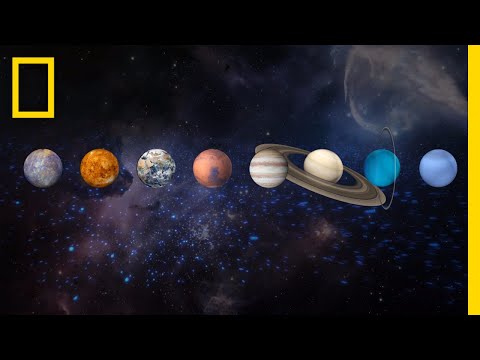
Solar System 101, by National Geographic (4 min). As you watch, note one fact about each group of planets: the rocky inner planets and the giant outer planets.
Rwanda is a small, landlocked country. Why might it still be worth having a space agency and its own satellites? Think about farming, weather, disasters and schools.
Warning
Stars and planets are different. A star makes its own light; a planet only reflects light from its star. Venus, often seen low in the west after sunset, is called the "evening star", but it is a planet.
Practice
Remember
Sources and credits
The lesson text, diagrams, planet table, worked example and practice are written by Ganzaa. Planet figures are from NASA's planetary fact sheets.