Balance of Payments
Senior 6 · Economics
Balance of Payments
Lesson 1 of 4
25 min
In 2025 Rwanda bought goods worth US$4,826 million from the rest of the world but sold goods worth only US$2,449 million (National Bank of Rwanda, BNR). That is a gap of
Yet fuel still arrived, factories still received their machines and the franc did not collapse. Where did the other US$2.4 billion come from? The answer is in a country's full set of accounts with the rest of the world: its balance of payments.
Definition
Balance of payments (BoP): a systematic record of all economic transactions between the residents of a country and the rest of the world over a period, usually a quarter or a year.
Example: the BNR's balance of payments for Rwanda records exports and imports, tourists' spending, remittances from Rwandans abroad, foreign investment, loans and changes in the reserves.
Definition
Balance of trade (visible balance): the value of exports of goods minus the value of imports of goods.
Invisible balance: exports minus imports of services (and, in older textbooks, income and transfers too).
Example: Rwanda's balance of trade in 2025 was million US dollars, a deficit.
| Balance of trade | Balance of payments |
|---|---|
| Covers goods only (visible trade) | Covers all transactions: goods, services, income, transfers, investment and loans |
| Is one part of the current account | Is the complete set of accounts |
| Can be in surplus or deficit | Always balances in total, because of double entry; only its parts are in surplus or deficit |
| Shows how competitive a country's goods are | Shows how the country pays its way with the world and how it finances any gap |
Definition
Current account: records trade in goods and services and flows of income and transfers. It has four parts.
Definition
Capital account: records capital transfers, such as grants from donors to build a road or a school, and the purchase or sale of non-produced assets such as land used by an embassy or rights and licences.
Financial account: records changes in the ownership of foreign financial assets and liabilities:
Definition
Net errors and omissions: a balancing item that makes the accounts add up, because some transactions are missed, recorded late or valued wrongly.
Every transaction is recorded twice, once as a credit and once as a debit (double entry). When a Rwandan importer pays for fuel, the import is a debit in the current account, and the money leaving the importer's bank abroad is recorded in the financial account. So all the accounts together must add up to zero. Written with the financial account measured as net inflows (money coming in minus money going out):
where CA and KA are the current and capital account balances, FA is the financial account balance excluding reserve assets, NEO is net errors and omissions, and is the change in the central bank's reserves. If the left side is positive the reserves rise (an overall surplus); if it is negative the reserves fall (an overall deficit).
Note on signs. Central banks now follow the IMF's sixth manual (BPM6), in which a net inflow to the financial account is shown as net borrowing with a minus sign. The BNR's tables use that convention. In this unit we show inflows as positive so the logic is easy to follow.
Worked example
Worked example 1: building a balance of payments (illustrative, US$ million)
In one year a country: exports goods 800 and imports goods 1,500; earns 300 from foreign tourists and pays 200 in freight to foreign carriers; pays 80 in interest and 40 in dividends to foreigners; receives 250 in remittances and 150 in budget grants; receives a capital grant of 100 to build a bridge; receives FDI of 300 and new loans of 250, while its residents buy 30 of foreign shares. Errors and omissions are .
| Item | Working | Balance |
|---|---|---|
| Goods (balance of trade) | ||
| Services | ||
| Primary income | ||
| Secondary income | ||
| Current account | ||
| Capital account | bridge grant | |
| Financial account (net inflows) | ||
| Net errors and omissions | ||
| Change in reserves |
The country has a current account deficit of 320, but inflows of capital more than cover it, so its reserves rise by 280.
Worked example
Worked example 2: Rwanda in 2025 (BNR, US$ million)
Current account = goods + services + primary income + secondary income:
Overall balance, with a capital account of 294, net financial inflows of 1,229 and net errors and omissions of 96:
Rwanda's reserves therefore fell by about US$298 million in 2025. The BNR reports that reserve cover dropped from 5.4 months of prospective imports at the end of 2024 to 4.2 months at the end of 2025, still above the 4-month benchmark it uses.
Warning
"Deficit" always needs a name. The balance of payments as a whole always balances, so saying "Rwanda has a balance of payments deficit" is incomplete. Say which balance: the balance of trade, the current account, or the overall balance (the change in reserves). And never call the balance of trade "the balance of payments".

Tip
Where does it go? Ask what the money is FOR. Buying or selling something now: current account (goods, services). Earning from something owned or lent abroad: primary income. Getting something for nothing: secondary income (or capital account if it pays for an asset). Buying or selling an asset or a debt: financial account.
Important
Discuss. In 2025 Rwanda's goods deficit was US$2,377 million, but its current account deficit was smaller, at US$1,917 million. Which items narrowed the gap? What does that tell you about the importance of Rwandans living abroad and of foreign donors to Rwanda's economy?
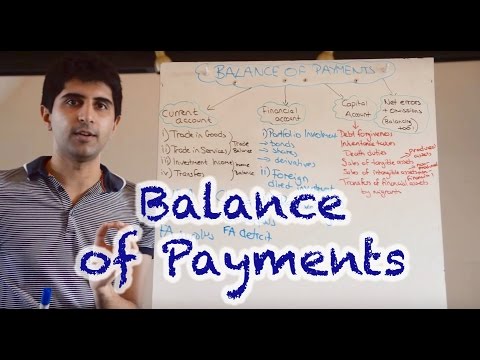
EconplusDal, "Balance of Payments (Current Account, Financial Account and Capital Account)" (about 12 minutes). A walk through each account and the reason the whole must balance. He uses UK examples; match each one to a Rwandan equivalent.
Practice
Sources and credits
Written by Ganzaa: the structure diagram, the tables, the worked examples and the practice items. The country in worked example 1 is illustrative. This lesson adapts CC BY-SA material and is shared under CC BY-SA 4.0.