Complex Numbers
Senior 6 · Mathematics
Complex Numbers
Lesson 1 of 5
25 min
In S4 (Linear and Quadratic Equations) you solved with , and when you wrote "no real roots". Take : here , and the formula asks for . No real number squares to , because the square of every real number is at least 0. This unit builds a larger set of numbers, the complex numbers, in which every quadratic equation (and, as you will see, every polynomial equation) has roots. Engineers use the same numbers every day to analyse alternating current, which Lesson 5 shows.
Definition
Imaginary unit: the number whose square is :
Square root of a negative real number: for a real number , , because .
Example: and . Electrical engineers write instead of , because already stands for current.
Warning
The rule is only for . Using it on negative numbers gives nonsense: , not . Always convert to first, then multiply.
Multiply by again and again, and use at each step:
| 0 | 1 | 2 | 3 | 4 | 5 | 6 | 7 | |
|---|---|---|---|---|---|---|---|---|
Since , the pattern repeats with period 4. If with , then
So only the remainder of on division by 4 matters. It follows that : any four consecutive powers of add up to 0.
Worked example 1: powers of
Simplify (a) (b) (c) .
Solution
Definition
Complex number: a number of the form , where and are real numbers and . This is the algebraic (Cartesian) form of .
Notation: is the real part and is the imaginary part. Note that the imaginary part is the real number , not . The set of all complex numbers is .
If , is purely real; if and , is purely imaginary. So .
Example: has and .
Definition
Equality of complex numbers: (with real) if and only if and .
Why: suppose but . Then would be a real number, and its square would be at least 0, not . So , and then . One equation between complex numbers therefore gives two real equations.
Worked example 2: two equations from one
Find the real numbers and such that .
Solution Equate real parts and imaginary parts:
From the first, . Substituting: , so , and .
Check: ✓ and ✓.
Treat like a letter in algebra and collect the real parts and the imaginary parts:
For example, and . Because the real parts and the imaginary parts are added as real numbers, addition in is commutative and associative, is the identity, and is the opposite of .
Definition
Argand diagram (complex plane): a plane with a horizontal real axis and a vertical imaginary axis, in which the complex number is drawn as the point , or as the vector from the origin to that point.
The point that represents is called the image of , and is called the affix of the point.
Because behaves like the vector , adding complex numbers is adding vectors, which you met in S4 (Vector Space of Real Numbers). The sum is found with the parallelogram rule, and is the vector that goes from the point to the point .
Definition
Modulus of : the distance from the origin to the point ,
Distance between two points: the distance between the points and is , since is the vector joining them.
Example: . For a real number, the modulus is the absolute value: .
Worked example 3: modulus and distance
(a) Find and . (b) Find the distance between the points and .
Solution
A locus is the set of all points that satisfy a condition. Read as "the distance from to ", and many loci can be drawn at sight.
To find the Cartesian equation, put and square both moduli.
A circle. The condition is . With : , so
the circle with centre and radius 3.
Worked example 4: a perpendicular bisector
Find the Cartesian equation of the locus , and describe it.
Solution Put . Then . Square both sides:
Check: the midpoint of and is , and ✓. The segment from to has gradient , and the locus has gradient ; their product is , so they are perpendicular ✓.
Important
| Condition on | Locus in the Argand diagram |
|---|---|
| circle, centre , radius | |
| inside of that circle (open disc) | |
| perpendicular bisector of the segment from to | |
| the half-plane on the side of |
Warning
Watch the signs of the centre. In the centre is , not . Always rewrite the condition as before reading off the centre.
Tip
In an exam, sketch the locus first and write the Cartesian equation second. The sketch tells you what shape to expect (circle or straight line), so an algebra slip shows up at once.
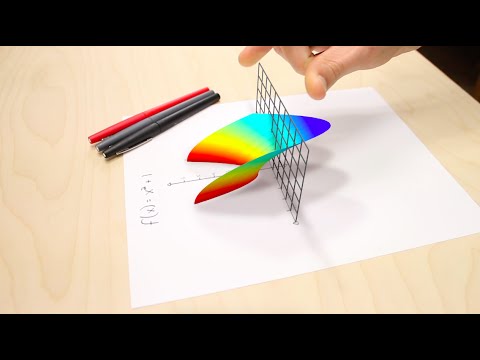
Welch Labs: Imaginary Numbers Are Real, Part 1 (about 5 min). Watch for how a graph shows the real roots of a polynomial, and why an equation with no real roots pushed mathematicians towards a second, imaginary axis.
Practice
Try each one before opening the answers. The last two are harder.
Sources and credits