Solvent Extraction and Colligative Properties
Senior 6 · Chemistry
Solvent Extraction and Colligative Properties
Lesson 1 of 5
25 min
Pyrethrum daisies grown on the volcanic soils around Musanze contain pyrethrins, natural insecticides used in household sprays. At the Horizon SOPYRWA factory in Musanze the dried flowers are milled and extracted to give a crude extract, which is then refined. A 2012 sector report describes how: the powder is mixed with hexane, which dissolves the pyrethrins, and steam then separates the hexane from the oily extract; about 60 kg of dried flowers give 1 kg of extract. Why hexane? Because pyrethrins dissolve far better in it than in water. This lesson turns that idea into a law you can calculate with.

Definition
Immiscible liquids: liquids that do not mix but form two separate layers. Example: hexane and water.
Partition coefficient (distribution coefficient), or : the ratio of the concentrations of a solute in two immiscible solvents in contact, at equilibrium, at a stated temperature:
It has no units, because both concentrations are in the same units. Always state which solvent is on top of the fraction. Example: if a solute's concentration is 0.60 mol dm⁻³ in hexane and 0.030 mol dm⁻³ in water, .
Solvent extraction: removing a solute from one solvent by shaking it with a second, immiscible solvent in which the solute is more soluble.
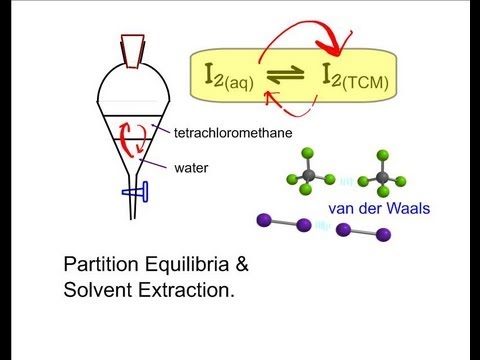
Shake iodine solution in water with hexane and let the layers settle. Iodine molecules keep crossing the interface in both directions. When the rate at which they cross from water into hexane equals the rate back, the system is in dynamic equilibrium, and the ratio of the two concentrations stays fixed. Adding more iodine raises both concentrations, but not their ratio. This is the partition law (Nernst's distribution law, 1891):
It is the equilibrium law of Unit 7 applied to one substance and two phases. It holds only when:
A non-polar solute such as iodine prefers a non-polar solvent ("like dissolves like"), so is large and the violet hexane layer takes most of the iodine (Figure 1.1).
Figure 1.1 Solvent extraction in a separating funnel, held in a ring clamp on a stand. Hexane (density 0.66 g cm⁻³) floats on water; a solvent denser than water, such as dichloromethane (1.33 g cm⁻³), would form the LOWER layer. The funnel is stoppered, inverted and shaken, with the tap opened now and then to release vapour, then left to settle.

Suppose a mass of solute is dissolved in a volume of water, and it is shaken with a volume of organic solvent. Let be the mass left in the water at equilibrium. Then
If the same total volume of solvent is split into equal portions, each extraction leaves the same fraction behind, so after extractions
This fraction gets smaller as increases: for the same volume of solvent, several small extractions remove more solute than one large extraction. That is why a chemist "washes" a solution two or three times, and why an industrial extractor runs the solvent through the solid again and again.
Choosing a solvent. A good extracting solvent is immiscible with the first solvent, dissolves the solute much better (large ), does not react with it, and is volatile, so it can be boiled off afterwards; it should also be as safe and cheap as possible.
Table 1.1: Uses of partition
| Use | What partitions between what |
|---|---|
| extracting natural products (pyrethrins, essential oils, plant medicines) | from the plant material into an organic solvent such as hexane |
| decaffeinating coffee | caffeine from moist beans into a solvent such as ethyl ethanoate or supercritical |
| purifying a product in the laboratory | impurities washed from an organic layer into water, or the reverse |
| paper chromatography | solutes between water held in the paper and the moving solvent |
| designing medicines | octan-1-ol/water partition coefficient predicts how easily a drug crosses cell membranes |
Worked example
Problem. Butanedioic acid (a diprotic acid) was shaken with water and ethoxyethane at 25 °C until equilibrium. 25.0 cm³ of the aqueous layer needed 20.0 cm³ of 0.100 mol dm⁻³ NaOH for neutralisation; 25.0 cm³ of the ethoxyethane layer needed 3.00 cm³ of the same NaOH. Calculate (ethoxyethane/water).
Solution. Each mole of acid reacts with 2 mol NaOH.
Answer: 0.150. The acid is more soluble in water, because its two –COOH groups form hydrogen bonds with water. (Since the same volumes and the same NaOH were used, is simply the ratio of the titres, .)
Worked example
Problem. 100 cm³ of water contains 2.00 g of compound X. (dichloromethane/water) for X is 5.0. Calculate the mass of X extracted by (a) one 50 cm³ portion of dichloromethane, (b) two successive 25 cm³ portions.
Solution. (a) Let g remain in the water:
Extracted: (71 %).
(b) Each 25 cm³ portion leaves the fraction in the water. After two portions:
Answer: (a) 1.43 g; (b) 1.60 g. The same 50 cm³ of solvent does more work in two portions. (Three portions of 16.7 cm³ would extract 1.68 g.)
Warning
Common mistakes. (1) Putting the solvents the wrong way up in the ratio: always write which is on top, e.g. . (2) Using masses instead of concentrations when the volumes differ: divide each mass by its own volume. (3) Assuming the organic layer is always on top: it depends on density.
Safety. Hexane, ethoxyethane and other extracting solvents are highly flammable, and their vapour builds up pressure in a shaken funnel. Keep flames away, work in a fume cupboard, hold the stopper in, and vent through the open tap with the stem pointing up and away from people.
Tip
For any extraction problem, write one line: , put the unknown mass in the right place, and solve. For repeated extractions, reuse the same fraction left behind each time.
FranklyChemistry: Partition equilibria and solvent extraction, principles and questions. Watch how the partition law is set up as an equilibrium and how single and repeated extractions are calculated.
Practice
Sources and credits