Electrochemical Cells and Applications
Senior 6 · Chemistry
Electrochemical Cells and Applications
Lesson 1 of 5
25 min
Put a strip of zinc into blue copper(II) sulfate solution and, as you saw in earlier years, the zinc becomes coated with brown copper, the blue colour fades and the solution warms up: . Electrons pass directly from zinc atoms to copper ions, and the energy released is wasted as heat.
Now keep the two halves of the reaction apart: zinc in one beaker, copper ions in another, joined by a wire and a "salt bridge". The same electrons are forced to travel through the wire, and they can light a lamp on the way. This is a galvanic cell (also called a voltaic cell), the basis of every battery. A lemon with two different metals pushed into it is a simple version.

Definition
Galvanic (voltaic) cell: a device in which a spontaneous redox reaction produces an electric current, because oxidation and reduction take place in separate half-cells. Example: the Daniell cell (zinc and copper).
Half-cell: an electrode in contact with a solution containing the oxidised and reduced forms of one redox couple. Example: a zinc rod in , the half-cell.
Anode: the electrode where oxidation happens. Cathode: the electrode where reduction happens. In a galvanic cell the anode is the negative terminal and the cathode the positive one.
Salt bridge: a tube or strip of filter paper soaked in a concentrated solution of an unreactive salt, such as , that joins the two solutions and lets ions move between them, completing the circuit.
Cell emf, : the potential difference between the two electrodes when no current flows, measured in volts with a high-resistance voltmeter. Example: 1.10 V for the standard Daniell cell.
Figure 1.1 shows a zinc half-cell joined to a copper half-cell.
Figure 1.1: In the Daniell cell, electrons flow through the wire from the zinc anode to the copper cathode, and ions move through the salt bridge.
Adding the two half-equations gives the overall cell reaction, : the displacement reaction, now made to do electrical work.
Chemists write a cell in a shorthand called a cell diagram (or cell notation):
| Symbol or rule | Meaning |
|---|---|
| left-hand electrode | the anode (oxidation); right-hand electrode: the cathode (reduction) |
| single vertical line, | | a boundary between phases, e.g. solid metal and solution |
| double vertical line, ‖ | the salt bridge |
| comma | two species in the same phase, e.g. |
| Pt(s) at an end | an inert platinum electrode, used when neither form of the couple is a metal that can carry electrons |
For example, a cell in which iron(II) ions are oxidised and silver ions are reduced is written .
Worked example
Problem. A magnesium half-cell is joined to a silver half-cell. Magnesium is the more reactive metal. (a) Write the half-equations at each electrode and name the anode and cathode. (b) Write the overall equation. (c) Write the cell diagram. (d) State the direction of electron flow in the wire.
Solution.
(a) The more reactive metal is oxidised. Anode (−): . Cathode (+): .
(b) Balance the electrons by doubling the silver half-equation: .
(c) .
(d) From the magnesium electrode to the silver electrode.
Answer: as above. Note that the salt bridge here must not contain chloride: would precipitate as AgCl. Potassium nitrate is used.
Worked example
Problem. For the cell , write the reactions at each electrode and the overall reaction, and explain why both electrodes are platinum.
Solution. Left (anode, oxidation): . Right (cathode, reduction): . Doubling the second and adding:
All four species are dissolved ions or molecules; none is a solid conductor. Platinum is unreactive and conducts, so it can pass electrons to and from the solution without taking part in the reaction.
Answer: as above.
Warning
Common mistakes
Tip
"An Ox, Red Cat": ANode = OXidation, REDuction = CAThode. In cell diagrams, think "oxidation on the left, reduction on the right", in the same order as the electrons travel.
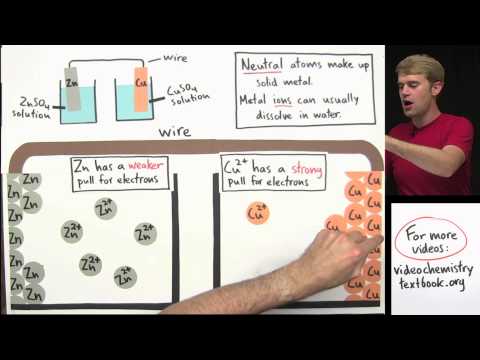
Tyler DeWitt: Galvanic cells (voltaic cells). Watch how the electrons move through the wire and the ions through the salt bridge, and why the zinc electrode gets lighter while the copper electrode gets heavier.
Practice
Sources and credits