Stock Control
Senior 6 · Entrepreneurship
Stock Control
Lesson 1 of 4
35 min
Isange Hardware in Rubavu sells about 90 bags of cement a week. Last March it ran out for nine days: builders went to a competitor, and two of them never came back. In July it went the other way, with 1,100 bags filling the storeroom and the yard, some of them hardening in the damp while the owner waited months to get his cash back. (An illustrative business.) Both mistakes cost money. Stock control is the skill of holding enough stock to serve customers without tying up more cash and space than necessary.
Definition
Stock (inventory): goods a business holds for sale, or for use in making goods for sale. Inventory management (stock control): planning, ordering, storing, recording and checking stock so that the right quantity is available at the lowest total cost.
Example: cement, iron sheets and nails in a hardware shop.
Definition
Lead time: the time between placing an order and receiving the goods. Reorder level: the stock level at which a new order is placed. Reorder quantity: the amount ordered each time. Buffer stock (minimum level): stock kept for emergencies, below which stock should not normally fall. Maximum level: the most stock that should be held.
| Kind | Meaning | Example |
|---|---|---|
| Raw materials | Inputs not yet used in production | Timber in a furniture workshop |
| Work in progress | Partly finished goods | Desks assembled but not yet varnished |
| Finished goods | Goods ready to sell | Packed bags of maize flour at a mill |
| Goods for resale | Goods bought to sell unchanged | Cement in a hardware shop |
| Consumables | Items used up in running the business | Cleaning materials, printer paper |
| Costs of holding too much stock | Costs of holding too little stock |
|---|---|
| Cash tied up that could earn a return or pay debts | Lost sales and lost customers (stock-outs) |
| Storage space, security and insurance | Production stops while waiting for materials |
| Damage, theft, expiry and going out of fashion | Many small, expensive emergency orders |
| Interest on money borrowed to buy the stock | Losing bulk discounts from suppliers |
Costs that rise with the amount held are called holding costs; costs that rise with the number of orders (transport, paperwork, time) are ordering costs. Good stock control balances the two.
In this ideal chart, usage is steady, so stock falls in straight lines. When it reaches the reorder level, an order is placed; the delivery arrives one lead time later, just as stock reaches the buffer. In real life usage and lead times vary, which is why the buffer exists.
Worked example 1: setting the stock levels
Isange Hardware sells between 60 and 120 bags a week (average 90). Its supplier delivers in 2 to 4 weeks (average 3). It orders 400 bags at a time. Find the reorder level, the buffer stock and the maximum level.
Reorder level (enough to survive the worst case: fastest sales and slowest delivery):
Buffer (minimum) level:
Maximum level:
Check: 760 bags is the stock if sales are slowest and delivery fastest. The storeroom must hold that many; the 1,100 bags of July were far above it.
Worked example 2: the economic order quantity
The shop sells bags a year. Each order costs Frw 30,000 (transport and paperwork), and holding one bag for a year costs Frw 1,300 (space, damage, interest). Find the order size that minimises total ordering and holding cost.
Comparison: ordering 400 bags gives orders, costing , plus holding an average of 200 bags, : total Frw 611,000 a year. At the EOQ both parts are about Frw 302,000, a total of about Frw 604,000. The saving is small, which is typical: total cost changes slowly near the EOQ, so a convenient round number close to it is fine.
Conditions: the formula assumes steady demand, a fixed cost per order and a fixed holding cost per unit, with no bulk discounts.
Warning
Just-in-time needs reliable suppliers. Some factories keep almost no stock and have materials delivered just as they are needed. For a business in a landlocked country, whose imports may travel weeks by road from the coast, a delayed lorry can stop production, so a buffer is usually wiser than copying just-in-time blindly.
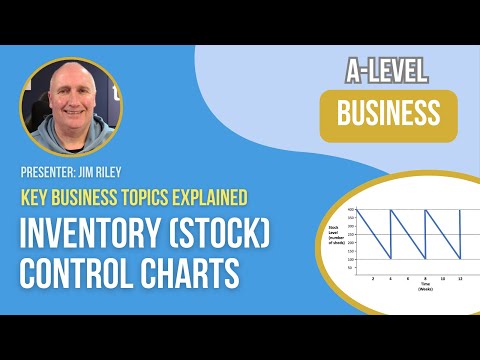
tutor2u, "Inventory (Stock) Control Charts". Watch the worked example and identify the maximum level, the reorder level, the buffer stock and the lead time on its chart.
Practice
Sources and credits
Written by Ganzaa: the hardware-shop case, the stock control chart, the tables, the worked examples and the practice items. The reorder-level, minimum, maximum and EOQ formulas are standard results of management accounting. Isange Hardware and all its figures are illustrative (2026).