Transport, Communication and Trade in Africa
Senior 3 · Geography
Transport, Communication and Trade in Africa
Lesson 1 of 5
30 min
Let's begin
A container of coffee leaving a washing station in Huye has a long way to go before it reaches a buyer in Europe. It travels by lorry to Kigali, then by road through Uganda or Tanzania to the Indian Ocean at Mombasa or Dar es Salaam, roughly 1,400 to 1,700 km away by road, and only then onto a ship. Rwanda has no railway and no coast, so every tonne it sells abroad starts on a road. Why does Africa move its goods the way it does, and why are some regions well served while others are cut off?
Definition
Transport: the movement of people and goods from one place to another. Mode of transport: a type of transport, such as road, rail, water, air or pipeline. Transport network: all the routes and terminals (stations, ports, airports) that serve an area.
Road transport is the most used mode in Africa for both people and goods. It uses lorries, buses, minibuses, cars, motorcycles and bicycles. Roads reach almost every village, so road transport gives a door-to-door service. Major international routes include the Trans-African Highway network planned by the African Union and the regional corridors such as the Northern Corridor (Mombasa–Nairobi–Kampala–Kigali).
Rail transport carries heavy, bulky goods such as minerals, cement, fuel and grain over long distances. Most of Africa's older lines were built in colonial times to link a mine or a farming area to a port, for example the Benguela Railway from the Copperbelt to Lobito in Angola. Newer lines include Kenya's Standard Gauge Railway (SGR) from Mombasa to Nairobi, opened by Kenya Railways on 31 May 2017, and Tanzania's SGR from Dar es Salaam, whose first passenger trains to Morogoro and Dodoma began running in 2024 (Tanzania Railways Corporation).
Water transport has two forms. Ocean transport carries most of Africa's foreign trade through ports such as Durban, Mombasa, Dar es Salaam, Lagos, Abidjan, Tanger Med and Port Said. Inland water transport uses navigable rivers and lakes: the Congo River between Kinshasa and Kisangani, the Nile in Egypt and Sudan, Lake Victoria (ferries between Mwanza, Port Bell and Kisumu) and Lake Kivu between Rubavu, Karongi and Rusizi.
Air transport is the fastest mode. It carries passengers, mail and light, valuable or perishable goods such as flowers, fresh vegetables, medicines and gold. Major hubs include Addis Ababa, Johannesburg, Nairobi, Cairo and Casablanca; Rwanda's main airport is Kigali International Airport, and RwandAir is the national carrier.
Pipeline transport moves liquids and gases: crude oil, refined fuel, natural gas and water. Examples are the TAZAMA pipeline from Dar es Salaam to Ndola in Zambia, the Kenya Pipeline from Mombasa to Nairobi, Eldoret and Kisumu, and the East African Crude Oil Pipeline (EACOP) being built from Hoima in Uganda to Tanga in Tanzania.

| Mode | Advantages | Disadvantages |
|---|---|---|
| Road | Door-to-door; flexible routes and times; cheap to build compared with rail; best for short distances and small loads | Small loads per vehicle; accidents; roads damaged by heavy rain and overloading; congestion in cities; high fuel cost per tonne over long distances |
| Rail | Carries heavy, bulky goods cheaply over long distances; fewer accidents; less fuel per tonne than road | Very costly to build; fixed routes and timetables; goods must be loaded twice (at both ends); steep slopes need tunnels and gentle gradients |
| Water | Cheapest per tonne for very long distances and very large loads; ships carry thousands of containers | Slow; limited to coasts, navigable rivers and lakes; rapids, falls, shallow water and silting block rivers; ports cost a great deal |
| Air | Fastest; crosses mountains, forests, deserts and water; good for perishable and valuable goods | Most expensive per tonne; small loads; needs airports, skilled staff and costly fuel |
| Pipeline | Cheap to run once built; continuous flow; little theft or road damage | Costly to build; carries only liquids and gases; one direction, fixed route; leaks can pollute land and water |
The cost of a journey has two parts. Terminal costs are paid at each end, whatever the distance: loading, unloading, port and station charges. Line-haul costs are paid for each kilometre travelled. Water transport has high terminal costs but low line-haul costs, road transport the opposite. Figure 1 shows why, in general, road wins on short trips, rail on medium ones and ships on the longest.
Figure 1 is a model with illustrative numbers. Real break-even distances depend on the goods, the route and fuel prices.
Definition
Terminal costs: costs paid at the start and end of a journey, such as loading, unloading and port charges. Line-haul costs: costs that rise with every kilometre travelled, mainly fuel, wages and wear. Gauge: the distance between the two rails of a railway track.

Worked example
Worked example 1: comparing journey times. A lorry and a train both carry goods 480 km from a port to an inland city. The lorry averages 40 km/h, including stops at weighbridges and border posts; the train averages 80 km/h. How much faster is the train? (Illustrative figures.)
Lorry time = 480 ÷ 40 = 12 hours. Train time = 480 ÷ 80 = 6 hours. The train saves 12 − 6 = 6 hours, and it carries far more goods per trip. But the goods must still go by road from the station to the customer, so the full door-to-door saving is smaller.
Worked example
Worked example 2: reading Figure 1. A trader must send 20 tonnes of cement a short distance, well to the left of the first dashed line. Which mode is cheapest, and why?
On the left of the graph the road line is lowest. Road has the lowest terminal cost, and over a short distance the cheap terminals matter more than the high cost per kilometre. Over very long distances the gentle slope of the water line wins instead.
Warning
Do not say "water transport is cheap" without a condition. It is cheap per tonne over long distances. For a short trip, port charges and loading make it expensive. In the exam, always link a mode's cost to the distance and the type of goods.
Tip
Use African examples. A factor scores full marks when you name a place: "steep relief, as in Rwanda's hills, raises road costs" beats "relief affects transport".
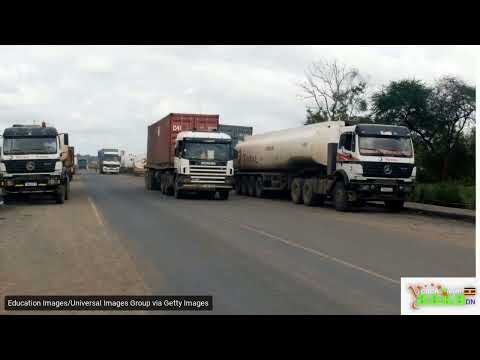
Yaaka Digital Network: the development of transport, communication and trade in Africa (made for Uganda's Senior Four). As you watch, list each mode of transport and one African example of it.
Practice
Sources and credits
This lesson adapts CC BY-SA material and is shared under CC BY-SA 4.0.