World Multipurpose River Projects
Senior 6 · Geography
World Multipurpose River Projects
Lesson 1 of 4
40 min
At Rusumo Falls the Kagera River forms the border between Rwanda and Tanzania. In 2012 Burundi, Rwanda and Tanzania signed an agreement to build a power station there together, and on 6 August 2013 the World Bank approved US$ 340 million for it. Construction began on 30 March 2017. The plant has three turbines with a total capacity of 80 MW, shared equally among the three countries, and between November 2023 and January 2024 it delivered 66 million kWh to their grids (Nile Basin Initiative, 2024).
Rusumo is a run-of-river scheme: it uses the flow and fall of the river with only a small pond behind a low weir, so its main purpose is electricity. Compare the Kariba Dam, 128 m high, on the Zambezi between Zambia and Zimbabwe: its reservoir, Lake Kariba, is 280 km long and can hold 185 billion m³ of water (Zambezi River Authority). Kariba produces power, but its lake also supports fishing, tourism, transport and the control of floods. That is the difference between a single-purpose scheme and a multipurpose river project.
Definition
Multipurpose river project: a scheme that develops a river, usually by building one or more dams and reservoirs, to serve several purposes at once, such as hydroelectric power, irrigation, flood control, navigation, water supply and fishing. Example: the Aswan High Dam on the Nile.
River basin development: planning the use of a whole river basin (drainage basin) as one unit, including dams, farming, forestry and soil conservation. Example: the Tennessee Valley Authority.
Reservoir: an artificial lake formed behind a dam, in which water is stored.
Hydroelectric power (HEP): electricity generated when falling water turns turbines connected to generators.
Run-of-river scheme: an HEP station that uses the natural flow of a river with little or no storage. Example: Rusumo Falls.
Head: the vertical height through which water falls before it reaches the turbines.
Figure 1. Cross-section of a multipurpose river project (not to scale). Drawn by Ganzaa.
| Number | Part | Purpose it serves |
|---|---|---|
| 1 | Reservoir | Stores water for dry seasons; holds back floods; fishing, lake transport and tourism |
| 2 | Dam wall | Raises the water level to create the head and the reservoir |
| 3 | Spillway | Releases surplus water safely during floods so the dam is not overtopped |
| 4 | Intake and penstock | Carries water at high pressure down to the turbines |
| 5 | Power station | Turbines and generators turn the energy of falling water into electricity |
| 6 | Transmission lines | Carry electricity to towns, industries and neighbouring countries |
| 7 | Irrigation canal and farms | Supply water for crops throughout the year |
| 8 | River downstream | A regulated, more even flow for navigation, water supply and further irrigation |

Worked example 1: how much power can a river give?
Problem. The power of a hydroelectric station is , where is the density of water, , is the flow through the turbines, is the head and the efficiency. Using illustrative values of , and , calculate the power.
Solution.
Interpretation. About 80 MW, the size of the Rusumo plant. Power rises in proportion to both flow and head, which is why engineers look for a large, reliable river (high ) and a waterfall or narrow gorge where a dam can create a big drop (high ).
Worked example 2: how hard does a power station work?
Problem. The two Kariba power stations have a combined capacity of 2,130 MW and generate about 10,035 GWh a year in normal conditions (Zambezi River Authority). Calculate the capacity factor: actual output as a percentage of the output if the stations ran at full power all year.
Solution. A year has 8,760 hours.
Interpretation. The stations produce a little over half their maximum. Water must be shared between the two countries and kept in the lake for dry years, so the turbines cannot all run all the time. In drought years, when the Zambezi Authority allocates less water, the capacity factor falls further.
| Sector | Importance | Example |
|---|---|---|
| Energy and industry | Cheap, renewable electricity attracts industries such as aluminium smelting and copper refining | Akosombo supplies the Tema aluminium smelter in Ghana; Kariba powers Zambia's Copperbelt |
| Agriculture | Perennial irrigation allows two or three harvests a year and reclaims desert | Egypt's irrigated farmland expanded after the Aswan High Dam |
| Safety | Floods are held back, saving lives, crops and property | TVA dams protect Chattanooga |
| Transport | Calmer, deeper water for barges and lake ferries | The Tennessee carries more than 50 million tons of cargo a year (TVA, 2026) |
| Food and income | New lake fisheries; tourism around the reservoir | Kapenta fishing and houseboat tourism on Lake Kariba |
| Regional cooperation | Shared projects build trust and power trade between countries | Rusumo (Burundi, Rwanda, Tanzania); Kariba (Zambia, Zimbabwe) |
| Development of backward regions | Roads, towns, schools and jobs follow the project | The Tennessee Valley, once one of the poorest parts of the USA |
Warning
Common mistakes
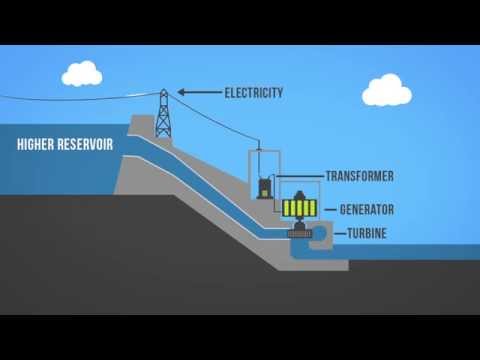
Student Energy: "Hydropower 101". As you watch, match the parts of a hydroelectric scheme in the video with the numbers in Figure 1, and note the difference between storage and run-of-river schemes.
Practice
Summary
Sources and credits
Photo: Urugomero rw'amashanyarazi rwa Rusumo (Uwimpuhwe Va, CC0), via Wikimedia Commons.
Video: "Hydropower 101", Student Energy, embedded from YouTube.
Figure 1, the worked examples and the exercises were drawn and written by Ganzaa.
This lesson adapts CC BY-SA material and is shared under CC BY-SA 4.0.