Introduction to Logic
Senior 4 · Mathematics
Introduction to Logic
Lesson 1 of 5
25 min
A school notice says: "Visitors may enter if they sign the register and show an identity card." A visitor who shows a card but does not sign is turned away. Had the notice said "or", the same visitor would walk in. In everyday talk such words are used loosely; in mathematics, computing and law their meaning must be exact, because a proof, a program or a contract depends on it. Logic is the study of exact reasoning: which sentences can be true or false, how they combine, and when a conclusion really follows from what is given (an argument). This lesson starts with the building blocks.
Definition
Statement (proposition): a declarative sentence that is either true or false, but not both. Its truth value is written T (true) or F (false); some books write 1 and 0. Statements are named by small letters
Argument: a list of statements, the premises, followed by a statement claimed to follow from them, the conclusion. Lesson 5 shows how to test whether an argument is valid.
Examples: "91 is divisible by 7" is a true statement (); "" is a false statement; "Close the door" is not a statement.
| Sentence | Statement? | Reason |
|---|---|---|
| Kigali is the capital of Rwanda. | Yes (T) | declarative, and true |
| 51 is a prime number. | Yes (F) | declarative, and false: |
| Is it raining? | No | a question |
| Please sit down. | No | a command |
| No | an open sentence: true for , false otherwise (Lesson 4) | |
| Every even number greater than 2 is the sum of two primes. | Yes | it is true or false, although nobody has yet proved which (Goldbach's conjecture) |
The last row matters: a statement must have a truth value, not that we must know it.

Definition
Logical connectives. From statements and we build compound statements:
A truth table lists every possible combination of truth values of the simple statements and the resulting value of the compound statement. With two statements there are rows; with statements there are .
| T | T | F | T | T | F |
| T | F | F | F | T | T |
| F | T | T | F | T | T |
| F | F | T | F | F | F |
In mathematics "or" always means the inclusive unless "but not both" is said. In English, "but", "although" and "yet" are all conjunctions: "It is raining but the match goes on" is .
Worked example 1: truth values of compound statements
Let : "9 is a perfect square" and : "9 is even". Find the truth values of (a) (b) (c) (d) (e) .
Solution is T () and is F.
Worked example 2: from words to symbols
Let : "It is raining" and : "The match is cancelled". Write in symbols: (a) It is raining but the match is not cancelled. (b) It is neither raining nor is the match cancelled. (c) It is not true that it is raining and the match is cancelled.
Solution (a) (b) (c) . Notice that (b) and (c) are different: (c) is true on a dry day when the match is cancelled, but (b) is false then.
Worked example 3: building a truth table
Construct the truth table of and compare it with .
Solution Work in columns, from the inside out.
| T | T | T | T | F | F |
| T | F | T | F | T | T |
| F | T | T | F | T | T |
| F | F | F | F | T | F |
The last column is F, T, T, F, exactly the column of : " or , and not both" is the exclusive or.
Worked example 4: three statements
Construct the truth table of .
Solution Three statements give rows.
| T | T | T | F | T | T |
| T | T | F | T | T | T |
| T | F | T | F | F | F |
| T | F | F | T | T | T |
| F | T | T | F | T | F |
| F | T | F | T | T | F |
| F | F | T | F | F | F |
| F | F | F | T | T | F |
The statement is true in exactly three rows: whenever is true, except when is false and is true.
Warning
The negation of "and" is not "not … and not …". and have different truth tables (compare Worked example 2). Lesson 3 gives the correct rule, De Morgan's law: is equivalent to .
Tip
Fill the first columns of a truth table in a fixed pattern so that no row is missed or repeated: with statements, the first column is T's then F's, the next column halves the blocks, and the last column alternates T, F, T, F.
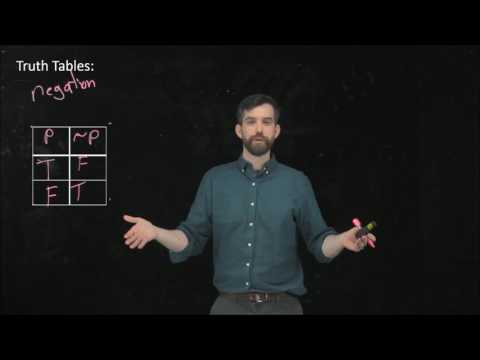
Dr. Trefor Bazett: Intro to Truth Tables, negation, conjunction and disjunction. Watch for how each column of a truth table is built from the columns before it.
Practice
Use T and F for truth values.
Key points
Sources and credits
Quick check
Which of these is a statement?