Air Composition and Pollution
Senior 1 · Chemistry
Air Composition and Pollution
Lesson 1 of 5
25 min
You cannot see air, smell it or catch it in your hand, yet your classroom holds more than 100 kg of it. Blow up a balloon and it gets heavier; leave a bowl of limewater open on the bench and a white skin forms on it by the next morning; stand a cold bottle of water in a Kigali kitchen and drops appear on the outside. Each of these tells you about a different gas in the air. What exactly is air made of, and in what proportions?
Warning
Safety. Limewater and copper(II) sulfate irritate the eyes: wear goggles and wash your hands. Stand the candle in a heat-proof dish, keep hair and paper away from the flame, and let the jar cool before you lift it.
Careful measurements show that dry air (air with its water vapour removed) has almost the same composition all over the world:
Table 1.1: The composition of dry air by volume
| Gas | Formula | Percentage by volume | Element or compound? |
|---|---|---|---|
| Nitrogen | 78% | element | |
| Oxygen | 21% | element | |
| Argon | 0.93% | element (noble gas) | |
| Carbon dioxide | about 0.04%, and slowly rising | compound | |
| Neon, helium, krypton, hydrogen and others | about 0.003% in total | elements | |
| Water vapour (not in dry air) | varies, from 0 to about 4% | compound |
Figure 1.1: The composition of dry air by volume.
Definition
Air: the mixture of gases that surrounds the Earth, made up of about 78% nitrogen, 21% oxygen, 0.93% argon, about 0.04% carbon dioxide and traces of other gases, together with a variable amount of water vapour. Example: the air in Kigali and the air over Lake Kivu have the same proportions of nitrogen and oxygen, but different amounts of water vapour.
Worked example
Problem. A classroom measures 8 m by 6 m by 3 m. What volume of (a) nitrogen, (b) oxygen and (c) argon does it contain?
Solution.
Answer: about of nitrogen, of oxygen and of argon.
Worked example
Problem. Calculate the angle of each sector needed to draw Figure 1.1: nitrogen 78%, oxygen 21%, other gases 1%.
Solution. A whole circle is , so each sector's angle is its fraction of :
Check: . The argon and carbon dioxide sector is so thin that the chart needs a label to show it.
Figure 1.2 shows air as particles. The nitrogen and oxygen molecules are not joined to one another; they simply move about together. The evidence that air is a mixture is summed up in Table 1.2.
Figure 1.2: Air drawn as particles.
Table 1.2: Why air is a mixture
| Test | Air (a mixture) | A compound, e.g. carbon dioxide |
|---|---|---|
| Composition | varies slightly: more water vapour on a rainy day, more carbon dioxide beside a fire | always fixed: one carbon atom to two oxygen atoms |
| Properties | each gas keeps its own properties: the oxygen in air still supports burning | different from those of its elements |
| Separation | separated by a physical method, fractional distillation of liquid air | only by a chemical reaction |
| Formula | cannot be written | |
| Making it | mixing nitrogen and oxygen gives no heat or light | forming it gives out or takes in energy |
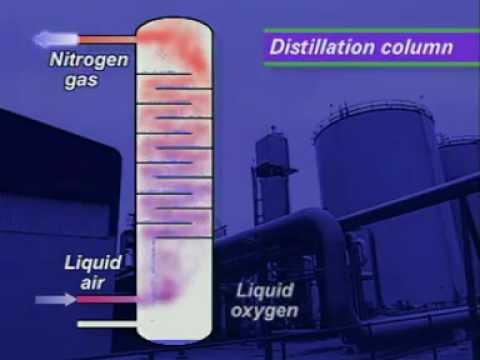
Industry obtains pure oxygen, nitrogen and argon by fractional distillation of liquid air, the same method you used for ethanol and water in Unit 4. Air is filtered to remove dust, and water vapour and carbon dioxide are removed because they would freeze and block the pipes. The air is then compressed and cooled until it becomes a liquid at about . As the liquid warms slowly in a fractionating column, each gas boils off at its own boiling point:
Table 1.3: Boiling points of the main gases in air
| Gas | Boiling point | Order of boiling off |
|---|---|---|
| Nitrogen | first (lowest boiling point); collected at the top | |
| Argon | second | |
| Oxygen | last; stays liquid longest, collected at the bottom |

Warning
Common mistake: saying that air is "mostly oxygen". Nearly four-fifths of air is nitrogen. And carbon dioxide, which people talk about a great deal, is only about 0.04%: four particles in every ten thousand.
Tip
"Four-fifths, one-fifth." Air is roughly four-fifths nitrogen and one-fifth oxygen; everything else together is less than 1%.
Royal Society of Chemistry: Gases from the Air (4 min). Watch how liquid air is separated in a fractionating column, and note which gas leaves first.
Practice
Sources and credits
This lesson adapts CC BY-SA material and is shared under CC BY-SA 4.0.