The Art of Embroidery
Senior 1 · Fine Arts
The Art of Embroidery
Lesson 3 of 4
25 min
In China under the Qing emperors, a government official wore a square badge on the front and back of his robe. The animal on it showed his rank: a lion meant a military officer of the second rank. Look at the badge below from arm's length, then lean close to the screen. From far away you see a lion; close up, you see thousands of stitches.

Worked example
Reading an embroidery: a Chinese rank badge
Step 1. What you see. A blue lion with a curly tail stands on a rock above stylised waves. Clouds, bats and flowers fill the dark blue sky, and a red sun sits at the top right. A key-pattern border frames it all.
Step 2. How it is made. Silk threads are stitched close together on silk satin. Areas such as petals and waves are filled with smooth, parallel stitches that catch the light, and gold-wrapped thread adds shine.
Step 3. What it means. This is a badge of office, as clear as a soldier's stripes: anyone could read the wearer's rank from the animal. Bats and clouds were symbols of good fortune. One way to read the whole badge is as a message of authority, order and luck, shown through the most costly materials and the finest skill.
Definition
Chain stitch: a line stitch made of loops, each held down by the next, so the line looks like a chain. Use: bold outlines, curves, and filling areas with rows.
Definition
Satin stitch: a filling stitch made of straight stitches laid closely side by side across a shape, from one edge to the other, so the shape is covered smoothly. Use: petals, leaves, letters, small solid shapes.
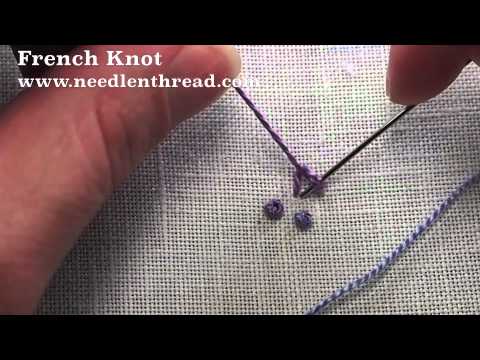
French knot: a small raised knot made by wrapping the thread round the needle before taking it back through the fabric. Use: eyes, flower centres, dots and texture.
| Stitch | Group | Looks like | Best for | Rwandan example idea |
|---|---|---|---|---|
| Running | line | a dashed line | outlines, quilting | the edge of a kitenge place mat |
| Back | line | a solid, thin line | letters, fine details | a name or class on a school bag |
| Stem | line | a twisted rope | curved stems, flowing outlines | the stalk of a banana plant |
| Chain | line or fill | linked loops | bold outlines, rows that fill | the pattern on an agaseke basket |
| Satin | fill | a smooth, shiny area | petals, leaves, small shapes | a coffee cherry or an avocado leaf |
| French knot | knot | a raised dot | eyes, flower centres, texture | the seeds of a sunflower |
Worked example: choosing stitches for a motif
Umutoni is embroidering a coffee branch: a curved stem, three leaves, four red cherries and a small label saying “KAWA”.
1. Sort each part into line, fill or dot. Stem: line. Leaves: fill (with a line for the middle vein). Cherries: fill. Label: line.
2. Choose a stitch for each. Stem: stem stitch, because it follows curves smoothly. Leaves: satin stitch, each leaf only about 1.5 cm wide, stitched in two halves either side of a backstitch vein so no stitch is longer than 1 cm. Cherries: satin stitch in red, with one French knot in dark red for the end of each cherry. Label: backstitch, because it keeps letters thin and clear.
3. Check the long stitches. A leaf 1.5 cm wide stitched straight across would need 1.5 cm stitches, longer than the 1 cm limit. Splitting it along the vein gives two halves about wide, so each stitch is short enough.
<em>French Knots</em>, from Mary Corbet (Needle 'n Thread). Watch how she keeps the working thread pulled taut while the needle goes down, and where the needle re-enters the fabric compared with where it came up.
Warning
Common mistakes, and how to avoid them
Safety: when wrapping a French knot, keep the needle point facing away from you and hold the thread, not the point.
Tip
Line, fill or dot? Ask that question for every part of a design before choosing a stitch. In the exam, name the stitch and give the reason: “satin stitch, because the petal is a small shape to fill”.
Practice
Name the stitch: (a) linked loops; (b) a small raised dot; (c) straight stitches laid side by side to cover a shape.
Why must the needle go down beside, not into, the hole it came up from when you make a French knot?
A heart shape is 3 cm wide. Explain why straight satin stitch across it would be a poor choice, and suggest a better method.
Choose stitches for a sunflower: the petals, the seed centre, the stem and a leaf. Give a reason for each.
Compare chain stitch and backstitch as outlines for a bold, easy-to-see shape.
On your practice cloth, stitch a line of chain stitch, a leaf in satin stitch, and a row of five French knots.
1. (a) chain stitch; (b) French knot; (c) satin stitch.
2. If it goes down in the same hole, the wrapped knot is pulled straight through to the back and disappears. Going down beside it leaves a thread of fabric for the knot to sit on.
3. Each stitch would be 3 cm long: loose, easy to snag, and likely to pucker. Split the heart into smaller sections (for example down the middle), fill it with rows of chain stitch, or use long-and-short stitch.
4. For example: petals in satin stitch (small shapes to fill); centre in French knots (texture like seeds); stem in stem stitch (a curved line); leaf in satin stitch with a backstitch vein.
5. Chain stitch makes a thicker, more raised line, so a bold shape is seen from further away; backstitch is thinner and neater for fine detail but weaker at a distance.
6. Practical. Check that the chain loops are even, the satin stitches cover the leaf without gaps, and the knots stay on the surface.
Sources and credits