Soils
Senior 1 · Geography
Soils
Lesson 1 of 4
22 min
Pick up a handful of damp soil from a garden and squeeze it. Some of it crumbles like biscuit, some is gritty, some is smooth and sticky. Put it in a clear bottle of water, shake it and wait: a layer of sand sinks first, then finer silt, and last the clay; bits of dead leaves float on top, and air bubbles rise. That bottle holds the whole answer to the question "what is soil?"

Definition
Soil: the thin, loose top layer of the Earth's land surface, made of mineral particles from weathered rock mixed with organic matter, water and air, in which plants can grow. Example: the dark, crumbly soil of a banana garden near Musanze.
Figure 1. What a healthy loam soil is made of, by volume. The water and air shares change after rain and in dry spells.
Definition
Humus: dark, decayed organic matter in the soil, formed from rotted leaves, roots, dung and dead organisms. It holds water and nutrients like a sponge and gives topsoil its dark colour. Example: the black upper layer of soil under a forest floor in Nyungwe.
| Component | Where it comes from | Why plants need it |
|---|---|---|
| Mineral particles | Weathering of the parent rock: sand, silt and clay | Give the soil its body; release nutrients such as potassium and phosphorus |
| Organic matter | Dead leaves, roots, animal dung and dead organisms, rotted into humus | Holds water and nutrients; feeds soil life; binds grains into crumbs |
| Water | Rain, held in the small pores between particles | Plants take it up with dissolved nutrients |
| Air | The atmosphere, filling the larger pores | Roots and soil organisms need oxygen |
| Living organisms | Earthworms, termites, fungi, bacteria | Break down dead matter, mix the soil, make tunnels for air and water |
Worked example 1: drawing the pie chart
A soil scientist finds that a soil sample, by volume, is 45% minerals, 25% water, 25% air and 5% organic matter. How many degrees does each part take in a pie chart?
Check: . After heavy rain the water share rises and the air share falls; a waterlogged soil has almost no air, which is why most crops die in flooded fields.
Figure 2. Soil forms slowly as rock weathers and living things add organic matter.
Five factors control what kind of soil forms in a place:
Definition
Weathering: the breaking down of rock where it lies, by the weather and living things: by heating and cooling, by water and chemicals dissolving minerals, and by roots. Weathering makes the mineral part of soil.
Worked example 2: why lost soil is lost for good
Soil scientists estimate that in many places it takes a few hundred years, and sometimes about a thousand, to form just 1 cm of soil. Suppose a bare hillside field loses 5 mm of soil in one very wet rainy season. If new soil forms at 1 cm per 500 years, how long would it take to replace?
One season of erosion can remove what took about 250 years to build. That is why terraces and ground cover matter so much on Rwanda's hills.
Important
Case study: three Rwandan soils from three parent materials
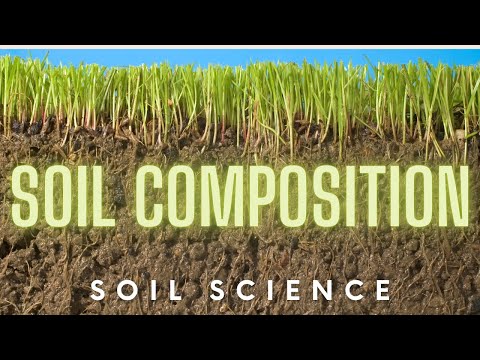
What Is Soil Made Of?, by Earth Science Classroom (6.5 min). As you watch, check each component against Figure 1 and note one job it does for plants.
Two farmers own fields of the same size, one near Musanze and one on a quartzite ridge in the Southern Province. Using the five factors of soil formation, explain why one of them needs to buy much more fertiliser than the other.
Tip
Soil = "MOWA": Minerals, Organic matter, Water, Air. For formation, remember "Please Can Little Rabbits Talk?": Parent rock, Climate, Living things, Relief, Time.
Practice
Remember
Sources and credits
The lesson text, pie chart, soil-formation diagram, table, worked examples and practice are written by Ganzaa.
This lesson adapts CC BY-SA material and is shared under CC BY-SA 4.0.