Trans-Atlantic Slave Trade (Triangular Trade)
Senior 1 · History and Citizenship
Trans-Atlantic Slave Trade (Triangular Trade)
Lesson 1 of 4
25 min
This unit is about one of the greatest crimes in human history. Between about 1500 and 1866, millions of African women, men and children were taken from their homes, carried across the Atlantic Ocean by force and made to work without pay for the rest of their lives. Historians study it carefully and respectfully, because the people it harmed were human beings with names, families and hopes, and because its effects are still felt today.
Start with Figure 1. It shows the ocean routes of the trade, drawn on a map of the Atlantic.
Study the map and answer in your notebook:
Definition
Trans-Atlantic slave trade: the forced transport of enslaved Africans across the Atlantic Ocean to the Americas by European and American traders, from the early 1500s to 1866. Example: the voyage that carried Olaudah Equiano from West Africa to Barbados in the 1750s.
Definition
Triangular trade: the three-sided pattern of Atlantic trade: ships sailed from Europe to Africa with manufactured goods, from Africa to the Americas with enslaved Africans, and from the Americas back to Europe with plantation goods. Example: a ship leaving Liverpool with cloth and guns, sailing to the Bight of Benin, then to Jamaica, and back to Liverpool with sugar.
Definition
Middle Passage: the second leg of the triangle: the crossing of the Atlantic from Africa to the Americas, during which captives were held below deck in terrible conditions. It lasted from about one to six months, depending on winds and weather. Example: the crossing from Ouidah to Saint-Domingue.
Definition
Plantation: a large farm in a hot region that grows one main crop, such as sugar cane, tobacco, cotton or coffee, for sale overseas, worked by large numbers of labourers. Example: the sugar plantations of Brazil and Jamaica.
Important
Why this book says "enslaved person". Historians today usually write enslaved person or enslaved African instead of "slave". The word "slave" describes a person only by what was done to them. "Enslaved person" reminds the reader that they were people first, and that someone else enslaved them. You will still see the word "slave" in old sources and in names such as "slave trade".
| Leg | From → to | What the ships carried | Who profited |
|---|---|---|---|
| 1. Outward passage | European ports (Liverpool, Bristol, London, Nantes, Lisbon) → the West African coast | cloth (much of it cotton cloth from India), guns and gunpowder, iron and copper bars, brass pots, alcohol, glass beads, cowrie shells | European manufacturers and merchants; African rulers and traders who received the goods |
| 2. Middle Passage | West and West-Central Africa → the Caribbean, Brazil, North and South America | enslaved African people, bought on the coast in exchange for the goods of leg 1 | ship owners, captains and merchants who sold the captives in the Americas |
| 3. Return passage | the Americas → Europe | sugar, molasses and rum, tobacco, cotton, coffee, cocoa and indigo dye, grown by enslaved people | plantation owners, merchants, refiners, factories and governments that taxed the goods |
Not every voyage made a neat triangle. Many ships from Brazil sailed straight across the South Atlantic to Luanda and back, carrying tobacco, rum and gold one way and captives the other: the dashed line in Figure 1. But the triangle explains how three continents were tied together by one business.
Worked example: reading the SlaveVoyages estimates
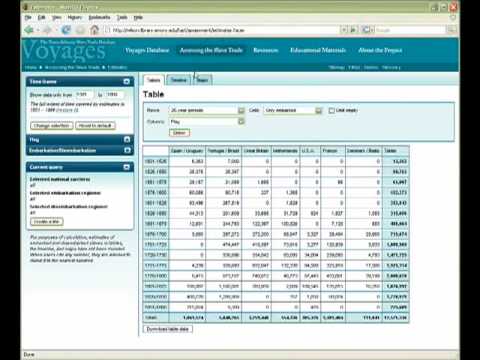
Historians have gathered records of about 36,000 slaving voyages into the Trans-Atlantic Slave Trade Database (slavevoyages.org). From these records they estimate that between 1501 and 1866 about 12.5 million Africans were taken on board ships in Africa, and about 10.7 million survived to land in the Americas.
Important
Along the coast of present-day Ghana, European trading companies built about forty forts and "castles". Cape Coast Castle began as a Portuguese trading post, was rebuilt as a fort by a Swedish company in 1653, and became the headquarters of the British on the Gold Coast. Under the castle's parade ground, in rock-cut dungeons, as many as a thousand captives at a time were held for weeks or months until a ship arrived. They left through a gate to the sea that is now called the "Door of No Return".
Today the castle is a museum and part of a UNESCO World Heritage Site. Visitors from Africa and from the African diaspora in the Americas come to remember the people who passed through it. Many Ghanaian historians and guides tell its story so that the names and lives of the captives are not forgotten.

Tip
Memory hook: "Goods, People, Crops". Leg 1 carried goods to Africa; leg 2 carried people to the Americas; leg 3 carried crops to Europe.
Emory University: "The Transatlantic Slave Trade Database". The historian David Eltis, one of the database's creators, shows how records of more than 35,000 voyages were gathered. Watch for how historians turn old ship records into estimates.
Think, pair, share: A number like "12.5 million" is hard to imagine. Rwanda's population in the 2022 census was about 13.2 million. What does that comparison help you understand? What does any number, however large, fail to tell us about the people behind it?
Practice
Sources and credits
The rest of this lesson, its diagrams, tables, worked examples and practice items, and the unit exercises were written by Ganzaa.
This lesson adapts CC BY-SA material and is shared under CC BY-SA 4.0.