State and Forms of Government
Senior 1 · History and Citizenship
State and Forms of Government
Lesson 3 of 5
24 min
Source A. "There would be an end of every thing, were the same man, or the same body whether of the nobles or of the people, to exercise those three powers, that of enacting laws, that of executing the public resolutions, and that of judging the crimes or differences of individuals."
Montesquieu, The Spirit of Laws (1748), Book XI, chapter 6, in Thomas Nugent's English translation.
Source B. "Branches of Government are the following: 1. The Legislature 2. The Executive 3. The Judiciary. The three branches are separate and independent from each other but are all complementary."
Constitution of the Republic of Rwanda of 2003, revised in 2015, Article 61.
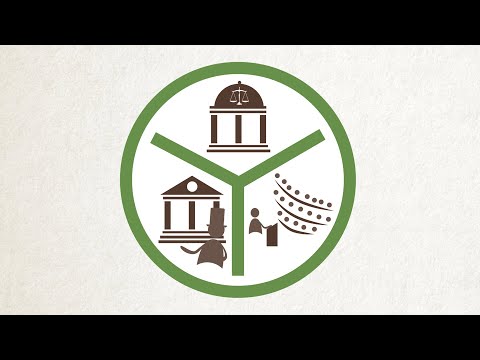
A French writer in 1748 and Rwanda's Constitution agree: the power of the state must be divided into three parts. Figure 3 shows the three branches and how each one keeps the others in check.
| Check | Who checks whom | How it works in Rwanda | Constitution |
|---|---|---|---|
| 1 | Legislature checks Executive | Deputies question ministers orally and in writing, hold committee hearings and set up commissions of inquiry; Parliament votes the budget | Article 128 |
| 2 | Executive checks Legislature | the President signs (promulgates) a law within 30 days, or may send it back for a second reading | Article 106 |
| 3 | Legislature checks Judiciary | the Senate must approve the appointment of the President, Vice President and judges of the Supreme Court | Article 86 |
| 4 | Judiciary checks Legislature | the Supreme Court gives the official interpretation of laws and hears claims that a law breaks the Constitution | Article 96 |
| 5 | Executive checks Judiciary | the President appoints senior judges, but only after the Senate approves (check 3) | Article 86 |
| 6 | Judiciary checks Executive | courts hear cases against government decisions, and officials who break the law are tried like anyone else | Article 61: the branches are independent |
Worked example: reading a constitution article word by word
Question: What does Article 61 (Source B) tell us about how Rwanda is governed?
Definition
Organ of the state: a body through which the state uses its power. The three organs, also called branches or arms, are the legislature, the executive and the judiciary.
Definition
Legislature: the organ that makes, changes and repeals laws, and watches over the executive. Example: Rwanda's Parliament, made up of the Chamber of Deputies and the Senate.
Definition
Executive: the organ that carries out the laws and runs the country day to day. Example: in Rwanda, the President of the Republic, the Prime Minister and the Cabinet.
Definition
Judiciary: the organ that interprets the laws and settles disputes through the courts. Example: Rwanda's Supreme Court and the courts below it.
Definition
Separation of powers: the principle that the three organs must be held by different people and bodies, so that no one holds all state power. Example: Article 61 of Rwanda's Constitution.
Definition
Checks and balances: the ways in which each organ can limit the others, so that power stays balanced. Example: the Senate must approve the appointment of Supreme Court judges.

The organs exist to carry out the functions of the state: the jobs that citizens expect a state to do for them. The government is the part that performs them day to day.
| Function of the state | What it means | Rwandan example |
|---|---|---|
| Defence and security | protecting the territory and the people from attack | the Rwanda Defence Force guards the borders |
| Law and order | making laws, keeping the peace and punishing crime | the Rwanda National Police and the courts |
| Social services | education, health, water and help for vulnerable people | free basic education in public schools; community-based health insurance (mutuelle de santé) |
| Economic development | building roads and power lines, supporting farming, trade and jobs | national road and electricity programmes; the Made in Rwanda policy (Unit 12) |
| Collecting revenue | raising taxes to pay for public services | the Rwanda Revenue Authority collects taxes |
| Foreign relations | treaties, trade and cooperation with other states | embassies abroad; membership of the United Nations, the African Union and the East African Community |
| Protecting rights and unity | guarding citizens' rights and national unity | the National Commission for Human Rights; the Ministry of National Unity and Civic Engagement (Unit 10) |
Important
On 1 September 2017, the Supreme Court of Kenya cancelled the result of the presidential election held on 8 August, ruling that the election had not been conducted as the Constitution required. It ordered a new election within 60 days, and one was held in October 2017. It was the first time a court in Africa had cancelled a presidential election. Whatever people thought of the ruling, the case shows the judiciary acting as an independent check: the other branches accepted the court's decision and a new vote took place.
Imagine a school where the head teacher alone writes the rules, punishes pupils and also hears every appeal against a punishment. What problems could arise? Now compare your answer with Source A. Which check in Figure 3 do you think matters most, and why?
Tip
Memory hook: "Make, Do, Judge". The legislature makes the law, the executive does what the law says, the judiciary judges whether it was done rightly.
Civics Academy (South Africa): "What is the Separation of Powers?". Listen for the meaning of "checks and balances", then find one check in the video that is similar to a check in Figure 3.
Practice
Sources and credits