Points, Lines and Angles
Senior 1 · Mathematics
Points, Lines and Angles
Lesson 2 of 5
25 min
In one hour, the minute hand of the classroom clock turns all the way round and returns to 12. In 15 minutes it makes a quarter of that turn. An angle measures an amount of turn like this, and mathematicians divide one full turn into 360 equal parts called degrees. So in 15 minutes the minute hand turns through .
Definition
Angle: the figure formed by two rays that start at the same point. The common starting point is the vertex, and the two rays are the arms of the angle. The size of the angle is the amount of turn from one arm to the other.
Notation: the angle with vertex and arms and is written , , or simply when only one angle has its vertex at . An angle can also be named by a small letter such as , or a Greek letter such as ("theta").
Definition
Degree: the unit of angle, one 360th part of a full turn, so that
Example: the minute hand turns in 60 minutes, so it turns every minute.
A protractor has two scales, one running each way. To measure :
To draw an angle of, say, : draw one arm, put the centre on its endpoint and the base line along it, mark a dot at 65 on the scale that starts from 0 on your arm, and join the dot to the vertex.
Angles are named by their size, compared with a right angle () and a straight angle ().
Definition
Acute angle: an angle between and , that is .
Right angle: an angle of exactly , a quarter turn. It is marked with a small square, not an arc.
Obtuse angle: an angle between and , that is .
Definition
Straight angle: an angle of exactly , a half turn. Its two arms form a straight line.
Reflex angle: an angle between and , that is .
Full turn (revolution): an angle of exactly ; the turning arm comes back to where it started.
| Type | Size | Where you see one |
|---|---|---|
| acute | the tip of a slice of cake | |
| right | the corner of a page or a door frame | |
| obtuse | a laptop screen opened wide | |
| straight | the hands of a clock at 6:00 | |
| reflex | the outside of the corner of a room | |
| full turn | a wheel turning once |
Important
Every pair of arms makes two angles, and they add up to . If one of them is , the other is .
Why: turning from one arm to the other the short way, and then carrying on the long way back to the first arm, is exactly one full turn. So an angle of comes with a reflex angle of . Unless a question says "reflex", "the angle between two arms" means the smaller one.
Worked example 1: classifying angles
Name the type of each angle: (a) (b) (c) (d) (e) (f) .
Solution Compare each size with , and .
Worked example 2: the hands of a clock
Find the angle between the hands of a clock at (a) 4:00 (b) 3:00 and (c) 6:00, and name each type. At 4:00, what is the reflex angle between the hands?
Solution The 12 hour marks divide the full turn into 12 equal parts, so the angle between neighbouring marks is
The reflex angle at 4:00 is .
Worked example 3: finding a mistake
Mugisha measures an angle with a protractor and writes , but the angle is clearly smaller than the corner of his exercise book. What has gone wrong, and what is the correct size?
Solution An angle smaller than a right angle is acute, so (obtuse) cannot be right. Mugisha read the scale that starts from 0 on the other side. The two scales always add up to , so the correct reading is
Warning
Two common mistakes
Tip
Carry a right angle with you: the corner of any page is . Hold it against an angle. If the angle fits inside the corner, it is acute; if it is wider than the corner but not yet a straight line, it is obtuse.
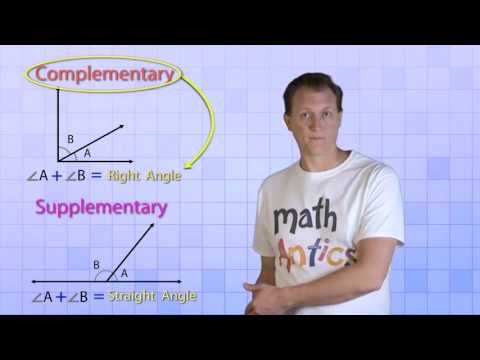
Math Antics: Angle Basics (8 min). Watch how an angle is measured as an amount of turn, why a full turn is 360°, and how right, acute, obtuse and straight angles compare.
Practice
Estimate before you calculate. The last two questions are harder.
Sources and credits
The protractor, clock and angle-type diagrams, the worked examples, the practice items and the quiz questions were written by Ganzaa.