Electric Current and Ohm's Law
Senior 1 · Physics
Electric Current and Ohm's Law
Lesson 5 of 5
25 min
We cannot see a current in a wire; we know it is there only from what it does. It heats the element of a kettle and the filament of a lamp. It turns the motor of a hair clipper in a barber's kiosk and rings an electric bell at the school gate. It charges the battery of a motorbike and coats a cheap bracelet with a thin shine of silver. These are the three effects of an electric current: magnetic, heating and chemical.
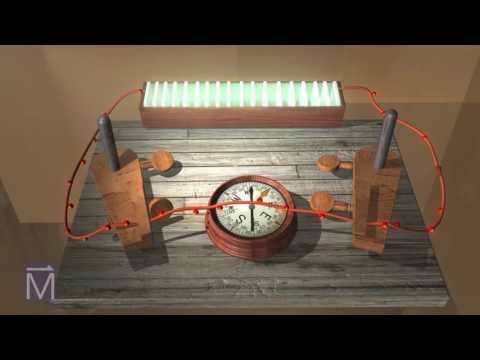
In 1820 the Danish physicist Hans Christian Ørsted noticed that a compass needle near a wire moved each time he switched a current on. Repeat his experiment: lay a wire north–south directly over a compass, then close the switch for a moment.
Figure 5.1: (a), (b) Oersted's experiment seen from above. (c) The magnetic field round a straight wire: circles centred on the wire.
A current produces a magnetic field around it. The field lines round a straight wire are circles centred on the wire. Right-hand grip rule: grip the wire with your right hand, thumb pointing along the conventional current; your curled fingers show the direction of the field lines.
Figure 5.2: An electromagnet. The iron core becomes a strong magnet only while current flows in the coil.
Winding the wire into a coil adds the fields of all the turns together, and an iron core inside the coil makes the field hundreds of times stronger. When the switch is opened, soft iron loses its magnetism at once and the clips fall. That is the great advantage of an electromagnet: it can be switched on and off.
| To make an electromagnet stronger | Why it works |
|---|---|
| increase the current | each turn makes a stronger field |
| add more turns of wire | more turns add their fields together |
| use a soft-iron core | the iron is magnetised and adds its own strong field |
Definition
An electromagnet is a coil of insulated wire, usually wound on a soft-iron core, that becomes a magnet only while a current flows through it. Uses: electric bells, relays and door locks, the lifting magnets on scrap-metal cranes, loudspeakers and electric motors.
As electrons drift through a conductor they keep colliding with its atoms, giving them energy, so the conductor warms up. The bigger the resistance and the current, the more heat. For a resistor of resistance carrying a current for a time , the heat produced (Joule's law) is
with in joules, in amperes, in ohms and in seconds. Because is squared, doubling the current gives FOUR times the heat.

Definition
The heating effect of a current is the production of heat when a current flows through a resistance: . It is used in kettles, irons, cookers, water heaters, hair dryers, filament lamps and fuses.
Worked example 1: heat from a resistor
A current of flows through a resistor for 5.0 minutes. How much heat is produced?
That is .
Worked example 2: a kettle on the mains
A kettle element has a resistance of and is connected to the mains. Find the current, and the heat it produces in 2.0 minutes.
(Keep the unrounded current, , in the second step.)

Figure 5.3: Copper plating a key. Copper dissolves from the anode and is deposited on the key, the cathode.
Pure water hardly conducts, but a solution of a salt, an acid or an alkali does, because it contains ions that can move. When a current passes through such a liquid, chemical changes happen at the two plates where the current enters and leaves. In Figure 5.3, positive copper ions in the copper(II) sulfate solution move to the negative key and are deposited on it as a thin, even layer of copper, while copper from the positive plate dissolves to replace them.
Definition
Electrolysis is the chemical change produced when a current passes through a liquid that conducts (an electrolyte). The current enters and leaves through two conducting plates, the electrodes: the anode is joined to the + terminal and the cathode to the − terminal.
Electroplating uses electrolysis to coat an object (made the cathode) with a thin layer of another metal, for decoration or to stop rusting.
Worked example 3: planning to silver-plate a spoon
A jeweller wants to coat a brass spoon with silver. Which object goes where, and what liquid is used?
| Effect | What happens | Where it is used |
|---|---|---|
| magnetic | a magnetic field forms around the current | electromagnets, bells, relays, motors, loudspeakers |
| heating | the conductor gets hot: | kettles, irons, cookers, filament lamps, fuses |
| chemical | an electrolyte is decomposed at the electrodes | electroplating, refining copper, charging batteries |
Warning
Common mistakes. (1) Making the object to be plated the ANODE: it then dissolves instead of being coated. It must be the cathode (−). (2) Thinking that heat is proportional to the current: it is proportional to . (3) Forgetting that a wire has a magnetic field only while a current flows in it.
Tip
Three effects, three words: a magnet (Oersted's compass), a heater (), a platter (the object to be plated goes on the negative side: "cathode coated").
The heating effect boils water in homes and hotels, and irons clothes in every tailor's workshop. Electric motors, which depend on the magnetic effect, run maize mills, water pumps and the machines in Kigali's factories. The chemical effect recharges the batteries of phones, solar lamps and electric motorbikes, which are becoming common on Kigali's roads.
What Oersted discovered with his compass (National MagLab). Watch the compass needle jump when the current is switched on, and how the needle's direction reveals the circular field round the wire.
Practice
Key points
Further reading
Sources and credits
The heating and chemical effects sections, the diagrams, the worked examples and the practice exercises are written by Ganzaa.