Rectilinear Propagation of Light
Senior 1 · Physics
Rectilinear Propagation of Light
Lesson 2 of 5
25 min
Hold your hand under a single bright LED torch and its shadow on the desk has sharp edges. Hold it under a long fluorescent tube in the classroom ceiling and the shadow is fuzzy: dark in the middle and grey at the edges. On a cloudy afternoon your shadow almost disappears. All of these follow from one fact you met in lesson 1: light travels in straight lines, and an opaque object blocks the rays that hit it.
Definition
A shadow is a region that light from a source cannot reach because an opaque object blocks it.
The umbra is the part of a shadow that receives NO light from the source: it is completely dark. The penumbra is the part that receives light from only PART of the source: it is partly dark.
Figure 2.1: A point source. Every point on the screen either receives light from the source or does not, so the shadow is all umbra, with sharp edges.
To find the shadow, draw straight rays from the source past the top and bottom edges of the object to the screen. The shadow lies between them. The rays spread out, so the shadow is bigger than the object; the triangles formed by the rays are similar, so
Worked example 1: the size of a shadow
A card tall stands from a small bright lamp. A screen is from the lamp. How tall is the shadow?
Move the card closer to the lamp and its shadow grows; move it closer to the screen and the shadow shrinks towards the size of the card.
Figure 2.2: An extended source. The solid rays mark the umbra; the dashed rays, from each edge of the source past the opposite edge of the object, mark the outer edge of the penumbra.
A frosted bulb, a fluorescent tube or the Sun is an extended source: light comes from many points across its surface. Near the middle of the screen, no part of the source can be seen past the object: that is the umbra. Towards the edges, some of the source is hidden and some is not: that is the penumbra, which gets lighter towards its outer edge.
| Point source | Extended source | |
|---|---|---|
| Shadow | umbra only | umbra with a penumbra round it |
| Edges | sharp | fuzzy |
| Example | a small LED, a distant street lamp | a fluorescent tube, a frosted bulb, the Sun |
Worked example 2: shadows in sunlight
At the same moment, Ishimwe ( tall) casts a shadow long, and the school flagpole casts a shadow long. How tall is the flagpole?
The Sun is so far away that its rays arrive parallel, so both shadows make similar triangles:
The Sun lights the Earth and the Moon, and each of them casts a long shadow into space, with an umbra and a penumbra because the Sun is an extended source. An eclipse happens when the Sun, the Earth and the Moon are in a straight line, so that one of them moves into the shadow of another.
Figure 2.3: A solar eclipse (not to scale). People in the Moon's umbra see a total eclipse; people in its penumbra see a partial eclipse.
Definition
A solar eclipse (eclipse of the Sun) happens when the Moon passes between the Sun and the Earth and its shadow falls on the Earth. It can happen only at new moon.
A lunar eclipse (eclipse of the Moon) happens when the Earth is between the Sun and the Moon and the Moon moves into the Earth's shadow. It can happen only at full moon.

The Moon's umbra is only just long enough to reach the Earth, so a total solar eclipse is seen only along a narrow path, usually less than about wide, and lasts only a few minutes at any one place. Over a much wider region, in the penumbra, people see a partial eclipse: a "bite" taken out of the Sun. Sometimes the Moon is a little further from the Earth and its umbra does not reach us at all; then a bright ring of Sun is left round the Moon, an annular eclipse.
Figure 2.4: A lunar eclipse (not to scale). The Earth's umbra is wide enough to swallow the whole Moon.
A lunar eclipse can be seen from everywhere on the night side of the Earth, and totality can last well over an hour. The Moon does not disappear: a little sunlight is bent through the Earth's atmosphere into the umbra, and it lights the Moon a dull red. The total lunar eclipse of 27 July 2018, the longest of this century, was seen clearly across East Africa, including Rwanda.

Important
Why not every month? The Moon's orbit is tilted by about to the Earth's orbit round the Sun. At most new and full moons, the Moon passes a little above or below the line from the Sun to the Earth, and its shadow (or the Earth's) misses. Eclipses happen only when a new or full moon falls where the two orbits cross.
Warning
Never look at the Sun, even during an eclipse. The part of the Sun that is still uncovered can burn the retina at the back of your eye in seconds, without pain, and the damage is permanent. Watch a solar eclipse only through certified eclipse glasses, or project the Sun's image with a pinhole camera (lesson 3). A lunar eclipse is completely safe to watch with your bare eyes.
Warning
Common mistakes. (1) Mixing up the two eclipses: in a SOLAR eclipse the MOON is in the middle; in a LUNAR eclipse the EARTH is in the middle. (2) Drawing the penumbra rays from the same edge of the source as the umbra rays: penumbra rays cross over, from one edge of the source past the OPPOSITE edge of the object. (3) Thinking the Moon vanishes in a lunar eclipse: it turns dull red.
Tip
Name the eclipse after what is hidden: a solar eclipse hides the Sun (the Moon blocks it); a lunar eclipse darkens the Moon (the Earth's shadow falls on it). The body in the MIDDLE casts the shadow.
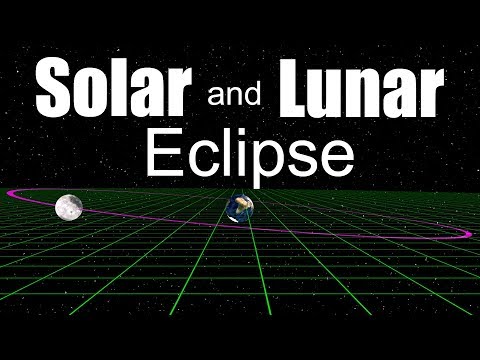
Solar eclipse and lunar eclipse (Jared Owen). Watch the 3D model of the Sun, Earth and Moon line up, and compare the shadows in the two kinds of eclipse with Figures 2.3 and 2.4.
Practice
Key points
Sources and credits
Written by Ganzaa: the lesson text, the shadow and eclipse diagrams, the worked examples and the practice exercises.