Nutrient Cycles
Senior 3 · Biology
Nutrient Cycles
Lesson 1 of 4
25 min
Nyungwe forest stands on the high ridge that divides Africa's two greatest river basins. Rain that falls on one side of the ridge ends up in the Congo River and the Atlantic Ocean; rain on the other side flows to the Nile and the Mediterranean. Much of that rain was water that evaporated from lakes and rose from the leaves of the forest itself only days before. The same water molecules go round and round: this is the water cycle.
In Senior 2 you learned that decomposers return mineral salts to the soil, while energy flows one way through an ecosystem. This unit follows four substances that cycle: water, carbon, nitrogen and phosphorus.
Definition
Nutrient (biogeochemical) cycle: the movement of a chemical element or substance from the non-living environment into living things and back again, over and over.
Water cycle (hydrological cycle): the continuous movement of water between the oceans, lakes, air, land and living things, driven by the energy of the sun.
Evaporation: the change of liquid water into water vapour at the surface of seas, lakes, rivers and wet ground. Transpiration: the loss of water vapour from plants, mainly through the stomata of the leaves.
Condensation: the change of water vapour into tiny liquid droplets when air cools, forming clouds, mist and dew. Precipitation: water falling from clouds as rain, hail or snow.
Infiltration: water soaking into the soil. Surface runoff: water flowing over the ground into streams and rivers. Groundwater: water stored in the soil and rocks underground.
Figure 1: The water cycle. Every arrow shows the direction in which the water moves.

Worked example 1: how much of Earth's water can we use?
Of all the water on Earth, 97.5% is salt water. Of the fresh water, about 99% is ice or groundwater, so less than 1% of the fresh water is in lakes and rivers. Imagine all Earth's water shrunk to 1,000 litres. How much would be (a) fresh water, and (b) fresh water in lakes and rivers?
Answer: of 1,000 litres, only 25 litres would be fresh, and less than a quarter of a litre, about one glass, would be in lakes and rivers. This is why protecting catchments such as Nyungwe matters.
Worked example 2: rain on a hillside catchment
A hillside catchment of receives of rain in a year. When it was forested, 20% of the rain ran off; after the forest was cleared for farms, 45% ran off. (Illustrative figures.) Calculate (a) the volume of rain, and (b) the increase in runoff.
Interpretation: with less leaf cover and fewer roots, less rain is caught and soaked up, so more rushes downhill at once. That is why deforested hills suffer floods, landslides and soil erosion, while their streams may dry up in the dry season because less water was stored underground.
Warning
Common mistakes. (1) Confusing evaporation (from water surfaces) with transpiration (from plants). (2) Saying clouds are water vapour: vapour is invisible; clouds are tiny liquid droplets formed by condensation. (3) Drawing arrows the wrong way: evaporation and transpiration arrows point up, precipitation down, runoff downhill.
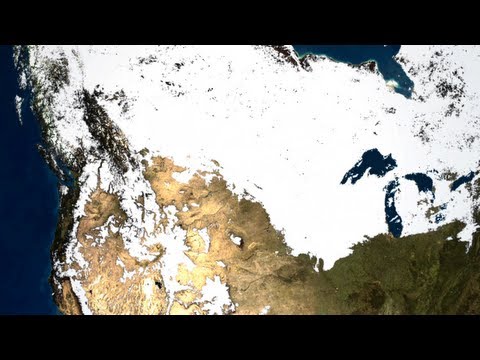
Earth's Water Cycle (NASA Goddard). Watch how satellites measure evaporation, clouds and rainfall, and notice that the sun's energy drives the whole cycle.
Tip
Memory hook: "up, across, down, back". Up (evaporation, transpiration), across (winds carry the vapour and clouds), down (precipitation), back (runoff, infiltration and groundwater return the water to lakes and the sea).
Practice: the water cycle
Key points
Sources and credits
Written by Ganzaa: Figure 1, the worked examples (the catchment figures are illustrative) and the practice questions.