Nitrogen and Its Inorganic Compounds
Senior 3 · Chemistry
Nitrogen and Its Inorganic Compounds
Lesson 3 of 4
25 min
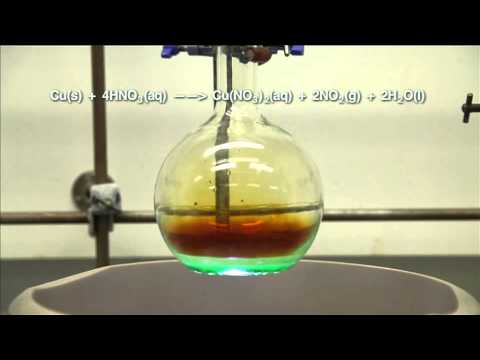
Drop a piece of copper wire into dilute hydrochloric or sulfuric acid and nothing happens: copper is below hydrogen in the reactivity series. Drop it into nitric acid and the liquid turns blue-green while a choking brown gas pours out of the flask. Nitric acid is an acid, but it is also a powerful oxidising agent, and that second property makes its chemistry different from the acids you met in S2.

Nitric acid is made by heating a nitrate with concentrated sulfuric acid. Sulfuric acid has a much higher boiling point, so it drives out the more volatile nitric acid, which distils over and is condensed (Figure 3.1):
The apparatus is made entirely of glass because nitric acid vapour attacks rubber and cork. The mixture is heated gently: strong heat would decompose some of the nitric acid into nitrogen dioxide, which dissolves in the product and colours it yellow.
Figure 3.1: Laboratory preparation of nitric acid (a teacher demonstration).
Warning
Safety. Concentrated nitric and sulfuric acids cause severe burns, and nitric acid fumes and nitrogen dioxide are toxic. This preparation is a teacher demonstration in a fume cupboard, with eye protection and gloves. If acid touches the skin, rinse it at once under plenty of running water for at least 15 minutes and tell the teacher.
Industrial nitric acid is made from ammonia from the Haber process, in three steps (Figure 3.2):
The first step uses a gauze of platinum and rhodium as a catalyst, at about 900 °C.
Figure 3.2: The Ostwald process.
Physical. Pure nitric acid is a colourless, fuming liquid that boils at 83 °C. It turns yellow on standing, because light decomposes it into nitrogen dioxide, so it is stored in brown bottles:
As an acid (dilute). Dilute nitric acid is a strong acid. It turns blue litmus red and reacts with bases, metal oxides and carbonates in the usual way, forming nitrates:
With metals, nitric acid does not usually give hydrogen. Any hydrogen formed is oxidised to water at once, and the acid itself is reduced to an oxide of nitrogen. Copper, which does not react with other dilute acids, reacts with dilute nitric acid to form colourless nitrogen monoxide, which turns brown as soon as it meets air:
As an oxidising agent (concentrated). Concentrated nitric acid oxidises copper, carbon and sulfur, and is itself reduced to brown nitrogen dioxide:
Iron and aluminium do not dissolve in the concentrated acid: it forms a thin, unreactive oxide layer on their surface, which protects them (they become passive).
Definition
Oxidising agent (oxidant): a substance that gives oxygen to another substance, or takes hydrogen or electrons from it. The oxidising agent is itself reduced. Example: in , nitric acid oxidises sulfur to sulfuric acid and is reduced to nitrogen dioxide.
Nitrogen dioxide, , is the brown gas given off when concentrated nitric acid reacts with copper, and when most metal nitrates are heated (Lesson 4).
Table 3.1: Uses of nitric acid
| Use | Why |
|---|---|
| fertilisers, especially ammonium nitrate | provides nitrogen as nitrate ions: |
| explosives for mining and quarrying | nitrates and nitro-compounds release large volumes of gas very quickly |
| dyes, drugs and plastics such as nylon | a starting material for many carbon compounds |
| etching metals and cleaning equipment | dissolves metals that other acids do not |
Worked example
Problem. What mass of nitric acid can be obtained from 20.2 g of potassium nitrate, assuming it all reacts? (K = 39, N = 14, O = 16, H = 1)
Solution. , so .
From , 1 mol gives 1 mol . , so the mass is .
Worked example
Problem. 3.2 g of copper reacts completely with concentrated nitric acid. (a) What volume of nitrogen dioxide, at room temperature and pressure, is given off? (b) Explain why no hydrogen is produced. (Cu = 64; molar volume )
Solution. (a) . From , 1 mol Cu gives 2 mol : and the volume is .
(b) Copper is below hydrogen in the reactivity series, so it cannot displace hydrogen from any acid. Copper dissolves here because nitric acid is an oxidising agent: it oxidises the copper to copper(II) ions and is itself reduced to nitrogen dioxide, not to hydrogen.
Tip
Dilute gives NO, concentrated gives NO₂. With copper, dilute nitric acid gives colourless NO (which browns in air); concentrated gives brown at once. Either way: no hydrogen.
Royal Society of Chemistry: Reaction of copper with nitric acid (3 min). Declan Fleming shows the reaction; watch for the brown gas and the colour of the solution, and name each product.
Practice
Sources and credits