Chlorine and Its Inorganic Compounds
Senior 3 · Chemistry
Chlorine and Its Inorganic Compounds
Lesson 4 of 4
25 min
At Lake Katwe, a salt lake in a volcanic crater in western Uganda, workers let the salty water evaporate in shallow pans under the sun and rake up the crystals that form. The main compound in those crystals, and in the salt on every kitchen table, is sodium chloride. It seasons and preserves food, it is a raw material for chlorine and sodium hydroxide, and a small amount of it in a drink can save the life of a child with diarrhoea. Too much of it, on the other hand, damages health. This lesson looks at sodium chloride, and at how chemists recognise chloride and the other halide ions.

From nature. Sodium chloride is obtained by evaporating sea water or the brine of salt lakes in pans, as at Lake Katwe, and by mining underground beds of rock salt left when ancient seas dried up.
In the laboratory. It is a soluble salt, so it is prepared by the titration method you used in S2: dilute hydrochloric acid is added to sodium hydroxide solution until the mixture is exactly neutral, then the solution is evaporated until crystals form:
It also forms when sodium carbonate reacts with hydrochloric acid, and when sodium burns in chlorine (Lesson 2).
Definition
Oral rehydration solution (ORS): a drink of clean water containing measured amounts of sodium chloride, glucose and other salts, which replaces the water and salts lost in diarrhoea. The glucose helps the gut absorb the sodium, and water follows the sodium into the body. Example: the WHO and UNICEF formula contains 2.6 g of sodium chloride and 13.5 g of glucose in every litre.
The body needs some sodium, but a diet high in salt raises blood pressure, which increases the risk of heart disease and stroke. The World Health Organization recommends that adults eat less than 5 g of salt a day, just under one teaspoon, including the salt already in bread, stock cubes, snacks and processed foods.
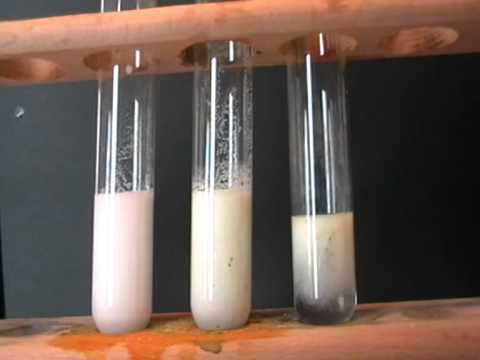
Acidify the solution with dilute nitric acid, then add silver nitrate solution. Each halide gives a precipitate of a different colour; ammonia solution confirms which (Figure 4.1):

Figure 4.1: Identifying chloride, bromide and iodide ions with silver nitrate and ammonia.
Warning
Safety. Silver nitrate stains skin and clothes black and is harmful to the eyes; concentrated ammonia solution gives off an irritating gas. Wear eye protection and gloves, and use concentrated ammonia in a fume cupboard.
Table 4.1: Tests for gases
| Gas | Test | Result |
|---|---|---|
| oxygen, | glowing splint | relights |
| hydrogen, | lighted splint | squeaky pop |
| carbon dioxide, | bubble through limewater | limewater turns milky |
| carbon monoxide, | light it; test the product with limewater | burns with a blue flame; product turns limewater milky |
| ammonia, | damp red litmus; concentrated hydrochloric acid on a glass rod | litmus turns blue; dense white fumes |
| nitrogen dioxide, | look; damp blue litmus | reddish-brown gas; litmus turns red |
| sulfur dioxide, | acidified potassium dichromate(VI) | orange turns green |
| hydrogen sulfide, | moist lead(II) ethanoate paper | turns black |
| chlorine, | look; damp blue litmus | yellow-green; litmus turns red, then white |
| hydrogen chloride, HCl | concentrated ammonia on a glass rod | dense white fumes |
Table 4.2: Tests for anions
| Anion | Test | Result |
|---|---|---|
| carbonate, | add dilute acid | fizzes; the gas turns limewater milky |
| sulfate, | dilute hydrochloric acid, then barium chloride | white precipitate that stays |
| sulfite, | warm with dilute hydrochloric acid | gas turns acidified dichromate(VI) green |
| nitrate, | warm with sodium hydroxide and aluminium | ammonia given off (damp red litmus turns blue) |
| chloride, | dilute nitric acid, then silver nitrate | white precipitate, soluble in dilute ammonia |
| bromide, | dilute nitric acid, then silver nitrate | cream precipitate, soluble in concentrated ammonia |
| iodide, | dilute nitric acid, then silver nitrate | yellow precipitate, insoluble in ammonia |
Worked example
Problem. Excess silver nitrate solution is added to a solution containing 1.17 g of sodium chloride. What mass of silver chloride precipitates? (Na = 23, Cl = 35.5, Ag = 108)
Solution. , so .
: 1 mol NaCl gives 1 mol AgCl. , so the mass is .
Worked example
Problem. A white solid gives a bright yellow-orange flame test. Its solution, acidified with dilute nitric acid, gives a cream precipitate with silver nitrate; the precipitate does not dissolve in dilute ammonia but dissolves in concentrated ammonia. Identify the solid, and explain why the student acidified with nitric acid, not hydrochloric acid.
Solution. The yellow-orange flame shows sodium ions (S2). A cream precipitate soluble only in concentrated ammonia is silver bromide, so the anion is bromide. The solid is sodium bromide, NaBr. Hydrochloric acid would have added chloride ions, which give their own white precipitate of silver chloride and would confuse the result.
Tip
White, cream, yellow: Cl, Br, I. The precipitates get darker, and harder to dissolve in ammonia, as you go down the group. Always acidify with nitric acid first.
Halides in solution: test using acidified silver nitrate (4 min). Watch the colour of each precipitate as silver nitrate is added, and match it to Figure 4.1.
Practice
Further reading
Sources and credits