Derivatives of Benzene
Senior 6 · Chemistry
Derivatives of Benzene
Lesson 4 of 5
25 min
The smell of bitter almonds and of almond-flavoured cakes is benzaldehyde. The label on a bottle of soft drink or fruit juice often lists "sodium benzoate (E211)", a preservative that stops yeasts and moulds from growing. Both are benzene derivatives with a carbonyl group, C=O, joined to the ring. In S5 you studied aldehydes, ketones and carboxylic acids; their aromatic members react in the same way at the functional group, with a few important differences.
Definition
Aromatic aldehyde: a compound with a –CHO group joined directly to a benzene ring. Example: benzaldehyde, .
Aromatic ketone: a compound with a C=O group joined to a benzene ring and to another carbon group. Example: phenylethanone, .
Aromatic carboxylic acid: a compound with a –COOH group joined directly to a benzene ring. Example: benzoic acid, .
Preparation. Benzaldehyde is made by the controlled oxidation of methylbenzene, or by hydrolysing (dichloromethyl)benzene from the side-chain chlorination of Lesson 2: . Phenylethanone is made by Friedel–Crafts acylation (Unit 3).
Table 4.1: Reactions of the carbonyl group
| Reagent | Benzaldehyde, | Phenylethanone, |
|---|---|---|
| 2,4-dinitrophenylhydrazine (2,4-DNPH) | orange precipitate | orange precipitate |
| Tollens' reagent, warm | silver mirror (oxidised to benzoate) | no change |
| Fehling's or Benedict's solution, warm | no red precipitate: aromatic aldehydes do not reduce it | no change |
| iodine in NaOH(aq), warm (triiodomethane test) | no change | yellow precipitate of (has a group) |
| HCN (from KCN + acid) | nucleophilic addition: | nucleophilic addition: |
| reduced to phenylmethanol, | reduced to 1-phenylethanol |
Benzaldehyde is also oxidised slowly by the air, so old bottles often contain white crystals of benzoic acid.
Benzoic acid is a white crystalline solid that melts at 122 °C. It is only slightly soluble in cold water but much more soluble in hot water, so it is purified by recrystallisation: dissolve it in the minimum of boiling water, filter while hot, and let the solution cool; pure needle-shaped crystals form and the soluble impurities stay in solution.

Acidity. Benzoic acid ( 4.20) is a slightly stronger acid than ethanoic acid ( 4.76), and much stronger than phenol ( 10.0). It fizzes with sodium hydrogencarbonate, which phenol does not:
Other reactions follow the carboxylic acids of S5:
Uses. Benzoic acid (E210) and sodium benzoate (E211) are preservatives in acidic foods and drinks such as fruit juices, soft drinks and sauces; they work best in acid, where the undissociated acid enters the microbes. Benzoates are also used in medicines, and benzaldehyde is a flavouring.
Figure 4.1: A scheme for telling apart four aromatic compounds met in this unit.
Worked example
Problem. Compounds P, Q and R are aromatic. P () gives an orange precipitate with 2,4-DNPH and a silver mirror with Tollens' reagent. Q () gives an orange precipitate with 2,4-DNPH, no silver mirror, and a yellow precipitate with iodine and sodium hydroxide. R () fizzes with sodium hydrogencarbonate. Identify P, Q and R.
Solution. P is a carbonyl compound (2,4-DNPH) that is an aldehyde (Tollens'): with seven carbons it is benzaldehyde, . Q is a ketone (2,4-DNPH positive, Tollens' negative) containing (triiodomethane): phenylethanone, . R is a carboxylic acid: benzoic acid, .
Worked example
Problem. 12.2 g of benzoic acid is refluxed with excess methanol and concentrated sulfuric acid, giving 10.9 g of methyl benzoate. Calculate the percentage yield, and give one reason it is below 100%. (: benzoic acid 122.1, methyl benzoate 136.1)
Solution.
Answer: 80.1%. Esterification is reversible, so the reaction does not go to completion; some product is also lost during separation and distillation.
Warning
Exam trap. Benzaldehyde gives a silver mirror with Tollens' reagent but no red precipitate with Fehling's or Benedict's solution. Do not use Fehling's solution to prove that an aromatic compound is an aldehyde. Also take care in the laboratory: benzaldehyde is harmful if swallowed, and 2,4-DNPH is toxic, and the dry solid is flammable and can explode, so it is kept damp.
Tip
Work through tests from the most general to the most specific: acid (NaHCO₃) → carbonyl (2,4-DNPH) → aldehyde (Tollens') → methyl ketone (iodine and NaOH). Figure 4.1 is this order drawn out.
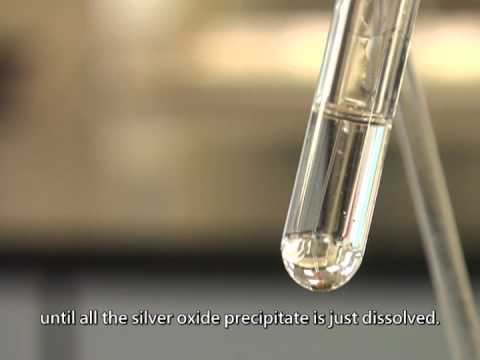
chemistry edb: Using Tollens' Reagent to Test for Aldehydes (3 min). Watch how the reagent is made and how the silver mirror forms on the inside of the test tube.
Practice
Sources and credits