Economic Integration and Globalization
Senior 6 · Economics
Economic Integration and Globalization
Lesson 1 of 5
25 min
The National Institute of Statistics of Rwanda (NISR) reports Rwanda's formal trade in goods with the regional groups it belongs to. Adding its four quarterly reports for 2025 gives (US$ million):
| 2025 | Domestic exports | Imports | Re-exports | Total trade |
|---|---|---|---|---|
| East African Community (EAC) | 85.5 | 1,438.3 | 15.9 | 1,539.7 |
| Common Market for Eastern and Southern Africa (COMESA) | 414.6 | 915.9 | 639.5 | 1,970.0 |
| Rwanda, all partners | 1,592.3 | 5,538.6 | 675.2 | 7,806.0 |
NISR's EAC figures cover Burundi, Kenya, South Sudan, Tanzania and Uganda. The Democratic Republic of Congo, the main buyer of Rwanda's re-exports, is counted in COMESA.
Read the table. (1) Does Rwanda buy more from, or sell more to, its EAC partners? (2) Why might COMESA matter more than the EAC for Rwanda's exports?
Definition
Economic integration: the process by which countries remove barriers to trade and to the movement of factors of production between them, and bring their economic policies closer together.
Regional economic community (trading bloc): a group of countries, usually neighbours, that have agreed to integrate their economies.
Example: the East African Community (EAC), whose members include Rwanda, Burundi, Kenya, Tanzania and Uganda.
Worked example
Worked example 1: how integrated is Rwanda's trade? (NISR, 2025)
(a) Share of Rwanda's total trade with the EAC:
(b) Share of Rwanda's imports that come from the EAC:
(c) Share of Rwanda's domestic exports that go to the EAC:
Interpretation: about a quarter of Rwanda's imports come from EAC partners, mainly Tanzania and Kenya, but only about one twentieth of its own products are sold there. Rwanda's larger export markets lie outside the EAC, for example the Democratic Republic of Congo, China and the United Arab Emirates, the top destinations in the last quarter of 2025 (NISR).
| Stage | What members agree | Example |
|---|---|---|
| Preferential trade area (PTA) | Lower, but not zero, tariffs on some goods traded between members | The Preferential Trade Area for Eastern and Southern Africa, founded in 1981 and replaced by COMESA in 1994 |
| Free trade area (FTA) | No tariffs on goods traded between members; each member keeps its own tariffs on goods from outside, so rules of origin are needed | The COMESA free trade area, launched on 31 October 2000, which Rwanda joined on 1 January 2004; the African Continental Free Trade Area (AfCFTA) |
| Customs union | A free trade area plus a common external tariff (CET) on goods from outside | The EAC Customs Union, operating from 1 January 2005 |
| Common market | A customs union plus free movement of labour, services and capital | The EAC Common Market, whose protocol came into force on 1 July 2010 |
| Economic union | A common market plus harmonised economic policies (competition, agriculture, transport, fiscal rules) | The European Union |
| Monetary union | One currency and one central bank | The euro area; the EAC signed a Monetary Union Protocol on 30 November 2013 |
| Political federation | One government for the whole bloc | A long-term goal in the EAC Treaty |
Definition
Common external tariff (CET): the single set of import duties that all members of a customs union charge on goods from outside the union.
Rules of origin: the rules that decide whether a good was made inside a free trade area (and so crosses internal borders duty-free), to stop outside goods entering through the member with the lowest tariff.
| Bloc | Key dates | Stage reached |
|---|---|---|
| East African Community (EAC) | Treaty signed 30 November 1999, in force 7 July 2000; Rwanda a full member from 1 July 2007; Customs Union from 1 January 2005; Common Market Protocol in force 1 July 2010; Monetary Union Protocol signed 30 November 2013 | Common market (being implemented) |
| Common Market for Eastern and Southern Africa (COMESA) | Free trade area launched 31 October 2000; Rwanda and Burundi joined it on 1 January 2004 | Free trade area |
| African Continental Free Trade Area (AfCFTA) | Signed in Kigali on 21 March 2018; Rwanda ratified on 25 May 2018, the third country to do so; in force 30 May 2019; trading began 1 January 2021 | Free trade area (being implemented) |
Worked example
Worked example 2: why a customs union changes where you buy (illustrative)
A Rwandan retailer can buy a crate of a product from a Kenyan firm for US$100 or from a firm outside the EAC for US$90. The good falls in the 25% CET band.
The retailer switches to the Kenyan firm, although the outside firm produces more cheaply. Whether that switch is good or bad for Rwanda is the question of the next lesson: trade creation or trade diversion?
Warning
Free trade area or customs union? The test is the tariff on goods from outside. In a free trade area each member sets its own; in a customs union all members charge the same CET. Don't call COMESA a customs union: its members trade with one another as a free trade area.
Tip
P-F-C-C-E-M-P. Preferential, Free trade, Customs union, Common market, Economic union, Monetary union, Political federation. Each step adds one thing: lower tariffs, no tariffs, the same outside tariff, free factors, shared policies, one currency, one government.
Important
Discuss. Only about 5% of Rwanda's own exports go to its EAC partners, but a quarter of its imports come from them. Does this mean the EAC benefits Kenya and Tanzania more than Rwanda? What other benefits of the EAC, apart from exports, should you weigh?
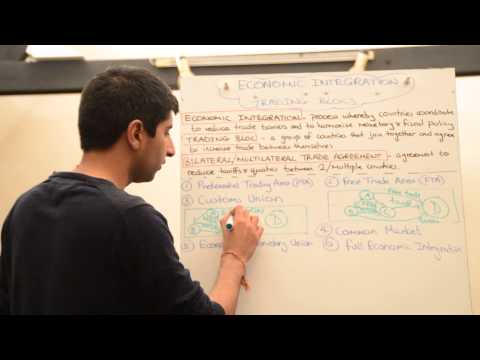
EconplusDal, "Economic Integration and Trading Blocs" (about 9 minutes). The types of trading bloc and the levels of integration. He uses the European Union as his main example; place the EAC, COMESA and the AfCFTA on his scale as you watch.
Practice
Sources and credits
Written by Ganzaa: the staircase diagram, the tables, the worked examples and the practice items. The prices in worked example 2 are illustrative. This lesson adapts CC BY-SA material and is shared under CC BY-SA 4.0.