Financial Statements
Senior 6 · Entrepreneurship
Financial Statements
Lesson 2 of 4
25 min
In the year to 30 June 2026 Uwase's shop sold Frw 24,500,000 of seed, fertiliser and tools. Yet when she counts what the year really earned her, the figure is far smaller. Part of the sales money paid for the goods themselves, part went back to customers who returned damaged sprayers, and part paid wages, rent and electricity.
The income statement follows the money down, one step at a time, from total sales to the profit that is really hers. It has two sections: the trading section, which finds the profit on buying and selling goods, and the profit and loss section, which adds other income and takes away the running expenses.
Definition
Cost of goods sold (or cost of sales): the cost of the stock that was actually sold during the period, not the cost of everything bought.
Example: Uwase started the year with Frw 1,850,000 of stock and ended with Frw 2,150,000 unsold, so not all of the year's purchases were sold.
Definition
Gross profit: net sales minus the cost of goods sold, the profit made on trading before running expenses. Net profit: gross profit plus other income minus all expenses, the profit that belongs to the owner. If the result is negative it is a gross loss or a net loss.
Example: a sprayer bought for Frw 30,000 and sold for Frw 42,000 earns a gross profit of Frw 12,000 before the shop's rent and wages are paid.
| Trading section (cost of the goods) | Profit and loss section (running the business) |
|---|---|
| Sales, less returns inwards | Other income: discount received, commission received, rent received |
| Opening and closing stock | Wages and salaries, rent, electricity, water, insurance |
| Purchases, less returns outwards | Advertising, telephone, transport of goods to customers (carriage outwards) |
| Carriage inwards (transport of goods bought), wages paid to bring goods into a saleable state | Discount allowed to customers, interest on loans, bank charges |
| Goods taken by the owner (deducted from purchases) | Never here: drawings, assets such as vans, loan repayments |
Definition
Carriage inwards and carriage outwards: carriage inwards is the cost of transporting goods TO the business when they are bought; it is part of the cost of the goods, so it is added to purchases. Carriage outwards is the cost of delivering goods to customers; it is a selling expense in the profit and loss section.
Example: the lorry that brings fertiliser from the wholesaler is carriage inwards; the delivery van taking orders to farmers' cooperatives is carriage outwards.
Definition
Accrued expense and prepaid expense: an accrued (owing) expense belongs to this year but has not yet been paid; it is ADDED to the expense and shown as a current liability. A prepaid expense has been paid this year but belongs to next year; it is SUBTRACTED from the expense and shown as a current asset. When nothing was owing or prepaid at the start of the year:
Example: June's electricity bill of Frw 30,000 arrives in July: it is still a June expense.
Tip
Carriage IN goes IN with the goods; carriage OUT goes OUT with the expenses. And returns follow their partners: returns inwards come off sales, returns outwards come off purchases.
Worked example 1: the adjustments first
Uwase's trial balance shows rent paid of Frw 1,300,000, which includes Frw 100,000 paid in advance for July 2026, and electricity paid of Frw 330,000, with June's bill of Frw 30,000 still unpaid. She also took fertiliser costing Frw 120,000 for her own farm and recorded nothing. Adjust each figure.
Rent: for the year; Frw 100,000 is a prepaid expense (current asset).
Electricity: for the year; Frw 30,000 is an accrued expense (current liability).
Goods taken: deduct Frw 120,000 from purchases, because those goods were not sold by the business, and add it to drawings: .
Worked example 2: Uwase's income statement
From this trial balance, and with closing stock valued at Frw 2,150,000 on 30 June 2026 and the adjustments in Worked example 1, prepare Uwase's income statement for the year.
| Uwase Agro-Inputs: trial balance as at 30 June 2026 | ||
|---|---|---|
| Account | Dr (Frw) | Cr (Frw) |
| Capital (1 July 2025) | 3,705,000 | |
| Drawings | 1,800,000 | |
| Delivery van | 6,000,000 | |
| Furniture and fittings | 1,400,000 | |
| Stock (1 July 2025) | 1,850,000 | |
| Sales | 24,500,000 | |
| Purchases | 14,600,000 | |
| Returns inwards | 240,000 | |
| Returns outwards | 320,000 | |
| Carriage inwards | 380,000 | |
| Carriage outwards | 210,000 | |
| Wages | 2,400,000 | |
| Rent | 1,300,000 | |
| Electricity | 330,000 | |
| Insurance | 180,000 | |
| Advertising | 150,000 | |
| Discount allowed | 60,000 | |
| Discount received | 90,000 | |
| Commission received | 250,000 | |
| Debtors | 1,150,000 | |
| Creditors | 1,640,000 | |
| Bank loan (repayable 2030) | 4,000,000 | |
| Cash at bank | 2,310,000 | |
| Cash in hand | 145,000 | |
| Totals | 34,505,000 | 34,505,000 |
Solution (vertical format):
| Uwase Agro-Inputs: income statement for the year ended 30 June 2026 | |||
|---|---|---|---|
| Frw | Frw | Frw | |
| Sales | 24,500,000 | ||
| Less: Returns inwards | (240,000) | ||
| Net sales | 24,260,000 | ||
| Less: Cost of goods sold | |||
| Opening stock | 1,850,000 | ||
| Purchases | 14,600,000 | ||
| Add: Carriage inwards | 380,000 | ||
| Less: Returns outwards | (320,000) | ||
| Less: Goods taken by the owner | (120,000) | ||
| Net purchases | 14,540,000 | ||
| Cost of goods available for sale | 16,390,000 | ||
| Less: Closing stock | (2,150,000) | ||
| Cost of goods sold | (14,240,000) | ||
| Gross profit | 10,020,000 | ||
| Add: Other income | |||
| Discount received | 90,000 | ||
| Commission received | 250,000 | 340,000 | |
| Gross income | 10,360,000 | ||
| Less: Expenses | |||
| Wages | 2,400,000 | ||
| Rent (1,300,000 − 100,000 prepaid) | 1,200,000 | ||
| Electricity (330,000 + 30,000 owing) | 360,000 | ||
| Insurance | 180,000 | ||
| Advertising | 150,000 | ||
| Carriage outwards | 210,000 | ||
| Discount allowed | 60,000 | ||
| Total expenses | (4,560,000) | ||
| Net profit | 5,800,000 | ||
Checks. Net purchases: . Cost of goods sold: . Gross profit: . Expenses: . Net profit: .
Items not used here (capital, drawings, the van, the fittings, debtors, creditors, the loan and the cash balances) all go to the balance sheet in Lesson 3.
Warning
Four errors that cost marks. (1) Deducting returns inwards from purchases instead of from sales. (2) Treating drawings as an expense: drawings are the owner taking value out, and come off capital. (3) Adding closing stock instead of subtracting it in the cost of goods sold. (4) Using the amount PAID for an expense when part is owing or prepaid. A company would go on to deduct corporate income tax from its profit before tax; a sole trader's statement stops at net profit, because the business is taxed through its owner.
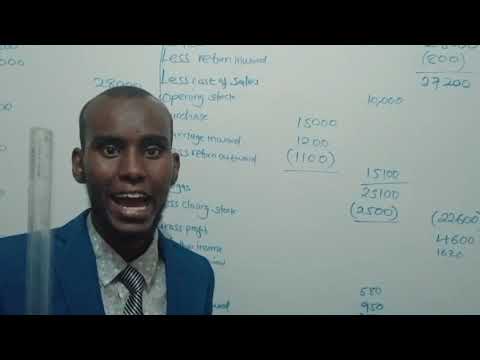
CPA Dekow Mohamed, "Trading Profit And Loss Account for Beginners" (about 7 minutes). Watch how gross profit is found in the trading section and then carried into the profit and loss section to find net profit.
Practice
Sources and credits
Written by Ganzaa: Uwase's trial balance and income statement, the ladder diagram, the tables, the worked examples and the practice items. The businesses, names and figures are illustrative (2026).