Environmental Impact Assessment
Senior 6 · Entrepreneurship
Environmental Impact Assessment
Lesson 2 of 4
25 min
An investor plans a 40-room eco-lodge on the shore of Lake Kivu. The plans are drawn, a loan is almost agreed, and the builders are ready. Then questions start to arrive. Fishing families ask whether they will still be able to reach the beach where they land their boats. The district asks where the sewage will go. A neighbour asks whether the hillside will slide when it is cut for the car park. (An illustrative project.)
Every one of these questions is easier and cheaper to answer on paper, before the first trench is dug, than after the lodge is built. That is the idea behind an environmental impact assessment.
Definition
Environmental impact assessment (EIA): a systematic process of identifying and evaluating the environmental, social and economic impacts of a proposed project before the decision to approve it is made, and of planning how to avoid or reduce the harmful ones. Rwanda's Law N° 48 of 2018 on environment defines it in these terms (Article 2). Because it covers people as well as nature, it is now usually called an environmental and social impact assessment (ESIA).
Example: before the eco-lodge is approved, experts study its effects on the lake water, the hillside, the fishing families and local jobs.
Definition
Mitigation measure: an action that avoids, reduces or repairs a harmful impact, or increases a positive one. Environmental management plan (EMP): the part of an EIA that lists each mitigation measure with who will carry it out, when, at what cost and how it will be checked.
Example: "Build a sewage treatment unit before the lodge opens; responsible: developer; checked by testing the outflow every three months."
Definition
Environmental audit: a systematic check, during and after a project's implementation, of whether it is complying with the law and with the conditions and plans approved in its EIA. Under Article 32 of Law N° 48 of 2018, every project that may have a significant impact on the environment must undergo one. (A strategic environmental assessment is the equivalent study for a government policy, plan or programme: Article 31.)
Example: two years after opening, an auditor checks the lodge's sewage outflow against the limits in its approval conditions.
| Instrument | What it says about EIA |
|---|---|
| Law N° 48 of 2018 of 13 August 2018 on environment | Projects on a list set by Ministerial Order must undergo an EIA before authorisation (Art. 30); projects with significant impact undergo environmental audit during and after implementation (Art. 32); EIAs are approved by the national environment authority or a State organ it authorises in writing (Art. 33); the project initiator pays the consultancy cost (Art. 34) |
| Ministerial Order N° 003/MoE/25 of 19 August 2025 relating to environmental and social impact assessment | The current order on ESIA, cited by the Rwanda Development Board (RDB) as the legal basis of its ESIA procedure |
| Law N° 36 of 2016 of 8 September 2016 establishing the Rwanda Association of Professional Environmental Practitioners (RAPEP) | RAPEP is made up of the environmental practitioners licensed to work in Rwanda and recorded on its register |
| Stakeholder | Role in the EIA |
|---|---|
| Developer (project owner) | Applies, hires and pays a licensed expert, submits the report, carries out the environmental management plan and the conditions of approval |
| Rwanda Development Board (RDB) | Receives the application, visits the site to screen the project, decides the level of assessment, sends terms of reference and a list of experts, reviews the report and issues the certificate with conditions |
| Rwanda Environment Management Authority (REMA) | The national environment authority: may join site visits on complex projects, and is responsible for environmental audit of projects once they are running |
| Licensed EIA experts (RAPEP members) | Carry out the study, collect baseline data, consult the public, predict impacts and write the report and management plan |
| District officials | District environmental and land officers may join the site visit and know local plans and land use |
| Local community and the public | Give their views and local knowledge during consultation, raise concerns, and watch that promises are kept |
Tip
"Assess before, audit after." The EIA looks forward, before the decision to build. The environmental audit looks back, while and after the project runs, to check that the EIA's promises are being kept. RDB leads the first; REMA is responsible for the second.
Worked example 1: who does what for the eco-lodge?
Match each task in the eco-lodge's EIA to the stakeholder responsible.
| Task | Responsible | Why |
|---|---|---|
| Submit the application and project brief | Developer | The project initiator starts the process |
| Visit the shore and decide whether a full EIA is needed | RDB (with district officers) | Screening is the reviewing body's job |
| Measure the lake water quality before building | Licensed EIA expert | Baseline data are part of the study |
| Explain where boats will land after the lodge is built | Community and expert, in consultation | The fishing families know the shore and are affected |
| Pay for the study | Developer | Law N° 48 of 2018, Article 34 |
| Check, two years after opening, that sewage is treated | REMA (environmental audit) | Audits follow implementation |
Worked example 2: is the EIA worth its cost?
The eco-lodge's EIA study costs Frw 6,000,000. It recommends moving the lodge further from the shore and building a sewage treatment unit costing Frw 25,000,000. The investor's accountant estimates that, without these measures, pollution complaints could close the lodge for 3 months, losing Frw 12,000,000 of profit a month, plus a clean-up bill of Frw 20,000,000. (Illustrative figures.)
Cost of acting now:
Possible cost of not acting: , before any fine, and without counting the damage to the lodge's name.
Evaluation: on these figures the EIA and its measures save at least Frw 25,000,000. The comparison is not the whole story: the treatment unit also protects the lake that guests come to see, and without an approved EIA the project could not legally go ahead or obtain its loan at all.
Warning
An EIA is not a form filled in after building. Its whole value comes from being done BEFORE the decision to build, while the design can still change. Nor is an EIA certificate a licence to pollute: it comes with conditions, and breaking them can lead to penalties and, through the environmental audit, to orders to put things right.
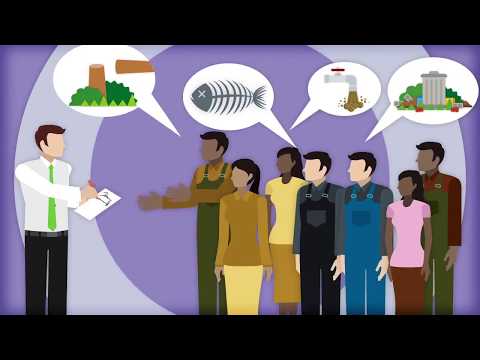
Inter-American Development Bank, "Environmental impact assessments: identifying relevant issues and concerns from the beginning" (about 4 minutes). Watch why the quality of an EIA depends on identifying, at the very start, the environmental and social issues a project may affect, and on talking to the people concerned.
Practice
Sources and credits
Written by Ganzaa: the eco-lodge case, the stakeholder diagram, the tables, the worked examples and the practice items. The project and figures are illustrative (2026).