Compound Interest, Reverse Percentage and Compound Proportional Change
Senior 3 · Mathematics
Compound Interest, Reverse Percentage and Compound Proportional Change
Lesson 2 of 4
25 min
Aline and Bosco each save 100,000 Frw in their SACCO accounts for 5 years at 10% a year (an illustrative rate). Aline's account pays simple interest: 10,000 Frw every year, always on the first 100,000. Bosco's account adds each year's interest to the balance, and the next year's interest is worked out on that bigger balance. After one year they are level; after that, Bosco pulls ahead every year.
| End of year | Aline, simple (Frw) | Bosco, compound (Frw) | Bosco's interest that year (Frw) |
|---|---|---|---|
| 1 | 110,000 | 110,000 | 10,000 |
| 2 | 120,000 | 121,000 | 11,000 |
| 3 | 130,000 | 133,100 | 12,100 |
| 4 | 140,000 | 146,410 | 13,310 |
| 5 | 150,000 | 161,051 | 14,641 |
Definition
Compound interest: interest that is added to the balance at the end of each period, so that interest for the next period is calculated on the principal plus the interest already earned.
Notation: the compounding period is how often interest is added (yearly, half-yearly, monthly). "8% per year compounded annually" means 8% is added once at the end of each year.
Example: 100,000 Frw at 10% compounded annually becomes 110,000 Frw after one year and Frw after two.
Important
The step-by-step method. For each period in turn:
The compound interest earned is the final balance minus the principal.
Worked example 1: three years, year by year
Find the amount and the compound interest when 500,000 Frw is saved for 3 years at 8% per year compounded annually. Compare it with simple interest.
Solution
| Year | Start (Frw) | Interest at 8% (Frw) | End (Frw) |
|---|---|---|---|
| 1 | 500,000 | 40,000 | 540,000 |
| 2 | 540,000 | 43,200 | 583,200 |
| 3 | 583,200 | 46,656 | 629,856 |
Amount 629,856 Frw; compound interest Frw. Simple interest would be Frw, which is 9,856 Frw less.
Worked example 2: the same working with a multiplier
Adding 8% is the same as multiplying by 1.08. So each row of the table is the one before :
In one line: Frw. This is the idea behind the formula in the next lesson.
Worked example 3: a loan with yearly repayments
A cooperative borrows 1,000,000 Frw at 15% per year compounded annually and repays 300,000 Frw at the end of each year, just after the interest is added (illustrative terms). How much does it still owe after 2 years?
Solution The repayments change the balance, so work year by year.
| Year | Start (Frw) | Interest at 15% (Frw) | Repayment (Frw) | End (Frw) |
|---|---|---|---|---|
| 1 | 1,000,000 | 150,000 | 300,000 | 850,000 |
| 2 | 850,000 | 127,500 | 300,000 | 677,500 |
It still owes 677,500 Frw. Of the 600,000 Frw repaid, 277,500 Frw went on interest, so the debt fell by only 322,500 Frw.
Worked example 4: interest added every six months
200,000 Frw is saved at 6% per year, compounded half-yearly. Find the amount after 1 year.
Solution Half-yearly means 2 periods a year at each.
After 6 months: . After 12 months: Frw.
Compounded annually it would be Frw. Adding interest more often earns a little more: 180 Frw here.
Warning
Don't reuse the first year's interest. In Worked example 1, the interest is 40,000 only in year 1. Writing "" is the simple interest method.
Match the rate to the period. 6% per year compounded half-yearly is 3% per half-year, applied twice a year, not 6% applied twice.
Tip
Keep a table. With columns for start, interest, repayment and end, every step is visible, and a mistake in one row is easy to find. Keep full values (do not round) until the final answer.
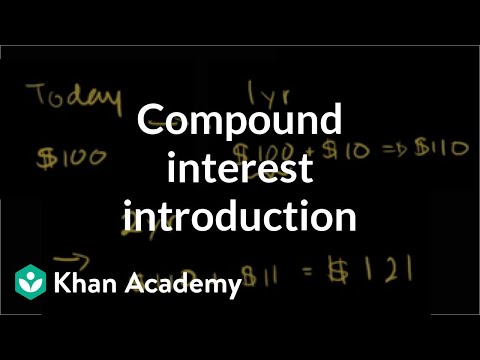
Khan Academy: Compound interest introduction. Watch how the interest earned in one year is added to the balance, so that the next year’s interest is paid on a larger amount, and how this becomes repeated multiplication.
Practice
Use a year-by-year table. The last three are harder.
Sources and credits
The tables, bar chart, worked examples, practice items and quiz questions were written by Ganzaa. Interest rates and loan terms are illustrative, not the rates of any real SACCO or bank.