Resources and Their Usage
Senior 3 · Entrepreneurship
Resources and Their Usage
Lesson 4 of 4
25 min
Kamali and Uwase each make liquid soap in Huye and each spend Frw 200,000 a week on inputs: the same chemicals, water, containers and a helper. Kamali weighs every ingredient, closes his containers, sells the oldest stock first and has trained his helper to fill without spilling. Uwase measures by eye, has one leaking drum, and last month threw away a batch that went off in the heat. At the end of the week Kamali has 400 litres to sell and Uwase has 320.
Nobody gave Kamali more resources. He used the same ones better. This lesson shows how to measure that difference and how an entrepreneur manages each type of resource so that little is wasted. The soap makers and their figures are illustrative.
Definition
Efficiency: producing the greatest output from given resources, or a given output from the fewest resources, with the least waste. Effectiveness: achieving the goal that was intended.
Productivity: output per unit of input,
Sustainable use: using a resource so that it meets today’s needs without reducing what future generations will have.
Example: Kamali is more efficient than Uwase (more soap from the same inputs). A soap maker who makes very cheap soap that nobody wants to buy is efficient but not effective.
| Resource | Effective use | Misuse to avoid |
|---|---|---|
| Natural | take only what is needed; replant trees and restore quarries; harvest rainwater; save water and energy; follow environmental laws and licences | overcutting, overfishing, polluting rivers, leaving pits open |
| Human | recruit people with the right skills; train them; give clear roles; pay fairly and on time; keep the workplace safe; motivate and recognise good work | idle workers, untrained staff, overwork, favouritism |
| Physical | service machines on schedule; use each tool for its purpose; store and secure equipment; insure it; rent out idle equipment; replace what is obsolete | running machines until they break; leaving tools out in the rain |
| Financial | budget; keep records; separate business money from personal money; borrow only for productive uses; collect debts on time; save for emergencies | spending the business’s cash on personal wants; borrowing to pay old debts |
| Time | plan the day and week; set priorities; keep to deadlines; avoid idle time and long queues | late deliveries, unplanned trips |
| Information | keep accurate records; back up data; share it with those who need it; protect customers’ data | lost records, unchecked rumours |
Rwanda applies the top step of the hierarchy, reduce, to the whole country. Law N° 17 of 2019, dated 10 August 2019, prohibits the manufacturing, use, importation and sale of plastic carry bags and single-use plastic items. A few items, such as home-compostable plastics, are allowed only with prior authorisation. It repealed Law N° 57 of 2008, which had banned polythene bags. For businesses the law is both a rule and an opportunity: shops pack goods in paper, cloth or woven bags, and entrepreneurs make and sell those alternatives.

Tip
Memory hook: PMS-R. Every resource needs Planning (how much, when), Maintenance or care (servicing, training, storage), Security (locks, insurance, backups) and Records (so waste can be measured). In an exam, apply the four letters to whichever resource the question names.
Worked example 1: measuring efficiency
Use the opening case. Both makers spend Frw 200,000 on inputs; Kamali makes 400 litres and Uwase 320 litres; both sell at Frw 800 a litre. Compare their productivity, cost per litre and profit.
Step 1: productivity (litres per Frw 1,000 of inputs, so the input is 200 thousand): Kamali ; Uwase .
Step 2: cost per litre: Kamali Frw; Uwase Frw.
Step 3: weekly profit: Kamali Frw; Uwase Frw.
Step 4: interpret. Uwase loses litres, a wastage rate of . The waste costs her Frw of profit every week, more than half of what Kamali earns.
Worked example 2: is maintenance worth paying for?
A maize mill earns a profit of Frw 40,000 a day. Servicing it every month costs Frw 30,000. Without servicing it breaks down about once every 2 months; each breakdown costs Frw 90,000 in repairs and 3 days without milling. Should the owner pay for servicing?
Step 1: cost of one breakdown: Frw.
Step 2: per month, since it happens every 2 months: Frw.
Step 3: compare: servicing costs Frw 30,000 a month, so it saves Frw a month.
Step 4: decide. Pay for servicing. Maintenance looks like a cost, but a machine that stands idle wastes every other resource that depends on it: the miller’s labour, the customers’ time and the business’s reputation. Figures are illustrative.
Warning
Common mistakes. (1) Treating every cost cut as efficiency: skipping servicing or training saves money this month and loses more later. (2) Confusing efficiency with effectiveness: a business can waste nothing and still fail if it makes the wrong product. (3) In calculations, comparing total output when the inputs differ; compare output per unit of input or cost per unit of output.

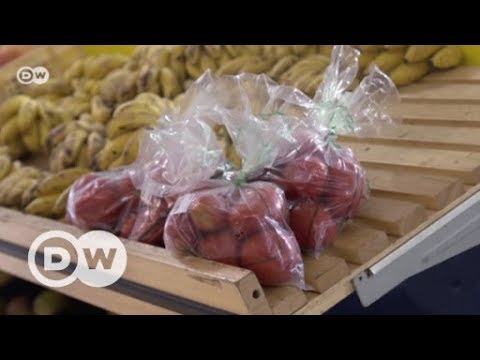
Ten years on: Rwanda’s plastic ban, DW News (about 4 minutes, 2018). Watch for how shops and shoppers changed the way goods are packed, and why the country chose to reduce plastic rather than try to clean it up afterwards.
Discussion: a cooperative has a spare pickup truck that stands idle four days a week. List three ways it could use the truck more effectively, and say which you would choose and why.
Practice
Further reading
Sources and credits
Written by Ganzaa: the soap-maker case, the table of effective use, the waste-hierarchy diagram, the worked examples, the discussion and the practice items. The businesses and figures are illustrative (2026).
This lesson adapts CC BY-SA material and is shared under CC BY-SA 4.0.