The First World War
Senior 3 · History and Citizenship
The First World War
Lesson 2 of 4
25 min
The photograph below was taken by a British army photographer in July 1916, in the first weeks of the Battle of the Somme. Study it for a full minute before reading the caption.

Analysing the source. This trench had been German a few days earlier: the front had moved only a few hundred metres at enormous cost. Only one man is awake; the rest sleep where they fell, because trench life allowed only a few hours of rest at a time. As an official British photograph, it was taken to be shown at home, so it shows no dead and no wounded. It is real, but it is not the whole reality.
Figure 1. The main phases of the First World War, 1914 to 1918.
Definition
Trench warfare: fighting from long systems of ditches dug facing the enemy, where neither side can easily advance.
Stalemate: a situation in which neither side can win or move forward.
No man's land: the ground between the two front lines, which neither side controlled.
War of attrition: a strategy of wearing down the enemy by killing and exhausting more of its soldiers and resources than you lose.
Armistice: an agreement to stop fighting while peace terms are worked out.
Germany's Schlieffen Plan sent its armies through Belgium to take Paris within about six weeks, before Russia was ready. Belgian resistance and the arrival of a British force slowed them down, and at the Battle of the Marne (September 1914) French and British troops stopped the Germans east of Paris. In the east, Germany crushed a Russian army at Tannenberg in August 1914. In the west both sides then tried to outflank each other northwards, the "race to the sea", until by November 1914 a line of trenches ran from the Swiss border to the North Sea.
On the Western Front, machine guns, barbed wire and artillery made defence far stronger than attack. Armies tried to break through with new weapons and ever bigger offensives.
Figure 2. A trench system seen from above (not to scale). The zigzag shape stopped a shell or an enemy in the trench from hitting everyone along a straight line.
| Battle | Dates | What happened |
|---|---|---|
| Second Ypres (Belgium) | April to May 1915 | Germany used poison gas (chlorine) on a large scale for the first time. |
| Gallipoli (Ottoman Empire) | 1915 to January 1916 | An Allied landing to reach Russia by sea failed and was withdrawn. |
| Verdun (France) | 21 February to 18 December 1916 | The longest battle of the war: Germany tried to wear down the French army; France held on. |
| The Somme (France) | 1 July to 18 November 1916 | On the first day alone the British army suffered 57,470 casualties, 19,240 of them killed, according to the British official history. Tanks were used for the first time in September. |
At sea, Britain blockaded Germany, and German submarines (U-boats) sank ships bringing food to Britain, including the liner Lusitania on 7 May 1915 with many Americans on board.
In February 1917 Germany began to sink every ship near Britain without warning. This, and a German telegram offering Mexico an alliance against the United States, brought the USA into the war on 6 April 1917, with its huge resources. In the same year Russia was torn by two revolutions; in November the Bolsheviks took power and asked for peace. In the west, the British offensive at Passchendaele (July to November 1917) gained a few kilometres of mud.
Russia left the war by the Treaty of Brest-Litovsk (3 March 1918). Germany moved its eastern armies west and launched a great Spring Offensive on 21 March 1918, which came close to Paris but ran out of men and supplies. From 8 August the Allies, now with fresh American troops and many tanks, attacked in the Hundred Days Offensive. Germany's allies surrendered one by one, the Kaiser abdicated on 9 November, and the armistice came into force at 11 a.m. on 11 November 1918.
Germany had four colonies in Africa, and the Allies attacked all of them: Togoland fell in August 1914, Kamerun by 1916 and German South West Africa in 1915. The longest campaign was in German East Africa, which then included Rwanda and Burundi. There the German commander Paul von Lettow-Vorbeck fought a guerrilla war with African soldiers (askari) and surrendered only on 25 November 1918, two weeks after the armistice in Europe.
From the Belgian Congo, the Belgian colonial army, the Force Publique, attacked from the west. Its campaign began on 18 April 1916 under General Charles Tombeur; it captured Kigali on 6 May 1916, and by 17 June Rwanda and Burundi were occupied. It went on to take Tabora on 19 September 1916. As you learned in Senior 2, this was the start of Belgian rule in Rwanda.
The war in East Africa was fought on foot, through bush and swamp, and every load was carried on people's heads. By 1917 about a million Africans had been conscripted as carriers across the campaign, and the historian Hew Strachan estimates that about 90,000 African porters died in British service alone, mostly from disease, hunger and exhaustion.

Worked example: explaining a stalemate
Question: Explain why the war on the Western Front became a stalemate after 1914. (6 marks)
Conclusion: until tanks, aircraft and new tactics were combined in 1918, attacks could not break through.
Tip
Four years, four words: 1914 movement, 1915 to 1916 stalemate, 1917 turning point, 1918 endgame. Hang each battle on its year.
Warning
It was a world war. Don't write only about the Western Front. It was fought in eastern Europe, the Middle East, at sea and in Africa, and soldiers and carriers came from Africa, India, Australia, Canada and beyond. Include Africa in your answers.
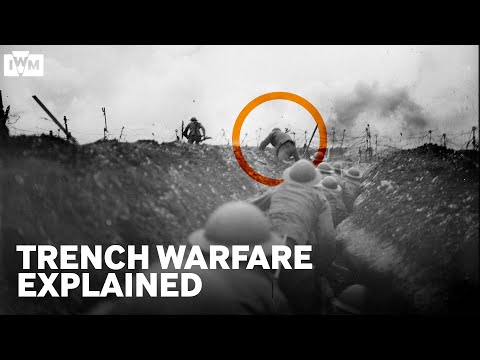
Imperial War Museums, "Life in the Trenches WW1 | Trench Warfare Explained". Watch for why trenches were dug, how a trench system was laid out (compare Figure 2) and how the deadlock was broken in 1918.
Monuments to the First World War usually show soldiers. Very few remember the African carriers, although far more of them died in East Africa than soldiers. Why do you think the carriers were forgotten, and how could Rwanda and its neighbours remember them?
Practice
Sources and credits
This lesson adapts CC BY-SA material and is shared under CC BY-SA 4.0.