Alternating Current
Senior 6 · Physics
Alternating Current
Lesson 1 of 4
25 min
Look at the rating plate on a kettle or a phone charger sold in Rwanda and you will find the symbol ~ next to the voltage. It means alternating. Rwanda's mains supply is 230 V at 50 Hz (REG designs its low-voltage network for 400 V/230 V, and the Rwanda Grid Code sets a nominal frequency of 50 Hz, normally held between 49.5 Hz and 50.5 Hz): the voltage between the live and neutral pins reverses direction 100 times a second, and it is not 230 V for most of that time. Its highest value is about 325 V. So what is the "230"? In Unit 3 you showed that a coil turning in a magnetic field gives . This lesson gives you the language for such quantities (peak, period, phase and phasor) and answers the question: what single number fairly describes a voltage that never stays still?
An AC generator, a signal generator in the laboratory and the national grid all produce voltages that vary sinusoidally with time:
Each symbol has a name and a meaning:
| Symbol | Name | Meaning and unit |
|---|---|---|
| instantaneous value | the voltage at the instant , in V | |
| peak value (amplitude) | the greatest value of , in V | |
| peak-to-peak value | from a crest to a trough, in V | |
| period | the time for one complete cycle, in s | |
| frequency | cycles per second, in Hz | |
| angular frequency | in | |
| phase | the angle that fixes where in its cycle the quantity is, in rad | |
| phase constant | the phase at , in rad |
Figure 1.1: An alternating voltage. Its peak is , its peak-to-peak value is , and one cycle takes a period .
Definition
An alternating current (AC) is a current that reverses its direction periodically. A sinusoidal current has the form , where is the peak value and is the angular frequency. Two sinusoids of the same frequency with phase constants and have a phase difference ; the one with the larger phase leads. Example: has and .
Worked example 1: reading a sinusoid
The mains voltage can be written , with in seconds. (a) State the peak value and find the frequency and period. (b) Find at . (c) Find the first two times after at which .
Solution
(a) . , so and .
(b) The phase is (45°). So (3 s.f.). Your calculator must be in radians for this step.
(c) , so or . Then and . There are two answers because the voltage passes 162.5 V once on the way up and once on the way down.
Adding sine curves point by point is slow. Engineers use a neater picture. Draw an arrow of length from the origin and let it turn anticlockwise at the angular velocity . At time it makes the angle with the horizontal reference line, and its vertical component is : exactly the instantaneous value . The rotating arrow is called a phasor.
Figure 1.2: As the phasor turns, the height of its tip traces out the sine wave. The marked point is at .
When several quantities have the same frequency, their phasors all turn together, so the angles between them never change. We therefore draw them at one instant, usually , and the diagram stays true for all time. A quantity that leads by is drawn anticlockwise from the reference; one that lags is drawn clockwise. Because the vertical component of a vector sum is the sum of the vertical components, adding sinusoids of the same frequency is the same as adding their phasors as vectors. This is the key idea of Lessons 2 and 3.
Definition
A phasor is a vector whose length equals the peak (or rms) value of a sinusoidal quantity and whose angle from a reference direction equals the quantity's phase. Phasors rotate anticlockwise at ; the sinusoid is the projection of the phasor on the vertical axis. Example: is a phasor of length 12 V drawn anticlockwise from the reference.
Worked example 2: adding two voltages with phasors
Two components in series have voltages and , in volts. Find the total voltage in the form .
Figure 1.3: Adding the phasors of and nose to tail.
Solution
leads by , so its phasor is at right angles to that of . By Pythagoras, . The phase angle is . So
Check at : , and . Note that the peak of the sum (5.0 V) is less than , because the two peaks happen at different times.
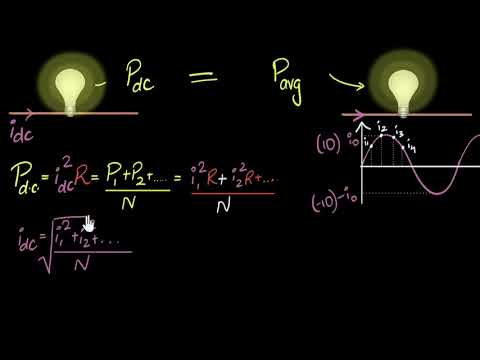
Over a whole cycle a sinusoidal current flows forwards as much as backwards, so its mean value is zero. A moving-coil meter reading the mean would show nothing, yet the current plainly heats a kettle. For heating, the direction does not matter: the power in a resistor is , and is never negative.
For in a resistance , the instantaneous power is . Using , the mean of over one period is
since . So the mean power is . A steady direct current gives the same heating if , that is
Figure 1.4: The mean of is , so the "root of the mean of the square" is .
The name says how to compute it for ANY waveform: square the current, take the mean over a cycle, then take the square root, . The factor holds only for a sinusoid.
Rectifier circuits use the mean of one half-cycle:
AC voltmeters and ammeters are scaled to read rms values, and every AC rating ("230 V", "13 A fuse") is an rms value unless it says otherwise.
Definition
The root mean square (rms) value of an alternating current is the value of the steady direct current that would dissipate heat at the same average rate in the same resistor. For a sinusoid, and . Example: the 230 V mains has a peak of .
Worked example 3: a 2.0 kW kettle
A kettle is rated 2.0 kW, 230 V. Find (a) the rms current, (b) the peak current, (c) its resistance and (d) the greatest instantaneous power it takes.
Solution
(a) The rating is an average power and an rms voltage: .
(b) .
(c) . (Dividing 230 V by the rounded 8.70 A gives 26.4 Ω; always work from unrounded values.)
(d) The power peaks when and peak together: . The power swings between 0 and 4.0 kW, 100 times a second, and averages 2.0 kW: the mean power is half the peak power.
Worked example 4: a waveform that is not a sine
Figure 1.5: A rectangular alternating current.
Find (a) the mean value and (b) the rms value of the current in Figure 1.5.
Solution
One cycle lasts .
(a) . The charge sent forwards equals the charge sent back.
(b) , so .
Using would be wrong: that shortcut is for sinusoids only.
Aim: to measure the peak value, rms value and frequency of an alternating voltage, and to test .
Apparatus: a signal generator (or the low-voltage AC outlet of a laboratory power pack), a cathode-ray or digital oscilloscope, a digital multimeter set to AC volts, connecting leads.
Method:
Figure 1.6: A trace from the experiment.
Reading Figure 1.6: peak-to-peak height = 5.6 div, so and . One cycle spans 5.0 div, so and . Measuring peak to peak and halving is more precise than measuring from the centre line, because the trace's thickness and any offset cancel.
Warning
Safety. Never connect an oscilloscope, or any student apparatus, to the mains. Use only a signal generator or a laboratory supply of 12 V or less. The mains peak of 325 V can kill, and an oscilloscope's earthed input lead can short a live circuit.
Warning
Common mistakes. (1) Calculator in degrees when the phase is radians. (2) Taking the peak-to-peak height as : halve it first. (3) Using for square, triangular or rectified waves; go back to . (4) Saying the mean of a sinusoidal current is : that is the mean of a HALF-cycle; over a full cycle it is zero.
Tip
Remember the chain: peak × 0.707 = rms, and rms × 1.414 = peak. If the question mentions heating, power or a meter reading, it wants rms. If it mentions insulation, breakdown or the height of a trace, it wants the peak.
What is RMS value? (Khan Academy India). Watch how the heating effect of a current leads to the root-mean-square value, and why it is the peak divided by √2 only for a sine wave.
Practice
Key points
Sources and credits
The experiment, the six diagrams, the worked examples and the practice exercises are written by Ganzaa.