Atmospheric Pressure and Archimedes' Principle
Senior 3 · Physics
Atmospheric Pressure and Archimedes' Principle
Lesson 2 of 5
25 min
Many smartphones contain a pressure sensor smaller than a grain of rice. Climb three floors of a school building, about 10 m, and a fitness app records "3 floors climbed". It knows because the air pressure at the top of the stairs is lower, by roughly , about a thousandth of the whole atmospheric pressure. Measuring pressure that precisely is a modern achievement. This lesson follows how it is done, from the mercury barometer to the metal box inside an aneroid barometer, and how a manometer compares a gas's pressure with the air's.
In S2 you saw that the atmosphere holds up a column of mercury in an inverted tube, with a vacuum above it, so that
where is the vertical height of the mercury column, and . The same rule tells you how tall a barometer made with any other liquid would have to be.
Worked example 1: a barometer on Karisimbi
At the summit of Karisimbi, a mercury barometer stands at 432 mm. Find the atmospheric pressure.
This is only 57% of the sea-level value.
Worked example 2: a water barometer in Kigali
How tall a column of water () could the atmosphere hold up in Kigali, where ?
A water barometer would need a tube taller than a two-storey house. This number also sets the limit for the lift pump in lesson 3.
Warning
Mercury is poisonous. Its vapour damages the nervous system and kidneys. Pupils must never touch spilt mercury or a broken mercury barometer or thermometer: move away, keep others out, open the windows and tell a teacher, who must follow the school's spill procedure. Never sweep up or vacuum spilt mercury; that spreads its vapour through the room. This is why most schools and weather stations now use aneroid or electronic barometers.
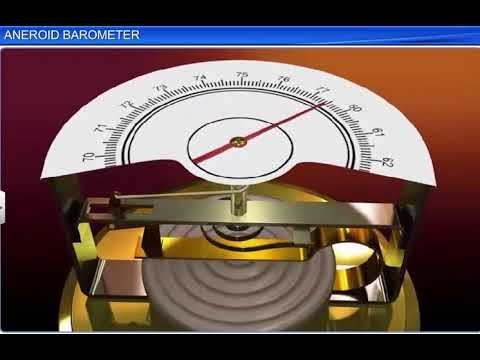
"Aneroid" means "without liquid". The heart of the instrument is a thin, flat, corrugated metal box from which most of the air has been pumped out. A strong spring stops the atmosphere from crushing it flat.
An aneroid barometer must be calibrated against a mercury or electronic standard, and a good one is adjusted for the height of the place where it hangs.
Definition
Barometer: an instrument that measures atmospheric pressure. A mercury barometer balances the atmosphere against a column of mercury; an aneroid barometer measures how much the atmosphere squeezes a partly evacuated metal box.
Altimeter: an aneroid barometer whose scale is marked in metres of height instead of units of pressure, used in aircraft and by climbers.

| Mercury barometer | Aneroid barometer | |
|---|---|---|
| Accuracy | Very accurate: a standard for checking others | Less accurate; must be calibrated |
| Size and transport | Tall (about 1 m), fragile, must stay upright | Small, robust, works in any position |
| Safety | Contains poisonous mercury | No liquid at all |
| Uses | Laboratories, calibration | Homes, ships, aircraft altimeters, hikers' watches |
Worked example 3: reading an altimeter
During a climb, an aneroid barometer's reading falls from 840 hPa to 810 hPa. Taking the air's average density as , estimate the height climbed.
An altimeter does this calculation for you, using a scale drawn from the standard atmosphere.
A U-tube manometer compares the pressure of a gas with the atmospheric pressure acting on its open arm. In S2 you used one on a biogas digester, where the gas pressure was higher than atmospheric and pushed the liquid down on the gas side: . If the gas pressure is lower than atmospheric, for example in a flask that is being pumped out, the atmosphere pushes the liquid up on the gas side instead:
Worked example 4: a flask being emptied
A mercury manometer is joined to a flask that is being pumped out. The mercury stands 250 mm higher in the arm joined to the flask. Atmospheric pressure is 84 kPa. Find the pressure of the gas in the flask.
Worked example 5: how hard can you blow?
A pupil blows into one arm of a water manometer and holds the water 45 cm lower on her side than on the open side. Find (a) the gauge pressure of her breath; (b) its absolute pressure in Kigali.
The gauge pressure is the pressure above atmospheric; the absolute pressure includes the atmosphere.
A tyre-pressure gauge or the dial on a gas cylinder (a Bourdon gauge, in which a curved tube straightens as the pressure inside it rises) reads gauge pressure, the excess over atmospheric. A tyre gauge reading 2.2 bar in Kigali means the absolute pressure in the tyre is about .
Tip
Which side is the gas? In a manometer the liquid is always pushed away from the higher pressure. Liquid lower on the gas side: . Liquid higher on the gas side: .
Aneroid barometer (Shiksha House, Best for NEET). A 3D animation of the vacuum box, spring, levers and pointer; watch how a small movement of the box becomes a large swing of the pointer.
Practice
Key points
Sources and credits
Written by Ganzaa: the lesson text, the aneroid and manometer diagrams, the table, worked examples and practice exercises.