Nature of Particles and Their Interactions
Senior 6 · Physics
Nature of Particles and Their Interactions
Lesson 1 of 5
25 min
In Senior 5 you met Rutherford's discovery: alpha particles bouncing back from gold foil revealed a tiny, hard nucleus inside the atom. In 1968, at the Stanford Linear Accelerator Center (SLAC) in California, physicists repeated the idea one level down. They fired electrons of up to about 17 GeV at protons. Far more electrons were scattered through large angles than a smooth, uniform proton would allow. Just as in 1911, the result meant that something small and hard was inside: the proton is not a fundamental particle but a bound group of smaller ones, now called quarks. In Unit 5 you treated the proton and neutron as building blocks. This unit asks what THEY are made of, and what holds everything together.
Figure 1.1: Each level of structure is found inside the one before.
A particle is called fundamental (or elementary) if no experiment has found any internal structure in it. Today the electron and the quarks are fundamental: collisions at the highest energies show no size for them down to about m. The proton and neutron are not: they have a size of about 1 fm and contain quarks.
| Year | Discovery | By |
|---|---|---|
| 1897 | electron | J. J. Thomson |
| 1919 | proton identified in nuclear reactions | E. Rutherford |
| 1932 | neutron; positron (the first antiparticle) | J. Chadwick; C. D. Anderson |
| 1936–1947 | muon; pion, found in cosmic rays | Anderson and Neddermeyer; Powell's group |
| 1956 | neutrino detected | C. Cowan and F. Reines |
| 1964 | quarks proposed | M. Gell-Mann; G. Zweig |
| 1968 | evidence for quarks inside the proton | SLAC–MIT experiment |
| 1983 | W and Z bosons | CERN |
| 1995 | top quark | Fermilab |
| 2012 | Higgs boson | ATLAS and CMS at CERN |
By the 1960s hundreds of short-lived particles had been found in cosmic rays and accelerators, a confusing "particle zoo". The quark model brought order to it, much as the periodic table brought order to the elements.
Figure 1.2: A family tree of particles.
Particles are sorted in two ways. By spin (their intrinsic angular momentum, in units of ): fermions have half-integer spin (, , ...) and obey Pauli's exclusion principle, so they make up matter; bosons have whole-number spin (0, 1, 2, ...) and include the particles that carry forces. And by which forces they feel: leptons do not feel the strong force; hadrons do.
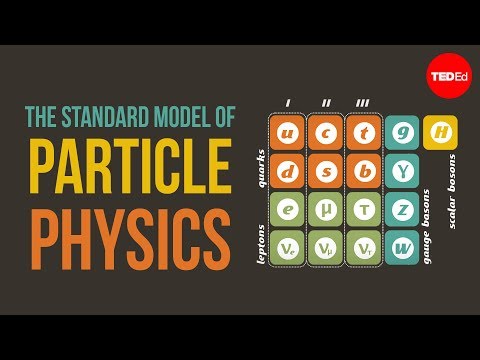
Leptons are fundamental fermions that do not feel the strong force. They come in three generations, each a charged lepton with its own neutrino:
| Generation | Charged lepton | Mass / MeV | Mean life | Neutrino |
|---|---|---|---|---|
| 1 | electron | 0.511 | stable | |
| 2 | muon | 105.66 | s | |
| 3 | tau | 1776.93 | s |
Each charged lepton has charge ; the neutrinos are neutral and have tiny masses (less than 0.45 eV, from tritium beta decay). The muon and tau behave like heavy electrons and decay into lighter particles.
Quarks are fundamental fermions that DO feel the strong force. Their charges are fractions of :
| Quark | Symbol | Charge | Mass | Generation |
|---|---|---|---|---|
| up | u | 2.16 MeV | 1 | |
| down | d | 4.70 MeV | 1 | |
| charm | c | 1.273 GeV | 2 | |
| strange | s | 92.9 MeV | 2 | |
| top | t | 172.6 GeV | 3 | |
| bottom | b | 4.186 GeV | 3 |
All masses and lifetimes on this page are from the Particle Data Group's Review of Particle Physics, 2026 edition, rounded. The light quark masses are not measured directly, because no quark can be isolated.
Quarks are never found alone: they are always bound into hadrons. This is called quark confinement. There are two kinds:
An antiquark (written with a bar, ) has the opposite charge to its quark: has . Antiparticles are the subject of Lesson 2. The only stable hadron is the proton; a free neutron decays with a mean life of 878 s.
Definition
A lepton is a fundamental fermion that does not feel the strong force (e, μ, τ and their neutrinos). A quark is a fundamental fermion with fractional charge that feels the strong force. A hadron is a particle made of quarks: a baryon has three quarks, a meson a quark and an antiquark. Example: the proton is a baryon (uud); the is a meson ().
Worked example 1: charges from quarks
Show that the quark models of the proton (uud) and neutron (udd) give the right charges.
Solution
Proton: , in units of .
Neutron: .
The neutron has no overall charge, but it contains charged quarks. This is why a neutron has a magnetic moment and why fast electrons scatter from charges inside it.
Worked example 2: naming a particle from its quarks
Find the charge of each combination and say whether it is a baryon or a meson: (a) uds; (b) ; (c) sss; (d) .
Solution
(a) : a neutral baryon, the .
(b) (the antiquark has ): a positive meson, the .
(c) : a negative baryon, the .
(d) : a negative meson, the .
Worked example 3: where does the proton's mass come from?
Compare the total mass of the three quarks in a proton with the proton's mass, 938.27 MeV. What does the result tell you?
Solution
, which is of the proton's mass.
About 99% of the proton's mass is not the mass of its quarks at all. It is the energy of the fast-moving quarks and of the gluon field that binds them, counted as mass through . In Unit 5 binding made a nucleus LIGHTER than its parts; inside a proton the confined quarks' energy makes the whole far HEAVIER than its parts. So most of the mass of your body is energy of the strong force.
Warning
Common mistakes. (1) "Leptons are light particles": the tau (1777 MeV) is almost twice as heavy as a proton. The test is which force a particle feels, not its mass. (2) Calling the proton or neutron fundamental: both contain quarks. (3) Forgetting that an antiquark has the OPPOSITE charge: is . (4) Saying a meson has two quarks: it has one quark and one ANTIquark. (5) Thinking a neutral particle contains no charge: the neutron (udd) and (uds) contain charged quarks.
Tip
Quark charges follow a simple pattern: the "upper" quarks u, c, t are ; the "lower" quarks d, s, b are . A baryon's charge is just the sum of its three quark charges, so a baryon made only of d, s and b quarks has charge .
What's the smallest thing in the universe? by Jonathan Butterworth (TED-Ed). Watch how each level of structure, from atoms to quarks, was found by looking at smaller and smaller distances with more and more energetic probes.
Practice
Key points
Sources and credits
The two diagrams, the worked examples and the practice exercises are written by Ganzaa.