Heterotrophic Nutrition
Senior 3 · Biology
Heterotrophic Nutrition
Lesson 3 of 5
25 min
Astronauts on the International Space Station eat and swallow normally, although there is no "down" for the food to fall. You could even swallow a mouthful of water while hanging upside down (not recommended). Food is not dropped into your stomach: it is pushed there by muscles in the wall of the gut. This lesson follows a mouthful from your lips to your stomach.
Definition
Alimentary canal (gut): the muscular tube that runs from the mouth to the anus. In a living adult it is about 5 metres long, two-thirds of it small intestine.
Digestion: the breakdown of large, insoluble food molecules into small, soluble ones that can be absorbed. Mechanical digestion breaks food into smaller pieces (chewing, churning); chemical digestion breaks the molecules themselves, using enzymes.
Peristalsis: waves of muscle contraction that pass along the wall of the gut and push the food along.
Sphincter: a ring of muscle that closes a tube, such as the one at the exit of the stomach.
Food passes through the alimentary canal: mouth, oesophagus, stomach, small intestine (duodenum, then ileum), large intestine (colon), rectum and anus. Three associated organs, the liver, gall bladder and pancreas, pour their juices into the gut through ducts, but food never passes through them.
Figure 1: The human digestive system, seen from the front. As in every anatomy diagram, the body's right side is on your left, so the liver appears on the left of the picture and the stomach on the right.
| Part | Main job |
|---|---|
| Mouth, teeth, tongue and salivary glands | Chewing; saliva starts the digestion of starch |
| Oesophagus (gullet) | Carries food to the stomach by peristalsis |
| Stomach | Stores and churns food; protein digestion starts |
| Liver | Makes bile |
| Gall bladder | Stores bile and releases it into the duodenum |
| Pancreas | Makes pancreatic juice, rich in enzymes |
| Duodenum | First part of the small intestine; receives bile and pancreatic juice |
| Ileum | Finishes digestion and absorbs the products |
| Large intestine (colon) | Absorbs water and mineral salts |
| Rectum and anus | Store faeces, then egest them |
The caecum and appendix, where the small intestine joins the large, play little or no part in digestion in humans; in a cow or a rabbit the caecum is large and full of microbes that digest cellulose.
Teeth chew the food and the tongue mixes it with saliva from three pairs of salivary glands, between half a litre and a litre and a half a day. Saliva contains:
When you swallow, the tongue pushes the bolus to the back of the throat, and a flap, the epiglottis, closes the entrance to the windpipe so food does not "go down the wrong way".
The wall of the oesophagus has two layers of muscle: circular muscles, which squeeze the tube narrower, and longitudinal muscles, which shorten it. A wave of contraction just behind the bolus pushes it along, while the muscles in front relax. The same peristalsis moves food through the whole gut.
Figure 2: Peristalsis in the oesophagus.
Worked example 1: saliva and starch
A class set up three test tubes at 37 °C, each with 5 cm³ of starch solution. Tube A got 1 cm³ of amylase solution, tube B 1 cm³ of amylase that had been boiled, and tube C 1 cm³ of water. Every minute a drop from each tube was tested with iodine solution on a spotting tile. (Illustrative results.)
| Time (min) | A: amylase | B: boiled amylase | C: water |
|---|---|---|---|
| 0 | blue-black | blue-black | blue-black |
| 2 | blue-black | blue-black | blue-black |
| 4 | brown | blue-black | blue-black |
| 6 | brown | blue-black | blue-black |
The stomach is a muscular bag that can hold over a litre of food. Its wall contains gastric glands that make gastric juice, and three layers of muscle that churn the food and mix it with the juice. The food stays for a few hours and becomes a creamy liquid, chyme.
| Part of gastric juice | What it does |
|---|---|
| Hydrochloric acid (pH about 2) | Kills most bacteria in the food; gives the acid pH that pepsin needs |
| Pepsin, a protease | Digests proteins into shorter chains called polypeptides. It works best in acid |
| Mucus | Coats the stomach wall and protects it from the acid and from pepsin |
Pepsin is made in an inactive form and becomes active only in the acid of the stomach cavity, which, with the mucus, stops the stomach digesting itself. The acid also stops salivary amylase from working, so starch digestion pauses in the stomach. Little is absorbed here except water, alcohol and some medicines. Every so often the pyloric sphincter at the exit relaxes and lets a little chyme into the duodenum.
Worked example 2: what does pepsin need?
Egg white was boiled and mixed with water to make a cloudy suspension of protein. Equal volumes were put into four tubes and kept at 37 °C. After 20 minutes: (illustrative results)
| Tube | Contents | After 20 min |
|---|---|---|
| 1 | egg white + pepsin + dilute hydrochloric acid | clear |
| 2 | egg white + pepsin + water | slightly cloudy |
| 3 | egg white + dilute hydrochloric acid | cloudy |
| 4 | egg white + boiled pepsin + dilute hydrochloric acid | cloudy |
Warning
Common mistakes. (1) Saying food passes through the liver or pancreas: it does not; they only send juices into the duodenum. (2) Saying pepsin digests protein into amino acids: it makes polypeptides; amino acids come later, in the small intestine. (3) Saying the stomach acid digests food: the acid kills bacteria and activates pepsin; the enzyme does the digesting. Safety: in experiments, dilute hydrochloric acid is an irritant; wear eye protection and wash off any splashes.
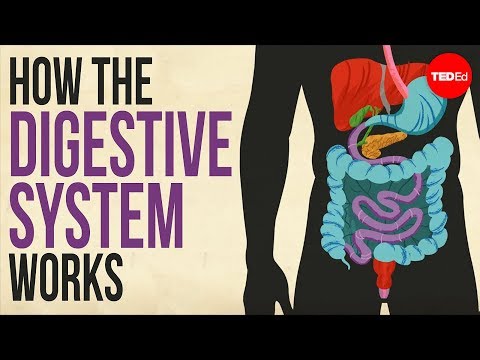
How your digestive system works, Emma Bryce, TED-Ed. Watch the whole journey once; for this lesson, note what happens in the mouth and stomach, and how long food stays in each part.
Tip
Memory hook: the order of the canal. "Many Old Soldiers Drink In Cool Rooms Alone": mouth, oesophagus, stomach, duodenum, ileum, colon, rectum, anus.
Practice: from mouth to stomach
Key points
Sources and credits
Written by Ganzaa: the text, Figures 1 and 2, the tables, the worked examples (illustrative results) and the practice questions.