The Second World War
Senior 3 · History and Citizenship
The Second World War
Lesson 2 of 5
25 min
Counted from the German invasion of Poland on 1 September 1939 to Japan's formal surrender on 2 September 1945, the Second World War lasted six years and a day. It was fought in two main theatres: Europe and North Africa, where Germany and Italy were the main Axis powers, and Asia and the Pacific, where Japan fought China, the United States and the British Empire. Study the timeline before you read on.
Figure 1. The war at a glance. The band is drawn to scale, one month to about 7 pixels.
Reading the timeline. In phase 1 every arrow of the war points the Axis way. Phase 2 is short but decisive: in six months Germany attacked the Soviet Union and Japan attacked the United States, so the two strongest powers outside the Axis entered the war. In phase 3 the Axis advance was stopped on land, at sea and in the desert, and in phase 4 the Allies closed in on Germany and Japan from several sides. Historians divide the war in slightly different ways, but most agree on these turning points.
Definition
Theatre of war: a large region in which fighting takes place, such as the Pacific theatre.
Blitzkrieg ("lightning war"): fast attacks by tanks, motorised infantry and dive-bombers working together, to break through the enemy's line before it can react.
Front: a line along which two armies face each other. The Eastern Front was the war between Germany and the Soviet Union.
Turning point: an event after which the course of a war changes direction for good.
Amphibious landing: an attack in which troops come ashore from the sea.
On 22 June 1941 Germany broke the Nazi–Soviet Pact and invaded the Soviet Union with more than 3.8 million Axis soldiers (Operation Barbarossa), on a front about 2,900 kilometres long. By December German troops were close to Moscow, but the Soviet army counter-attacked in the freezing winter, and the quick victory Hitler expected never came.
On 7 December 1941 Japanese aircraft carriers attacked the American naval base at Pearl Harbor, in Hawaii. Japan wanted to destroy the American fleet so that it could seize the oil, rubber and tin of South-East Asia, after the United States had stopped selling it oil. All eight American battleships in the harbour were damaged and four were sunk. The United States declared war on Japan the next day, and on 11 December Germany and Italy declared war on the United States. In the next months Japan conquered Hong Kong, Malaya, Singapore (15 February 1942), the Philippines, the Dutch East Indies and Burma.

On 6 June 1944, "D-Day", American, British, Canadian and other Allied troops landed on the beaches of Normandy in northern France: the largest amphibious landing in history. Paris was liberated on 25 August 1944. In the east, a vast Soviet offensive in the summer of 1944 destroyed a whole German army group. Germany's last attack in the west, in the Ardennes in December 1944, failed. With Soviet troops in Berlin, Hitler killed himself on 30 April 1945, and Germany surrendered on 8 May 1945, "Victory in Europe Day".

In the Pacific, American forces advanced from island to island towards Japan, while British, Indian and African troops drove the Japanese out of Burma. Japan fought on even after Germany fell. On 6 August 1945 the United States dropped an atomic bomb on Hiroshima, and on 9 August a second on Nagasaki. The two bombs killed an estimated 150,000 to 246,000 people, most of them civilians. On 8 August the Soviet Union declared war on Japan and invaded Manchuria. Emperor Hirohito announced Japan's surrender on 15 August, and the formal surrender was signed on 2 September 1945.

We hereby proclaim the unconditional surrender to the Allied Powers of the Japanese Imperial General Headquarters and of all Japanese armed forces and all armed forces under the Japanese control wherever situated.
Source D. Instrument of Surrender, signed in Tokyo Bay, 2 September 1945. Text: the Avalon Project, Yale Law School.
Worked example: explaining a turning point
Question: Explain why the Battle of Stalingrad was a turning point of the Second World War. (6 marks)
Step 1. What happened. The German Sixth Army attacked Stalingrad in August 1942, was surrounded by a Soviet counter-attack, and surrendered on 2 February 1943.
Step 2. Why it mattered militarily. Germany lost a whole army that it could not replace, and never again launched a major successful offensive in the east.
Step 3. Why it mattered for morale. It ended the idea that the German army could not be beaten, and gave hope to the Allies and to resistance movements in occupied Europe.
Step 4. What followed. After Kursk in July 1943 the Red Army advanced steadily west, until it reached Berlin in April 1945.
Tip
One word per phase: Lightning (1939 to 1941), Widening (1941 to 1942), Turning (1942 to 1943), Closing in (1944 to 1945). Then hang three events on each word.
Warning
Keep the two theatres apart. The war in Europe ended on 8 May 1945; the war in Asia went on until Japan's surrender, announced on 15 August and signed on 2 September 1945. The atomic bombs were dropped on Japan, not Germany, three months after Germany had surrendered.
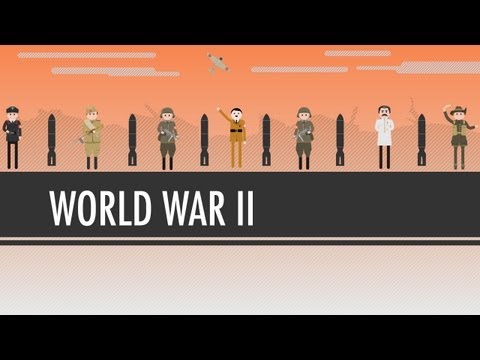
Crash Course World History: "World War II". Watch for the two main theatres and the turning points of 1942 and 1943, and compare the video's account with the timeline in Figure 1.
The atomic bombings ended the war quickly but killed tens of thousands of civilians in an instant. Historians still debate whether they were necessary. What questions would you need to answer before you could judge? Think about the laws of war you met in Unit 4, and about who decides what is "necessary".
Practice
Sources and credits
This lesson adapts CC BY-SA material and is shared under CC BY-SA 4.0.