Chemical Equilibrium
Senior 6 · Chemistry
Chemical Equilibrium
Lesson 4 of 5
25 min
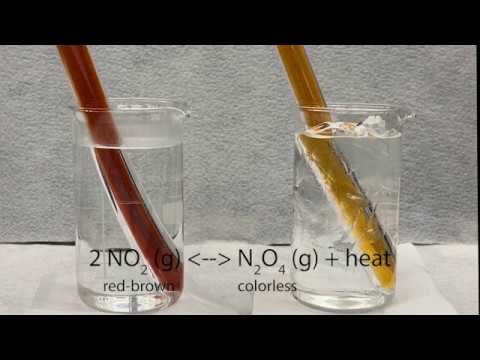
The photograph below shows the same sealed glass ampoule of nitrogen dioxide photographed at five temperatures. Nothing can get in or out, yet the gas is almost colourless when cold and deep red-brown when warm. Brown and colourless are in equilibrium:
So warming the ampoule must change the equilibrium mixture in favour of . Squeezing the gas into a smaller volume changes it too, and so does adding more of one substance. In 1884 the French chemist Henry Le Chatelier summed up all such changes in one rule. In this lesson you will use the rule to predict, and and to explain, what happens.

Definition
Le Chatelier's principle: if a system at equilibrium is disturbed by a change in concentration, pressure or temperature, the position of equilibrium shifts in the direction that tends to oppose the change.
Shift of equilibrium: a net reaction in one direction after a disturbance, until equilibrium is re-established. "Shifts to the right" means more products form. Example: heating the ampoule shifts to the right.
Endothermic direction: the direction of a reversible reaction that absorbs heat (); the reverse direction is exothermic by the same amount. Example: is endothermic, so is exothermic, .
Mix very dilute iron(III) and thiocyanate solutions and you get a pale orange-red solution of . A few drops of concentrated iron(III) chloride make it deeper red: the equilibrium has shifted right, using up some of the added .
Why, in terms of and : adding increases a term on the bottom of
so falls below . Net forward reaction follows until again. itself has not changed. Adding a product, or removing a reactant, makes and shifts the equilibrium left.
Figure 4.1 follows the mixture at 25 °C in a sealed syringe when the plunger is pushed in to halve the volume. The numbers come from (Lesson 3).
Figure 4.1: Compressing an equilibrium mixture of and at 25 °C.
Halving the volume doubles every partial pressure, to 63.6 kPa of and 136.4 kPa of . Then
so the net reaction goes backwards, , until and . Two gas molecules become one, so the total pressure drops from 200 to 191 kPa: the system has partly opposed the rise in pressure. In general:
Temperature is different: it changes the value of itself. Raising the temperature favours the endothermic direction, which absorbs the added heat. Table 4.1 shows the effect on , whose forward reaction is endothermic.
| Temperature / °C | 0 | 25 | 50 | 75 | 100 |
|---|---|---|---|---|---|
| / kPa | 1.80 | 14.8 | 88.5 | 408 | 1530 |
Table 4.1: for , calculated from thermodynamic data.
For an endothermic forward reaction, increases with temperature and the yield of products rises. For an exothermic forward reaction, such as ammonia synthesis, decreases as the temperature rises and the yield falls.
A catalyst lowers the activation energy of the forward and the backward reactions equally. Equilibrium is reached sooner, but , and the position of equilibrium are unchanged.
| Change | Does change? | Effect on position |
|---|---|---|
| add a reactant or remove a product | no | shifts right () |
| add a product or remove a reactant | no | shifts left () |
| increase pressure by compression | no | towards fewer moles of gas |
| raise the temperature | yes | towards the endothermic direction |
| add a catalyst | no | none; equilibrium is reached faster |
Worked example
Problem (testing the principle with numbers). An equilibrium mixture at 430 °C contains and (Lesson 1). Hydrogen is added until . Calculate the new equilibrium concentrations ().
Solution. Just after the addition, , so the reaction goes forward. Let mol dm⁻³ of react:
Solving (by the quadratic formula or by trial) gives .
Answer: , , . The equilibrium shifted right and used up some of the added hydrogen, but only about 15 % of it: stays far above its old value. Le Chatelier's principle says the system opposes the change; it never cancels it.
Worked example
Problem. For , , predict the effect on the equilibrium amount of , and on , of: (a) adding oxygen at constant volume; (b) compressing the mixture; (c) raising the temperature; (d) adding vanadium(V) oxide.
Solution.
Answer: more, more, less, no change; only (c) changes .
Lake Kivu, on Rwanda's border with the Democratic Republic of the Congo, holds an estimated 256 km³ of carbon dioxide and about 65 km³ of methane dissolved in its deep water. The gases stay in solution because the deep water is under high pressure: every 10 m of water adds roughly one atmosphere. Each dissolved gas is in a physical equilibrium such as
When the KivuWatt plant pumps gas-rich water up from the depths, the pressure falls, the equilibrium shifts towards the gas, and bubbles form, just as a fizzy drink fizzes when the bottle is opened. The methane is separated, cleaned and piped ashore to gas engines, which were generating 26 MW of electricity in 2016. The same principle explains the danger of the lake: if deep water were ever lifted suddenly, the dissolved carbon dioxide could come out of solution all at once.

Warning
Common mistakes
Tip
In an explanation, examiners want two steps, not just "Le Chatelier": (1) the change ("increasing the pressure"), (2) the response, with its reason ("shifts the equilibrium to the right, because the right-hand side has fewer moles of gas, which lowers the pressure"). For a temperature change, always say which direction is endothermic.
Chemistry and Biochemistry Demo Lab at OSU: Effect of temperature on the conversion of NO₂ to N₂O₄. One tube is placed in hot water and one in ice water. Watch which tube turns darker, and use the sign of ΔH to explain it.
Practice
Sources and credits