pH of Acidic and Alkaline Solutions
Senior 6 · Chemistry
pH of Acidic and Alkaline Solutions
Lesson 2 of 5
25 min
Water purified as far as modern technology allows, the kind used to rinse computer chips, still conducts electricity: its conductivity at 25 °C is 0.055 microsiemens per centimetre. That is tiny, but it is not zero, and conduction needs ions. Since nothing is dissolved in the water, the ions must come from the water itself. A very small fraction of water molecules pass a proton to their neighbours:
This equilibrium, present in every aqueous solution, is the key to the pH scale. In this lesson you will use it to calculate the pH and pOH of solutions of strong acids and strong bases.

Definition
Self-ionisation of water: the transfer of a proton from one water molecule to another, . Water is acting as both a Brønsted–Lowry acid and a base.
Ionic product of water, : . At 25 °C, .
pH: , with the concentration in . Example: gives pH 3.00.
pOH: . p: , 14.00 at 25 °C.
Strong acid: an acid that ionises completely in water, e.g. HCl, , (first proton). Strong base: one that is completely ionised in water, e.g. NaOH, KOH, .
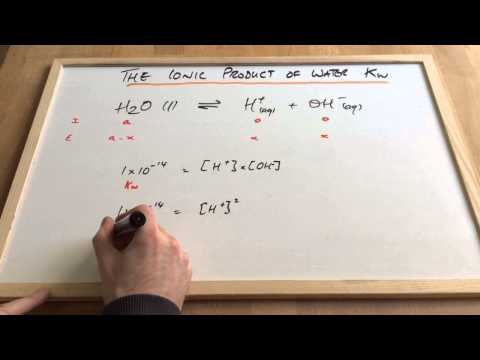
For the self-ionisation equilibrium,
So few molecules ionise that stays at about (1000 g of water is 55.5 mol) and can be taken into the constant:
In pure water every is made together with one , so , and pH = 7.00. In any aqueous solution, acid or alkali, the product stays equal to : adding acid raises and pushes down.
Self-ionisation is endothermic, so rises with temperature (Table 2.1). Water is neutral when ; its pH is 7.00 only at 25 °C.
| Temperature / °C | 0 | 25 | 50 | 100 |
|---|---|---|---|---|
| / | ||||
| pH of pure (neutral) water | 7.47 | 7.00 | 6.63 | 6.13 |
Table 2.1: and the pH of neutral water at different temperatures.
Taking of gives
Because the scale is logarithmic, a change of one pH unit means a tenfold change in (Figure 2.1). A pH can be negative (a 2 M strong acid has pH −0.30) or above 14.
Figure 2.1: The pH scale at 25 °C (M = mol dm⁻³).
Significant figures: the digits after the decimal point in a pH match the significant figures in the concentration. (2 s.f.) gives pH 2.60 (2 decimal places).
A strong acid is completely ionised, so equals the acid concentration times the number of protons released per formula. A strong base gives directly; then use and , or .
Worked example
Problem. Calculate the pH of 0.0250 mol dm⁻³ hydrochloric acid, and in it, at 25 °C.
Solution. HCl is fully ionised: .
Answer: pH = 1.602; . Even a strong acid contains some hydroxide ions.
Worked example
Problem. Calculate the pH at 25 °C of (a) 0.0150 mol dm⁻³ barium hydroxide; (b) the mixture of 25.0 cm³ of 0.100 mol dm⁻³ HCl with 20.0 cm³ of 0.100 mol dm⁻³ NaOH.
Solution.
(a) , so .
(b) ; . They neutralise mole for mole, leaving of in :
Answer: (a) pH 12.477; (b) pH 1.95. In (b), remember to divide by the total volume.
Worked example
Problem. A student says that hydrochloric acid has pH 8.00. Explain the error and find the true pH at 25 °C.
Solution. An acid cannot have a pH above 7. At this tiny concentration the from water itself is no longer negligible. Let ; then and
Answer: pH = 6.98: just on the acidic side of neutral. Ignoring water is safe only when the acid supplies much more than of .
Warning
Safety: strong acids and alkalis burn skin and eyes. Wear eye protection, add acid to water (never water to concentrated acid), and know where the eyewash and running water are.
First aid, following the US Centers for Disease Control and Prevention (CDC/ATSDR) guidelines:
Tip
Check every pH answer for sense before you move on. An acid must give pH below 7 and an alkali above 7 at 25 °C; diluting tenfold must move a strong acid's pH up by exactly 1. On a calculator, : for pH 4.75, .
MaChemGuy: The Ionic Product of Water, Kw. Watch how Kw is derived from the self-ionisation equilibrium, and how it is then used to find the pH of a solution of a strong base.
Practice
Sources and credits