The Inter-War Period (1920-1939)
Senior 6 · History
The Inter-War Period (1920-1939)
Lesson 1 of 5
25 min
The League of Nations came into existence on 10 January 1920, the day the Treaty of Versailles came into force. Its constitution, the Covenant, formed Part I of that treaty and of the other peace treaties. Before you read about what the League did, read what its members promised, and look closely at the verbs: who must act, and who may only advise?
Important
Source: three articles of the Covenant of the League of Nations (1919)
Article 5. "Except where otherwise expressly provided in this Covenant or by the terms of the present Treaty, decisions at any meeting of the Assembly or of the Council shall require the agreement of all the Members of the League represented at the meeting."
Article 10. "The Members of the League undertake to respect and preserve as against external aggression the territorial integrity and existing political independence of all Members of the League. In case of any such aggression or in case of any threat or danger of such aggression the Council shall advise upon the means by which this obligation shall be fulfilled."
Article 16 (first two paragraphs, shortened). "Should any Member of the League resort to war in disregard of its covenants […], it shall ipso facto be deemed to have committed an act of war against all other Members of the League, which hereby undertake immediately to subject it to the severance of all trade or financial relations […]. It shall be the duty of the Council in such case to recommend to the several Governments concerned what effective military, naval or air force the Members of the League shall severally contribute […]."
Covenant of the League of Nations, Part I of the Treaty of Versailles, 28 June 1919, official English text.
The promises are sweeping: every member guarantees every other, and an attack on one is an act of war against all. But the machinery is weak. The Council can only "advise" and "recommend"; it cannot order any state to send a single soldier. Economic sanctions are automatic in theory, yet each government decides for itself whether to apply them. And Article 5 requires unanimity, so one member can block a decision. Keep these three articles in mind as you judge the League's record.
The League had four main aims: to prevent war through collective security; to encourage disarmament; to settle disputes by arbitration and law; and to improve the lives of people everywhere through international co-operation on labour, health, refugees and the traffic in drugs and slaves. It also supervised the mandates (Lesson 2).
Definition
Collective security: the idea that all states together guarantee each state's safety, so that an aggressor faces the combined opposition of the rest.
Sanctions: penalties imposed on a state to force it to change its behaviour, such as stopping trade (economic sanctions) or, in the last resort, military action.
Arbitration: settling a dispute by referring it to a neutral judge or body whose decision the parties agree in advance to accept.
Unanimity: the rule that a decision needs the agreement of every member voting. It gave each member, in effect, a veto.
Covenant: a solemn agreement; the name of the League's founding document.
| Year | Case | What happened | Verdict |
|---|---|---|---|
| 1920 | Vilna (Vilnius) | Polish forces seized the city from Lithuania; the League could not make Poland withdraw | Failure |
| 1921 | Åland Islands | Claimed by Sweden and Finland; the League gave them to Finland, demilitarised and with autonomy for their Swedish-speaking people. Both sides accepted | Success |
| 1921 | Upper Silesia | After a plebiscite, the League divided the region between Germany and Poland | Partial success |
| 1923 | Corfu | Mussolini bombarded and occupied the Greek island of Corfu; the matter was settled by the great powers' Conference of Ambassadors, which made Greece pay compensation to Italy | Failure |
| 1925 | Greece and Bulgaria | After a border clash, the League ordered a Greek invasion force to withdraw, and Greece paid compensation | Success |
| 1920s | Humanitarian work | More than 400,000 prisoners of war sent home; "Nansen passports" (1922) for stateless refugees; campaigns against malaria and leprosy; the Slavery Convention (1926) | Success |
| 1930 | Liberia | A League commission of inquiry found that forced labour amounting to slavery was being exported from Liberia, one of the League's few African members; the president resigned | Partial success |
| 1931–33 | Manchuria | Japan's army seized Manchuria after the Mukden incident (18 September 1931). The Lytton Report (1932) condemned Japan, which left the League in 1933; no sanctions were applied | Failure |
| 1932–34 | World Disarmament Conference | Collapsed; Germany walked out and left the League in October 1933 | Failure |
| 1935–36 | Abyssinia (Ethiopia) | Italy invaded a fellow member; limited sanctions failed (Lesson 4) | Failure |
Notice the pattern. The League succeeded when the disputing states were small or middle powers and the great powers wanted a settlement. It failed whenever a great power was itself the aggressor (Italy in 1923 and 1935, Japan in 1931) or chose to defy it.


| Weaknesses built into the League | Circumstances of the 1930s |
|---|---|
| The United States never joined; Germany was a member only from 1926 to 1933 and the USSR only from 1934 to 1939 | The Depression made states put their own economies first and made sanctions look expensive |
| No army of its own; sanctions depended on each member's goodwill | Aggressive dictatorships in Japan, Italy and Germany were willing to use force and leave the League |
| Unanimity (Article 5) made firm decisions slow or impossible | Britain and France, the leading members, put their own interests and fear of war first |
| Associated with the Treaty of Versailles, so the defeated states saw it as a club of the victors | Collective security was never really tried against a determined great power |
Historians' verdicts. The traditional view, shaped by the outbreak of war in 1939, saw the League as doomed from the start. More recent historians, such as Zara Steiner and Susan Pedersen, judge it differently: it was never stronger than its great-power members wanted it to be, but its technical, humanitarian and supervisory work created practices that the United Nations took over in 1945. On that view the League failed at collective security but succeeded as an experiment in international co-operation.
Warning
Don't blame everything on the absence of the United States. It mattered, but Britain and France were members throughout and still chose not to act firmly over Manchuria and Abyssinia. Explain how several weaknesses worked together, and use cases as evidence for each.
Tip
Use a two-part judgement. For "How successful was the League of Nations?", judge it first against its aim of preventing war (largely a failure after 1931) and then against its humanitarian and co-operative aims (largely a success). Divide by decade as well: the 1920s and the 1930s tell different stories.
Important
Discuss. Liberia and Ethiopia, two of the very few independent African states, were members of the League. One was investigated for forced labour; the other was invaded by a fellow member and abandoned. What do these two cases suggest about how the League treated African states compared with European powers?
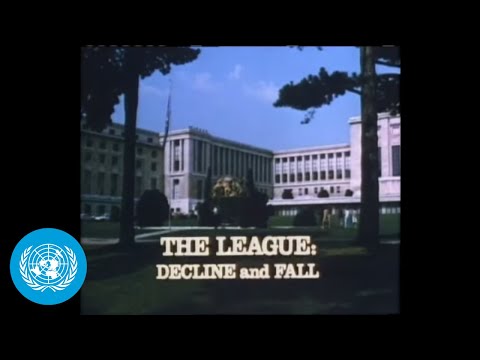
"The League of Nations: Decline and Fall", a 1970 film from the United Nations archives, posted by the United Nations. It follows the League from 1930 to the outbreak of war in 1939 with original footage. Watch for Manchuria, the Disarmament Conference and Abyssinia, and remember that it was made by the League's successor, the UN.
Practice
Sources and credits
Written by Ganzaa: the analysis, the diagram, the tables, the definitions and the exercises.