The Second World War (1939-1945)
Senior 6 · History
The Second World War (1939-1945)
Lesson 2 of 5
25 min
On 8 December 1941 President Franklin D. Roosevelt asked the United States Congress to declare war on Japan. Within four days the wars in Europe, Asia and Africa had joined into a single world war. This lesson follows the war in three phases and asks why the Allies won.
Important
Source: President Roosevelt to Congress, 8 December 1941
"Yesterday, December 7th, 1941—a date which will live in infamy—the United States of America was suddenly and deliberately attacked by naval and air forces of the Empire of Japan."
Franklin D. Roosevelt, address to a joint session of Congress, 8 December 1941.
Roosevelt chose words to unite a divided country: until that weekend many Americans had opposed entering the war. The attack on the US Pacific Fleet at Pearl Harbor, Hawaii, was meant to give Japan time to seize the oil and rubber of South-East Asia. On 11 December Germany and Italy declared war on the United States, bringing the world's largest industrial economy into the war against them.

Definition
Blitzkrieg ("lightning war"): fast attacks by tanks and motorised infantry supported by aircraft, used by Germany in 1939–41 to break through and encircle enemy armies.
Axis: Germany, Italy and Japan and their allies. Allies: Britain and its empire, France (until 1940, and the Free French), the USSR (from June 1941), the USA (from December 1941), China and others.
Turning point: an event after which the course of the war changed direction for good.
Unconditional surrender: surrender without any negotiated terms, demanded by the Allies from 1943.
Poland was crushed in five weeks. After a winter without major fighting in the west (the "Phoney War"), Germany took Denmark and Norway in April 1940, then attacked the Netherlands, Belgium and France on 10 May. German tanks broke through the Ardennes; British and French troops were evacuated from Dunkirk; France signed an armistice on 22 June 1940. Britain, now led by Winston Churchill, fought on, and in the Battle of Britain (summer–autumn 1940) the Royal Air Force prevented the German air superiority needed for an invasion. Italy entered the war in June 1940 and attacked in Egypt, East Africa and Greece, needing German help each time. On 22 June 1941 Germany invaded the Soviet Union and reached the outskirts of Moscow by December, but failed to take it. Then Japan attacked Pearl Harbor and swept through South-East Asia.
At Midway (June 1942) the US Navy sank four Japanese aircraft carriers. At El Alamein in Egypt (October–November 1942) British and Commonwealth forces defeated Rommel's German and Italian army, and Anglo-American forces landed in Morocco and Algeria. At Stalingrad the Red Army encircled a German army, which surrendered in February 1943; at Kursk in July 1943 the last great German offensive in the east failed. In May 1943 the Allies won the Battle of the Atlantic against the U-boats, and in July they landed in Sicily; Mussolini fell from power.
On 6 June 1944 (D-Day) British, American, Canadian and other Allied forces landed in Normandy, while a huge Soviet offensive destroyed a German army group in Belarus. Paris was liberated in August. Soviet troops took Berlin in April–May 1945; Hitler killed himself on 30 April, and Germany surrendered unconditionally on 8 May. In the Pacific, American forces advanced island by island; after the atomic bombing of Hiroshima (6 August) and Nagasaki (9 August) and the Soviet declaration of war on Japan (8 August), Japan announced its surrender on 15 August and signed it on 2 September 1945.

| Factor | Evidence |
|---|---|
| Resources and production | The USA, the USSR and the British Empire together far out-produced the Axis in aircraft, tanks, ships and oil; Soviet factories moved east of the Urals kept producing |
| The Soviet war effort | Most German soldiers who died were killed on the Eastern Front; the Soviet Union lost an estimated 24 to 27 million people |
| Sea and air power | Victory in the Atlantic kept supplies flowing; Allied bombing damaged German industry and transport, though at great cost |
| Axis mistakes | Invading the USSR before defeating Britain; declaring war on the USA; Japan's attack on a far stronger industrial power |
| Intelligence and co-operation | Code-breaking (Ultra); the Grand Alliance held together until victory, despite its tensions |
The historian Richard Overy, in Why the Allies Won (1995), argues that material superiority was necessary but not sufficient: the Allies also had to learn to fight better, organise their economies and keep their morale, which they did by 1943.
Warning
Don't tell only the Western story. D-Day matters, but the war against Germany was decided mainly on the Eastern Front, and the war was also fought in China, South-East Asia, the Pacific and Africa (Lesson 4). Give each theatre its weight.
Tip
Explain why a turning point turned. For "Which was the most important turning point?", don't just describe battles. Say what each changed: Midway ended Japan's naval advantage; Stalingrad destroyed a whole German army and moved the initiative to the Red Army; El Alamein ended the threat to Suez. Then compare them.
Important
Discuss. The atomic bombs ended the war in the Pacific but killed tens of thousands of civilians instantly. Historians still debate whether they were necessary. What criteria would you use to judge a decision like this, and what evidence would you need?
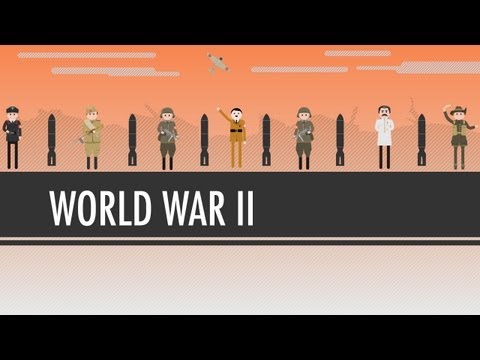
"World War II: Crash Course World History #38" (CrashCourse). John Green surveys the war in Europe and Asia and asks why it was fought and how it was won. Watch for the scale of the Eastern Front and of the war in China, and compare with the phases above.
Practice
Sources and credits
Written by Ganzaa: the analysis, the diagram, the table, the definitions and the exercises.