Rocks and Minerals
Senior 6 · Geography
Rocks and Minerals
Lesson 3 of 4
25 min
Several of the rock formations that geologists map in Rwanda are named after places in and around Kigali: the Nduba quartzite, the Nyabugogo schists and the Bulimbi phyllites. Rwanda Mines, Petroleum and Gas Board (RMB) describes them as very old (Mesoproterozoic) metasediments intruded by granite. That one word, metasediment, holds this lesson: these rocks began as layers of sand and mud on the floor of an ancient sea or basin (sedimentary rocks), and were later changed by heat and pressure into quartzite, schist and phyllite (metamorphic rocks).
Definition
Lithification: the process by which loose sediment becomes solid rock, by compaction (the weight of overlying layers squeezes out water and packs grains together) and cementation (minerals such as calcite, silica or iron oxide crystallise between the grains and glue them).
Strata (beds): the layers in which sedimentary rocks are laid down, separated by bedding planes.
Porosity: the percentage of a rock's volume that is pore space. Permeability: how easily water can flow through it.
| Type | How it forms | Examples |
|---|---|---|
| Clastic (mechanical) | Fragments of older rock are weathered, transported, deposited and lithified; named by grain size | Conglomerate (rounded pebbles), breccia (angular fragments), sandstone (sand), siltstone, shale and mudstone (clay) |
| Chemical | Minerals precipitate from water, often as it evaporates | Rock salt, gypsum, some limestones |
| Organic (biogenic) | Remains of living things accumulate | Coal (plants), chalk and shelly or coral limestone (shells and skeletons) |
Worked example 1: porosity of a sandstone
Problem. A dry sandstone block of volume 250 cm³ is soaked until its pores are full and absorbs 55 cm³ of water. Find its porosity. How much water could 1 m³ of this rock hold?
Solution.
So 1 m³ of rock holds about litres of water. That is why sandstones make good aquifers, provided the pores are connected (permeable).
Definition
Contact (thermal) metamorphism: change caused mainly by heat next to a body of magma, in a zone called the metamorphic aureole.
Regional metamorphism: change caused by heat and pressure over large areas, deep in mountain belts where plates collide.
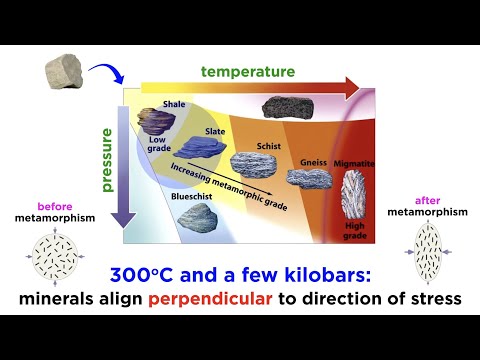
Foliation: a layered or banded texture produced when pressure lines up flat minerals such as mica.
Figure 3: a contact metamorphic aureole around a granite intrusion.
| Parent rock | Metamorphic rock | Notes |
|---|---|---|
| Shale or mudstone | Slate → phyllite → schist → gneiss | With rising grade the minerals grow larger: slate splits into thin sheets; schist glitters with mica; gneiss has light and dark bands |
| Sandstone | Quartzite | Very hard and resistant; the quartz grains are fused together |
| Limestone | Marble | Interlocking calcite crystals; still fizzes in acid |
| Granite | Granite gneiss | Regional metamorphism bands the minerals |
| Basalt | Greenschist, amphibolite | Green minerals such as chlorite form |
Metamorphic rocks are usually hard and crystalline, contain few or no fossils (they are destroyed), and are often foliated. Quartzite in particular resists weathering, so quartzite beds commonly form ridges and the crests of hills.

Worked example 2: reading the history of a rock
Problem. A rock in a road cutting is made of fused quartz grains, is very hard, and lies next to a granite body. Its layers can be traced away from the granite into ordinary sandstone. Explain its history.
Solution. The layers began as sand deposited and lithified into sandstone (sedimentary). Later, magma intruded and cooled to granite. Heat from the magma recrystallised the sandstone nearest to it into quartzite (contact metamorphism), while sandstone further away, outside the aureole, was unchanged.
Warning
Common mistakes
Tip
Exam technique. For any rock, state its class, its origin (process and setting) and two characteristics you could check in a hand specimen, such as grain shape, fossils, foliation or reaction with acid.
Professor Dave Explains: how heat and pressure create metamorphic rocks, and how foliation forms.
Practice
Summary
Sources and credits
Photo: Banded gneiss, Six Mile Lake (The Cosmonaut, CC BY-SA 2.5 CA), via Wikimedia Commons.
Figure 3, the worked examples and the exercises were drawn and written by Ganzaa.
Video: "Origin of Metamorphic Rocks", Professor Dave Explains, embedded from YouTube.
This lesson adapts CC BY-SA material and is shared under CC BY-SA 4.0.