Telecommunication Channels
Senior 3 · Physics
Telecommunication Channels
Lesson 1 of 4
25 min
When a relative in Rusizi phones you in Kigali, you hear her voice almost at the instant she speaks. On the way, her voice has been turned into an electrical signal in her phone, sent out as radio waves to a mast, carried as pulses of light along glass fibres and as radio waves again, and turned back into sound in your phone. Shouting could never carry that far: sound in air fades within a few hundred metres and would take minutes to arrive. This unit is about the paths, or channels, that carry information over long distances, and about the signals that travel along them.
In S2 ICT you met cables and wireless links as network media. Here you will look at the physics: what a signal is, why it weakens and picks up noise, and how waves are made to carry speech, music and data.
Definition
Communication: the transfer of information (a message) from a source to a destination. Example: a teacher explaining a sum to the class.
Telecommunication: communication over a distance by electrical signals, radio waves or light. Example: a phone call or a television broadcast.
Signal: a quantity that changes with time to carry information, such as a varying voltage, a radio wave or flashes of light.
Channel: the path along which a signal travels from transmitter to receiver, such as a pair of wires, a coaxial cable, an optical fibre or radio waves through the air.
Apparatus: two paper cups (or clean tins with no sharp edges), about 10 m of thin string, and a nail to pierce the cup bottoms.
What happens: the voice is clear only when the string is tight. Pinching the string stops the message completely. A longer string gives a fainter voice, and nearby talk makes the message harder to follow.
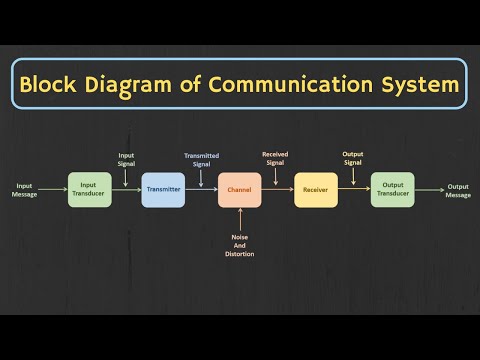
Explanation: the speaker's cup changes the sound into vibrations of the string; it acts as a transmitter. The string is the channel. The listener's cup turns the vibrations back into sound; it is the receiver. A slack or pinched string cannot carry the vibrations, so the channel is broken. Energy is lost along the string, so the signal gets weaker with distance: this is attenuation. The other pupils' voices are unwanted sound mixed with the message: this is noise. Every telecommunication system, however advanced, has these same parts and the same two enemies.

Definition
Transducer: a device that changes energy from one form to another. A microphone changes sound into an electrical signal; a loudspeaker changes an electrical signal into sound.
Attenuation: the gradual loss of strength of a signal as it travels along a channel.
Noise: unwanted random signals that add to the message signal in a communication system, for example the hiss on a badly tuned radio or interference from a nearby motor.
| System | Source | Transmitter | Channel | Receiver | Destination |
|---|---|---|---|---|---|
| Radio broadcast | Presenter's voice | Microphone and radio transmitter | Radio waves through the air | Radio set | Listener |
| Phone call | Caller's voice | Caller's phone | Radio waves, cables and fibres | Other phone | Person called |
| Text message | Typed text | Sender's phone | Radio waves, cables and fibres | Receiving phone | Reader |
| Television | Studio scene and sound | Cameras, microphones and transmitter | Radio waves, satellite or cable | Television set | Viewers |
A broadcast is simplex: listeners cannot reply through their radios. A walkie-talkie user must stop talking and release a button to listen, so it is half duplex. A telephone lets both people talk and hear at the same time: it is full duplex.
Worked example 1: naming the parts
A football commentator speaks into a microphone at Amahoro Stadium, and a farmer hears the match on a small radio in her field. Identify the parts of this communication system and its mode.
Source: the commentator's voice. Transmitter: the microphone (input transducer) and the radio station's transmitter. Channel: radio waves through the air. Receiver: the farmer's radio, whose loudspeaker is the output transducer. Destination: the farmer. The farmer cannot answer through her radio, so the mode is simplex.
Worked example 2: why not just shout?
A radio transmitter is 60 km from a listener. Compare the time taken by the radio signal () with the time sound would take in air (about ).
And long before 60 km, the sound would have faded below the noise. Radio waves are almost a million times faster, and can be received far away.
Warning
Common mistakes
Tip
S, T, C, R, D. Source, Transmitter, Channel, Receiver, Destination: "Some Teachers Can Really Dance". Noise always comes in at the Channel.
Introduction to Analog and Digital Communication: the basic block diagram (ALL ABOUT ELECTRONICS). Watch for the role of each block, and how the channel attenuates the signal and adds noise. The video also introduces analogue and digital signals, the topic of lesson 2.
Practice
Key points
Sources and credits
Written by Ganzaa: the lesson text, both diagrams, the table, worked examples and practice exercises.