Response and Coordination
Senior 3 · Biology
Response and Coordination
Lesson 3 of 4
25 min
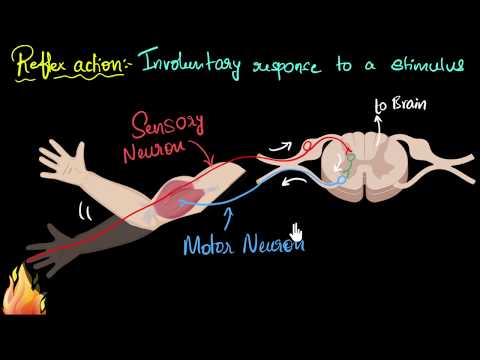
You reach for the handle of a saucepan on the imbabura (charcoal stove) and touch the hot rim by mistake. Your hand jumps away before you have had time to think "that is hot"; the pain arrives a fraction of a second later. The movement was not decided by your cerebrum at all. It was a reflex action, wired through your spinal cord, and it is the reason the burn is small.
Definition
Reflex action: a rapid, automatic response to a stimulus that happens without conscious thought. It is involuntary: you do not choose it. Example: pulling your hand away from a hot object.
Reflex arc: the pathway of neurones that an impulse follows in a reflex action: receptor → sensory neurone → relay neurone → motor neurone → effector.
Voluntary action: an action that you decide to make, controlled by the cerebrum, such as picking up a pen.
Conditioned reflex: a reflex that has been learnt, because a new stimulus has repeatedly come together with the stimulus that normally causes the reflex. Example: a dog that salivates at the sound of a bell that has often rung just before it was fed.
Follow Figure 1 step by step:
At the same time, the relay neurone passes impulses up the spinal cord to the brain, which is why you feel the pain and know what happened, just after the hand has moved. The brain can also override some reflexes: you can stop yourself dropping a hot plate of food if you know there is no safe place to drop it.
Figure 1: not to scale. Arrowheads on the neurones show the direction of the impulse. In the body the dorsal and ventral roots join to form one spinal nerve; they are drawn apart here for clarity.
In the spinal cord, the grey matter, shaped like a butterfly in cross-section, contains the cell bodies of relay and motor neurones and the synapses between them. The white matter round it is made of myelinated fibres running up and down the cord; myelin is fatty, which makes it look white. In the cerebrum the arrangement is the other way round: grey matter on the outside, white matter inside.
| Reflex | Stimulus | Response | Coordinated by | How it protects or helps you |
|---|---|---|---|---|
| Withdrawal reflex | Heat or a sharp point on the skin | Limb pulled away | Spinal cord | Limits burns and cuts |
| Knee-jerk reflex | A tap on the tendon below the kneecap | Lower leg kicks forward | Spinal cord | Part of keeping the body upright; doctors use it to test the nerves |
| Blinking | An object approaching or touching the eye | Eyelids close | Brain (cranial reflex) | Protects the cornea |
| Pupil reflex | Bright light entering the eye | Pupil becomes smaller | Brain (cranial reflex) | Protects the retina (Unit 10) |
| Coughing and sneezing | Dust or irritants in the airways or nose | Sudden blast of air out | Medulla (cranial reflex) | Clears the airways |
The knee-jerk is the simplest reflex arc of all: it has no relay neurone, so the sensory neurone synapses directly with the motor neurone. Reflexes coordinated by the spinal cord are called spinal reflexes; those coordinated by the brain are cranial reflexes.

| Feature | Reflex action | Voluntary action |
|---|---|---|
| Conscious thought | Not needed; automatic | Needed; you decide |
| Coordinated by | Spinal cord or lower parts of the brain | Cerebrum |
| Speed | Very fast | Slower |
| Response to the same stimulus | The same every time | Can vary; you may choose differently |
| Learnt? | Inborn (except conditioned reflexes) | Often learnt, e.g. writing |
| Example | Blinking when dust blows into the eye | Catching a ball in a game |
Knee-jerk. Work in pairs. Your partner sits on a high table or crosses one leg over the other so the lower leg hangs freely. Tap gently just below the kneecap with the side of your hand. Record what happens, and whether your partner can stop it.
Reaction time. Hold a 30 cm ruler vertically, with its zero mark level with your partner's open thumb and finger. Drop it without warning; your partner catches it as soon as possible. The distance it falls, , gives the reaction time , because a falling object obeys , so , with . Repeat five times and take the mean. Catching a ruler is a voluntary action (you see it fall and decide to grip), so it is slower than a reflex.
Warning
Safety. Tap the knee gently, with the side of the hand or a soft rubber hammer, never with a ruler's edge or anything hard, and never on the kneecap itself. Do not test anyone who has a knee injury or pain. In the ruler test, drop the ruler from a small height only, keep faces well away from it, and never use a metal ruler with a sharp edge. Never test reflexes with heat, a flame or a sharp object.
Worked example 1: reaction time from a ruler
In five trials the ruler fell 0.19 m, 0.21 m, 0.20 m, 0.22 m and 0.18 m before it was caught. Find the reaction time.
Worked example 2: where is the damage?
After an accident, a patient can feel a pin prick on her right hand, but cannot pull the hand away, and she has no withdrawal reflex in that hand. Which part of the reflex arc is most likely to be damaged, and why?
Warning
Common mistakes. (1) Writing that the brain decides a reflex: a spinal reflex is coordinated in the spinal cord; the brain is only informed. (2) Drawing the arrows on a reflex arc the wrong way: the impulse goes in through the dorsal root and out through the ventral root. (3) Putting the sensory neurone's cell body inside the spinal cord: it is in the dorsal root ganglion, outside the grey matter. (4) Forgetting the response itself: an answer must name the effector and what it does, e.g. "the biceps contracts and the hand is pulled away".
Reflex action (and reflex arc), Khan Academy India. Watch for the path from receptor to effector and why the spinal cord, not the brain, coordinates it; compare it with Figure 1.
Tip
Memory hook: "Dorsal in, Ventral out" (DIVO). Sensory impulses come in through the dorsal root (the side nearer your back); motor impulses go out through the ventral root (the side nearer your front).
Practice: reflex actions
Key points
Sources and credits
Written by Ganzaa: the text, Figure 1, the tables, the practical, the worked examples and the practice questions.