Intersection and Sum of Subspaces
Senior 6 · Mathematics
Intersection and Sum of Subspaces
Lesson 1 of 3
30 min
In S4 (Vector Space of Real Numbers) and S5 (Vector Space ) you added vectors, multiplied them by scalars, and described them with a basis. Inside some sets of vectors behave like small vector spaces of their own: a plane through the origin, or a line through the origin. Adding two vectors of the plane, or stretching one, never takes you out of it. This unit studies such subspaces, and then asks what happens when two of them meet (their intersection) or are combined (their sum).
Definition
Vector space (real): a set with an addition and a multiplication by real scalars that satisfy the usual rules (commutative and associative addition, a zero vector , opposites, , and the distributive laws). Examples: ; the set of real matrices; the set of polynomials of degree at most 2.
Subspace: a subset of a vector space that is itself a vector space with the same addition and scalar multiplication. We write .
Example: , the line through the origin with gradient 2, is a subspace of .
Important
Subspace test. A subset of a vector space is a subspace if and only if
Conditions 2 and 3 can be combined: for all and all scalars .
Reason: the other rules (commutativity, distributive laws and so on) hold in because they hold in . The opposite of is , which is in by condition 3.
Worked example 1: testing subsets of
Which of these are subspaces of ? (a) (b) (c) (d) , the union of the two axes.
Solution
Warning
Check the zero vector first. It is the quickest test, and it rules out every line or plane that misses the origin. But passing it is not enough: and above both contain and still fail.
The span of vectors is the set of all their linear combinations, . A span is always a subspace, since a combination of combinations is again a combination. A basis of a subspace is a linearly independent set that spans , and the dimension is the number of vectors in any basis.
| subspaces of | dimension |
|---|---|
| , the zero subspace | 0 |
| a line through the origin, with | 1 |
| a plane through the origin, | 2 |
| itself | 3 |
If , then , with equality only when .
Worked example 2: a basis from equations
(a) Show that is a subspace of , and find a basis and its dimension. (b) Do the same for .
Solution
The pattern: one independent linear equation in leaves 2 free variables (a plane); two independent equations leave 1 (a line).
Worked example 3: a subspace of matrices
Show that the symmetric matrices form a subspace of , and find its dimension.
Solution The zero matrix is symmetric, and a combination of symmetric matrices is symmetric, since . Every element can be written
and these three matrices are independent, so , while .
Tip
A set described by linear, homogeneous equations (every term contains a variable to the first power, and the right-hand side is 0) is always a subspace. A constant term (like ), a power (like ), a product (like ) or an inequality (like ) is a warning sign: test it.
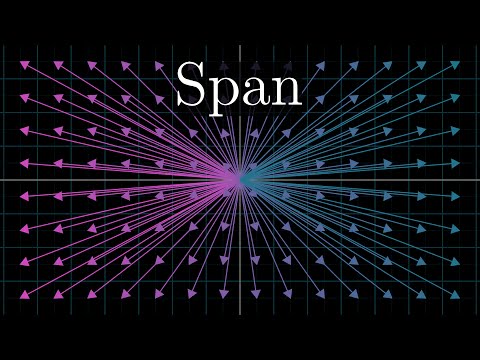
3Blue1Brown: Linear combinations, span, and basis vectors, Chapter 2 of Essence of Linear Algebra (about 10 min). Watch how the span of two vectors in space is a plane through the origin, and the span of one vector a line through it: the subspaces of the table above.
Practice
Questions 6 and 7 ask for reasons.
Sources and credits