Intersection and Sum of Subspaces
Senior 6 · Mathematics
Intersection and Sum of Subspaces
Lesson 3 of 3
35 min
The union of two subspaces is too small to be a subspace (lesson 2): the -axis and the -axis together do not contain . The repair is to allow all sums of a vector from one with a vector from the other. The result is the sum of the subspaces, and its dimension is tied to the dimension of the intersection by one of the neatest formulas in linear algebra.
Definition
Sum of subspaces: for subspaces and of ,
Example: in , the -axis plus the -axis is the -plane, since .
Important
Theorem. is a subspace of . It contains and , and it is the smallest subspace that does. If and , then .
Proof: . If and are in , then , a vector of plus a vector of . Each is , so , and likewise . Any subspace containing and contains all their sums, so it contains . Last, a sum of a combination of and a combination of is a combination of , and conversely.
Finding a basis of . Put the spanning vectors of and of together as the rows of one matrix and row-reduce. The non-zero rows that remain form a basis of , and
Definition
Direct sum: the sum is direct, written , when . If moreover , then and are complementary subspaces of .
Example: : the axes meet only at , and .
Important
Theorem (unique decomposition). is direct if and only if every vector of can be written as in exactly one way.
Proof: suppose and . Then ; the left side is in , the right side in , so both are in and equal . Hence and . Conversely, if were in , then would be two different decompositions of .
Important
Grassmann's dimension formula. For finite-dimensional subspaces and of ,
In particular, is direct exactly when .
Proof (sketch): take a basis of . Extend it to a basis of and to a basis of . Together the vectors span , and one checks that they are independent: in a relation, the -part would be a vector of equal to a vector of , so it lies in , which forces every coefficient to be 0. So
Tip
The formula looks like the counting rule for sets, : the shared part is counted twice, so it is subtracted once. But notice that it is the sum , not the union, that appears on the left.
Worked example 1: dimensions in and
(a) For the planes and of lesson 2, find . (b) In , let and . Find .
Solution
Worked example 2: from the rank to the intersection
Let and in . Find and , and a basis of .
Solution Row-reduce the four spanning vectors:
Three non-zero rows remain, so . Each pair of spanning vectors is independent, so , and by Grassmann
The zero row came from : this vector of lies in . So .
Worked example 3: a direct sum and a decomposition
Let and . Show that , and write as with and .
Solution In lesson 2 we found . Then , so , and the sum is direct. Write ; then must satisfy the equation of :
So and . Check: ✓ and ✓.
Warning
can never exceed . This gives a lower bound for every intersection: . For example, two subspaces of dimensions 3 and 4 in must share at least a 2-dimensional subspace. Forgetting this bound leads to impossible answers such as "".
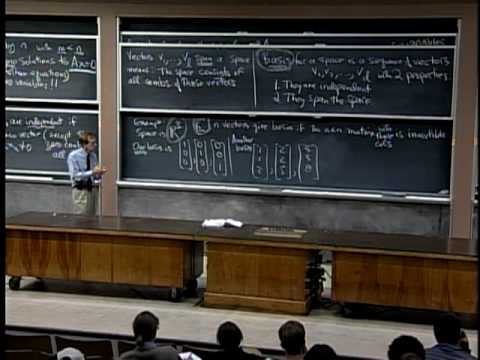
MIT OpenCourseWare: Lecture 9 of 18.06 Linear Algebra, Independence, Basis, and Dimension, with Gilbert Strang (about 50 min). Watch how independence and spanning together define a basis, and why every basis of a space has the same number of vectors: that number is the dimension counted by Grassmann's formula.
Practice
Questions 6 to 8 ask for proofs or reasons.
Further reading for this unit
Sources and credits