Diet and Health
Senior 3 · English
Diet and Health
Lesson 1 of 5
25 min
Let's begin
In S1 you sorted foods into groups. In S3 the question is harder: why does the body need each group, and what happens when it gets too little, or too much? The article below answers with three pictures that are easy to remember: fuel, bricks and shields. Read it as an informative text: look for the main idea of each paragraph and the facts that support it.
An article for a school health club magazine. The health facts follow the World Health Organization's fact sheet Healthy diet (updated 26 January 2026).
1 During adolescence your body grows faster than at any time since early childhood. Bones lengthen, muscles thicken, and the brain rewires itself for adult thinking. All of this is built from what you eat. A balanced diet is not a special diet for athletes or the sick: it is simply the right variety of foods, in the right amounts, for the body you are building.
2 Think first of fuel. Carbohydrates and fats give the body energy to walk to school, play football and concentrate in a three-hour examination. In Rwanda most of this fuel comes from staples such as sweet potatoes, cassava, maize, sorghum, rice and cooking bananas. The World Health Organization advises that carbohydrates should come mainly from whole grains, vegetables, fruits and pulses such as beans and peas, rather than from sugar. Fats matter too, but their quality counts: the fats in avocado, fish and sunflower oil are better choices than those in fatty meat, butter and palm oil.
3 Next come the bricks. Proteins build and repair every part of the body, from muscles to the enzymes that digest your lunch. Beans, peas, groundnuts and soya are cheap, rich sources, and so are milk, eggs, small dried fish and meat. A plate of beans eaten every day is one of the best habits a growing body can have.
4 Finally, the shields. Vitamins and minerals are needed in tiny amounts, yet without them the body cannot defend itself. Dark green leaves such as amaranth and cassava leaves, orange foods such as carrots and pumpkin, and fruits such as mangoes, oranges and passion fruit protect the eyes, the skin and the immune system. Iron, found in beans and dark green leaves, carries oxygen in the blood; too little of it causes anaemia, which leaves a student tired and unable to concentrate. Everyone older than ten should aim for at least 400 grams of fruit and vegetables a day, together with plenty of clean water and fibre.
5 When the balance tips, the result is malnutrition, and it can tip either way. Too little food, or too few nutrients over a long time, leads to stunting, anaemia and weak resistance to infection. Too much sugar, salt and unhealthy fat leads to overweight and obesity, type 2 diabetes, high blood pressure and heart disease. A person can even suffer from both at once: overweight, yet short of iron and vitamins. That is why the World Health Organization advises limiting free sugars to less than 10% of the day's energy, about 12 level teaspoons for an adult of healthy weight, and keeping salt for adults below 5 grams a day.
6 None of this requires expensive food. A meal of beans, a sweet potato, a handful of green leaves and a banana is balanced, local and affordable. The habits that matter most are simple: eat breakfast, eat a variety of colours, drink water instead of sweet drinks, and treat fried snacks and sweets as occasional, not daily, food.
Definition
Glossary
Paragraph 5 says that malnutrition "can tip either way". The diagram shows what lies on each side.
| Group | Main nutrients | Job in the body | Examples eaten in Rwanda |
|---|---|---|---|
| Energy foods | carbohydrates, some fats | fuel: energy for movement and thinking | sweet potatoes, cassava, maize, sorghum, rice, cooking bananas, avocado |
| Body-building foods | proteins | bricks: growth and repair | beans, peas, groundnuts, soya, milk, eggs, small dried fish, meat |
| Protective foods | vitamins, minerals, fibre | shields: fight infection, keep eyes, skin and blood healthy | amaranth, cassava leaves, carrots, pumpkin, mangoes, oranges, passion fruit |
| Useful phrase | Example |
|---|---|
| rich in / a good source of | Beans are rich in protein and a good source of iron. |
| high in / low in | Soft drinks are high in sugar and low in nutrients. |
| a lack of / a shortage of | A lack of iron can cause anaemia. |
| cut down on | Try to cut down on fried snacks. |
| a portion (serving) of | Eat a portion of green vegetables with every meal. |
Worked example
One root, five words: the nutrition family
Complete: (a) Amaranth is a very ___ vegetable. (b) Ask a ___ about your diet. (c) Iron is a ___ that the blood needs.
Worked example
Reading a food label
A packet of biscuits says, per 100 g: sugars 30 g; fat 20 g; salt 0.8 g. (Illustrative figures.) A student eats half the packet, 50 g. How much sugar is that, and how does it compare with the WHO limit?
Tip
Fuel, bricks, shields. When you plan a meal, ask three questions: Where is my fuel? Where are my bricks? Where are my shields? If one is missing, the meal is not balanced.
Warning
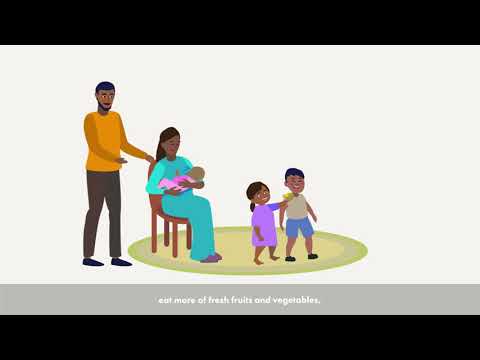
A healthy diet, a healthier world, from the World Health Organization (about 2 minutes). List the pieces of advice in the video, then tick the ones that also appear in the article.
Practice
Sources and credits
Written by Ganzaa.