The Rise of African Nationalism
Senior 6 · History
The Rise of African Nationalism
Lesson 3 of 5
25 min
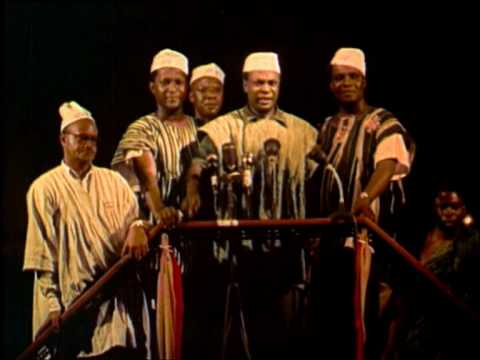
At midnight on 6 March 1957, at the Old Polo Ground in Accra, Kwame Nkrumah and his fellow leaders, dressed in northern smocks, stood before a huge crowd and declared the Gold Coast free as Ghana. Six years earlier he had been in James Fort prison. Read two lines from that night, then ask what he meant by linking one country's freedom to a whole continent's.
Important
Source B: Kwame Nkrumah, Accra, 6 March 1957 (extracts)
"At long last, the battle has ended! And thus, Ghana, your beloved country is free forever!"
"Our independence is meaningless unless it is linked up with the total liberation of the African continent."
Published versions of the speech differ slightly in wording; these lines appear in all of them.
Ghanapedia: "Kwame Nkrumah - Independence Speech (Colour) - Accra, 6th March 1957". A 19-second colour film of the opening words of Source B. Notice who stands beside Nkrumah on the platform and how they are dressed: what message did that send?
Definition
Self-Government Now: the slogan of the Convention People's Party (CPP), founded by Nkrumah on 12 June 1949, demanding immediate self-rule rather than gradual reform.
Positive Action: the CPP's campaign of strikes, boycotts and non-cooperation, launched on 8 January 1950 and modelled on non-violent methods used in India.
Leader of Government Business: the post Nkrumah held from February 1951, heading an African-majority government while the British governor kept final authority. In 1952 the title became Prime Minister.
Central African Federation (Federation of Rhodesia and Nyasaland, 1953–1963): a union of Northern Rhodesia (Zambia), Southern Rhodesia (Zimbabwe) and Nyasaland (Malawi), dominated by white settlers in Southern Rhodesia.
| Date | Event | Why it mattered |
|---|---|---|
| August 1947 | The United Gold Coast Convention (UGCC) is founded by lawyers and merchants led by J. B. Danquah; Nkrumah becomes its general secretary in December | an elite party with a gradual programme |
| February 1948 | The Christiansborg crossroads shooting and riots; the "Big Six" are arrested (Lesson 1) | the Watson Commission and the Coussey Committee draft a new constitution |
| 12 June 1949 | Nkrumah leaves the UGCC and founds the CPP with youth, workers, market women and ex-servicemen | the first mass party in the colony: "Self-Government Now" |
| January 1950 | Positive Action: a general strike; Nkrumah is arrested and imprisoned | mass action makes the CPP the voice of the people |
| February 1951 | First general election: the CPP wins 34 of the 38 popularly elected seats; Nkrumah is released to lead the government | Africans run internal affairs under the governor |
| 1954–1956 | The National Liberation Movement (NLM), based in Asante, demands a federal constitution; Britain asks for one more election, and in July 1956 the CPP wins 71 of 104 seats; British Togoland votes to join | the CPP proves it has the support of a majority, so Britain sets a date |
| 6 March 1957 | Independence as Ghana, within the Commonwealth; it becomes a republic on 1 July 1960 | a model and a base for nationalists across Africa |
Why was Ghana's road relatively peaceful and fast? There were almost no European settlers to defend their land; the cocoa economy produced an educated middle class and the money to fund a state; the CPP was well organised down to village level; and Britain decided that it was better to hand power to an elected leader than to fight him. The nationalists' unity was not complete, however: the NLM's challenge showed regional fears that later troubled independent Ghana.

Northern Rhodesia was a different kind of colony: its wealth was copper, mined on the Copperbelt by large companies, and a few tens of thousands of white settlers and miners held the best jobs. African politics grew in four steps.

| Factor | Ghana (Gold Coast) | Zambia (Northern Rhodesia) |
|---|---|---|
| Settlers | almost none | a powerful white minority, backed by Southern Rhodesia |
| Economy | cocoa, mostly grown by African farmers | copper, owned by foreign companies |
| Main party | CPP (1949), Nkrumah | UNIP (1959), Kaunda |
| Key mass action | Positive Action (1950) | Cha-cha-cha (1961) |
| Main obstacle | British caution; regional opposition (NLM) | the settler-dominated Federation |
| Independence | 6 March 1957 | 24 October 1964 |
Analysis. Both countries won independence through a mass party, non-violent pressure and elections. Zambia's road was slower and more confrontational because settler power, organised through the Federation, had to be broken first. Ghana's example helped: by 1960 Britain's prime minister, Harold Macmillan, spoke in Cape Town of a "wind of change" blowing through Africa.
Warning
"Peaceful" does not mean "without struggle". Both Nkrumah and Kaunda went to prison, people were shot in Accra in 1948, and the Cha-cha-cha campaign destroyed property and led to deaths. Say that independence was won mainly by non-violent mass action and negotiation, not that it was handed over.
Tip
Use a comparison grid. For any "compare the decolonisation of X and Y" question, compare the same factors for both (settlers, economy, party, leader, methods, colonial response, date), then state the most important similarity and the most important difference. A table like the one above is a good plan.
Important
Discuss. Nkrumah said Ghana's independence was "meaningless" without the liberation of all Africa. Ghana later hosted the All-African People's Conference (Accra, December 1958), which Kenyan, Congolese and Zambian leaders attended. How far can one country's independence change the history of others?
Practice
Sources and credits
Written by Ganzaa: the analysis, the tables, the case studies and the exercises.
This lesson adapts CC BY-SA material and is shared under CC BY-SA 4.0.