Rate Laws and Measurements
Senior 6 · Chemistry
Rate Laws and Measurements
Lesson 3 of 5
25 min
In Lesson 2 the iodine in the propanone reaction fell by the same amount in every 5-minute interval. Doubling the iodine at the start would not change that rate either; doubling the propanone, or the acid, would double it. The balanced equation gives no hint of this. It tells you what reacts, not how the rate depends on each concentration. That dependence must be measured, and it is summed up in a rate equation.
Definition
Rate equation (rate law): an experimentally found equation linking the rate to the concentrations of the species that affect it, . Example: for the iodination of propanone, .
Order with respect to a reactant: the power to which its concentration is raised in the rate equation ( for A, for B). It is usually 0, 1 or 2 and can be fractional.
Overall order: the sum of the individual orders, . Example: is second order in NO, first order in , and third order overall.
| Order in A | Doubling [A] multiplies the rate by | Rate–concentration graph |
|---|---|---|
| 0 | (no change) | horizontal line |
| 1 | straight line through the origin | |
| 2 | upward curve through the origin | |
| 3 | steeper upward curve |
Figure 3.1: The shape of a rate–concentration graph shows the order.
The rate always has units , so the unit of must make the two sides match. For overall order : .
| Overall order | Rate equation (example) | Unit of |
|---|---|---|
| 0 | ||
| 1 | ||
| 2 | ||
| 3 |
Worked example 1: the iodination of propanone
Problem. Use the initial rates below (illustrative data at 25 °C) to find the order with respect to each reactant, the rate equation and the rate constant.
| Run | / | / | / | Initial rate / |
|---|---|---|---|---|
| 1 | 0.40 | 0.0050 | 0.20 | |
| 2 | 0.80 | 0.0050 | 0.20 | |
| 3 | 0.40 | 0.0100 | 0.20 | |
| 4 | 0.40 | 0.0050 | 0.40 |
Solution.
Runs 1 and 2: propanone doubled, rate doubled: first order in propanone.
Runs 1 and 3: iodine doubled, rate unchanged: zero order in iodine.
Runs 1 and 4: doubled, rate doubled: first order in .
appears in the rate equation although it is not used up: it is a catalyst. Iodine is used up but does not appear: it must react only after the slow step (Lesson 5).
Worked example 2: when two concentrations change at once
Problem. For (illustrative data):
| Run | / | / | Initial rate / |
|---|---|---|---|
| 1 | 0.0050 | 0.0020 | |
| 2 | 0.0100 | 0.0020 | |
| 3 | 0.0100 | 0.0040 | |
| 4 | 0.0150 | 0.0060 | ? |
Find the rate equation, with units, and the missing rate.
Solution. Runs 1 and 2: [NO] × 2, rate × 4 = : second order in NO. Runs 2 and 3: × 2, rate × 2: first order in .
Run 4: both concentrations change, so use the rate equation: . Check by ratios from run 1: , and .
Worked example 3: a fractional order
Problem. When the concentration of ethanal is doubled, the initial rate of its thermal decomposition, , increases by a factor of 2.83. Find the order.
Solution. , so . The reaction is of order in ethanal, a sign that it goes by a chain mechanism of several steps. Orders are experimental numbers; they need not be whole numbers.
Warning
Common mistakes
Tip
Lay out an initial-rates answer as one line per reactant: "Runs __ and __: [X] × __, rate × __, so order in X = __." Examiners award a mark for each line, and the layout stops you comparing the wrong pair of runs.
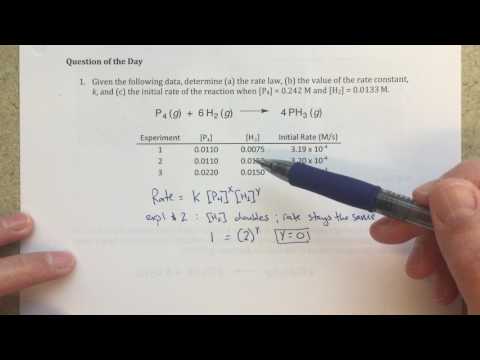
Tony St John: Solving a Rate Law Using the Initial Rates Method. Watch how each order is found by choosing two runs in which only one concentration changes, and how k and its units follow.
Practice
Sources and credits