Transport and Communication in the World
Senior 6 · Geography
Transport and Communication in the World
Lesson 4 of 4
25 min
Rwanda's 2022 census found that 78% of private households owned a mobile phone and 81% a radio. Yet only 14% of people aged 10 and over had used the internet in the previous twelve months (NISR, Fifth Population and Housing Census, 2022). The phone reached almost everyone; the internet did not yet. Figure 1 shows that the same gap exists across the region.
Figure 1: Share of people using the internet, world and sub-Saharan Africa. Data: World Bank.
In 2025 there were about 111 mobile subscriptions for every 100 people in the world and 90 per 100 in sub-Saharan Africa, but only 1.1 fixed broadband subscriptions per 100 people in sub-Saharan Africa against 20 worldwide (World Bank). Africa has largely skipped the fixed telephone line and gone straight to the mobile phone.
Definition
Communication: the sending and receiving of information, ideas and messages between people and places.
Telecommunication: communication over a distance by electronic means: telephone, radio, television, the internet.
Mass media: means that reach large audiences at once: newspapers, radio, television and websites.
Fibre-optic cable: a cable of thin glass strands that carry data as pulses of light; undersea fibre-optic cables carry most of the internet traffic between continents.
Digital divide: the gap between people, places or groups who have access to modern information technology and those who do not.
Bandwidth: the amount of data a connection can carry each second, measured in bits per second (for example megabits per second, Mbit s⁻¹).
| Means | Advantages | Disadvantages |
|---|---|---|
| Face to face, meetings, messengers, town criers | Personal, needs no equipment; trusted in communities | Slow over distance; reaches few people |
| Post and courier | Carries documents and parcels; a written record | Slow; costly over long distances; declining use |
| Newspapers and magazines | Detailed news; can be kept and re-read | Need literacy; slow to reach rural areas; costly |
| Radio | Cheap receivers, runs on batteries; reaches remote and non-literate listeners; local languages | One-way; no pictures; can spread rumours or propaganda |
| Television | Sound and pictures; powerful for education and news | Sets and electricity are costly; few rural owners |
| Mobile phone and SMS | Personal and two-way; works without fixed lines; carries mobile money, alerts and market prices | Needs network coverage and charging; airtime costs; scams |
| Internet (email, websites, social media, video calls) | Instant, global, two-way, multimedia; e-commerce, e-learning, e-government | Needs devices, data, skills and power; cybercrime; misinformation |
| Satellites | Cover remote areas, oceans and disasters; broadcast TV; weather and navigation | Very costly to launch; signal delay; limited capacity |

Worked example 1: is the digital divide closing?
Problem. Using Figure 1, compare the growth of internet use in the world and in sub-Saharan Africa between 2005 and 2025, both as a change in percentage points and as a multiple. Is the gap closing?
Solution.
Interpretation: in relative terms Africa grew much faster (almost 18 times against under 5), but the absolute gap in percentage points nearly tripled. Whether the divide is "closing" depends on which measure you use, which is why a good answer quotes both.
Worked example 2: why bandwidth matters
Problem. A teacher wants to download a 500 MB video lesson. How long does it take on a connection of 2 Mbit s⁻¹, and on one of 50 Mbit s⁻¹? (1 byte = 8 bits.)
Solution. Convert the file size to megabits: Mbit.
A slow connection makes video lessons, telemedicine and online business impractical. This is why fibre and 4G coverage, not just phone ownership, decide who benefits from the digital economy.
Warning
Common mistake. Confusing transport with communication. Transport moves people and goods; communication moves information. They are linked (phones track lorries, and roads carry newspapers), but answer the question that is asked.
Tip
Exam technique. For any communication question, think access, cost, skills, content, safety: who has the device and the signal, who can afford the data, who knows how to use it, whether there is useful content in their language, and whether it is safe. Each is both a problem and a place for a solution.
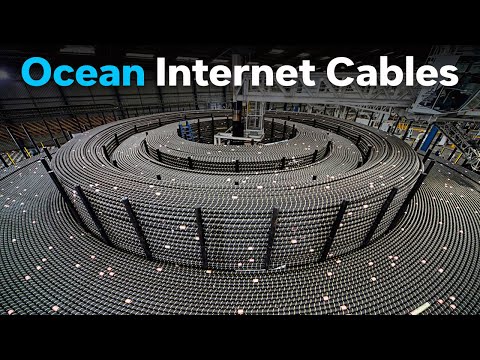
VISION: "How The Internet Travels Across Oceans". Watch for how fibre-optic cables are laid on the sea floor, what happens when they are damaged, and why most traffic between continents goes by cable rather than by satellite.
Practice
Summary
Further reading
Sources and credits
Photo: In Awerial settlement, a man charges a small fee to charge mobile phones (Oxfam East Africa, CC BY 2.0), via Wikimedia Commons.
Video: "How The Internet Travels Across Oceans", VISION, embedded from YouTube.
Figure 1, the text, worked examples and exercises: written by Ganzaa.