Soil
Senior 3 · Agriculture
Soil
Lesson 4 of 4
25 min
Every conservation measure on a Rwandan hillside, from a mulch of banana leaves to a flight of bench terraces, works by attacking one of the factors from Lesson 2. Learn the five principles first, and you will be able to explain any measure, even one you have never seen.
Definition
Soil conservation: all the practices that protect soil from erosion and exhaustion so that it stays productive.
Biological (agronomic) measures: practices that use plants and good farming to protect the soil. Example: mulching, cover crops, grass strips.
Mechanical (structural) measures: earth or stone structures that slow or divert runoff. Example: terraces, cut-off drains, check dams.
Contour: a line joining points of the same height on a slope. Work done "on the contour" runs across the slope, never up and down it.
Terrace: a level or nearly level step cut or built across a slope. A bench (radical) terrace is dug level in one go (in Kinyarwanda, amaterasi y'indinganire); a progressive terrace forms gradually as soil collects behind a grass strip or bank on the contour.
| Measure | How it is done | Principle |
|---|---|---|
| Mulching | Spread dry grass, crop residues or banana leaves over the soil between plants. | Cover; water soaks in |
| Cover crops | Grow low, spreading crops such as sweet potato, beans or Mucuna to cover the ground. | Cover |
| Contour farming | Dig, ridge and plant in rows along the contour, not downhill. | Slow runoff |
| Grass strips and hedgerows | Plant strips of Napier, Setaria or shrubs such as Calliandra along the contour, every 1 to 1.5 m of vertical drop. | Slow runoff; trap soil; give fodder |
| Strip cropping | Alternate strips of a row crop (maize) with a dense crop or grass along the contour. | Cover; slow runoff |
| Agroforestry | Grow trees such as Grevillea or Alnus on field edges and terrace banks. | Cover; roots bind soil; leaf litter |
| Afforestation | Keep hilltops and very steep slopes under forest. | Cover; water soaks in |
| Rotation, manure, compost, residues | Rotate cereals with legumes; return residues; add manure and compost. | Feed the soil; stable crumbs |
| Controlled grazing | Zero-grazing or rotational grazing; no grazing on bare slopes. | Cover |
Figure 4. (a) Bench terraces are dug level in one go; (b) progressive terraces build up slowly behind grass strips.


Contour work starts with finding the contour. An A-frame is a cheap level that any farmer can make from three poles, a string and a stone (Figure 5).
Figure 5. The A-frame level.
Worked example 1: spacing terraces
Problem. A field has a slope of 25% and is 48 m long, measured horizontally. Terraces are to be built with a vertical interval (height between one terrace and the next) of 1.5 m. Find the horizontal spacing and the number of terraces.
Solution.
Answer: one terrace every 6 m, 8 terraces in all. On a steeper slope the same vertical interval gives narrower benches, which is why bench terraces become impractical on very steep land.
Worked example 2: what Rwandan farmers use
Problem. In 2024 Season A, NISR recorded the main anti-erosion measure on plots that had one. Sort the measures into biological and mechanical, and find the share of each group.
| Measure | Share of plots (%) |
|---|---|
| Cover plants | 60.3 |
| Progressive terraces | 8.2 |
| Water channels | 7.4 |
| Trees, windbreaks, shelterbelts | 6.5 |
| Ditches | 5.2 |
| Bench terraces | 5.2 |
| Beds and ridges | 5.1 |
| Mulching | 1.7 |
| Water drainage | 0.5 |
Source: NISR, Seasonal Agricultural Survey 2024 Annual Report, Table 70 (national row; "others" under 0.1% left out).
Solution. Biological: cover plants, trees, mulching: . Mechanical: progressive terraces, water channels, ditches, bench terraces, beds and ridges, water drainage: .
Comment: about two-thirds of protected plots rely on plants, which are cheap and also feed the soil. Terraces protect fewer plots because they cost much more labour, but they are needed on the steepest land.
Warning
Common mistakes. (1) A ditch or terrace built without a safe outlet makes things worse: the collected water breaks out and cuts a gully. (2) When digging bench terraces, the fertile topsoil must be set aside and spread back on the bench; otherwise the new bench is infertile subsoil and needs heavy manuring and lime for several seasons.
Tip
Exam technique: for any measure, say how it is done and which principle it uses: "Mulching covers the soil, so raindrops cannot detach particles, and it slows runoff so more water soaks in." Group your answer into biological and mechanical measures.
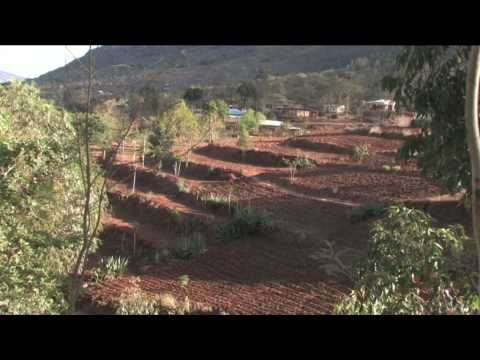
TerrAfrica: "Fanya juu Terraces". Watch how East African farmers dig the trench, throw the soil uphill to make a bank, and plant grass on it, and how the bank turns into a terrace over a few seasons, as in Figure 4(b).
Practice
Key points
Further reading
Sources and credits
Written by Ganzaa: the text, the tables, Figures 4 and 5 and the worked examples.
This lesson adapts CC BY-SA material and is shared under CC BY-SA 4.0.