Drawing Facial Expressions
Senior 3 · Fine Arts
Drawing Facial Expressions
Lesson 1 of 4
25 min
When you apply for a passport, the photographer asks you to stop smiling. International passport-photo rules, set by the International Civil Aviation Organization (ICAO), ask for a neutral expression: eyes open, mouth closed, no smile and no frown. A border officer can then compare your face with the photo, because a resting face is the one that changes least from day to day.
Artists need the neutral face for a different reason. Every expression you will draw in this unit, a smile, a frown, a look of sorrow, is a neutral face that has been moved. If the neutral face is badly proportioned, no expression drawn on it will look right. So this unit begins with the face at rest, built on a grid of measured lines.

Definition
Neutral expression: the look of a face whose muscles are relaxed, showing no particular emotion. Example: a passport photo.
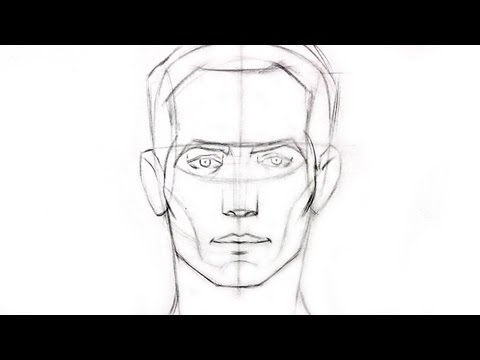
Proportional grid: a set of light guide lines, drawn before the features, that fixes where each feature sits as a fraction of the whole head. Example: the eye line drawn halfway down the head.
Centre line: the vertical line that divides the face into a left and a right half. In a front view it runs from the middle of the forehead, down the nose, to the middle of the chin.
In S2 you planned a clay head with three facts: the eyes are halfway down the head, the face divides into rough thirds, and the head is about two thirds as wide as it is tall. In drawing, those facts become a grid. The grid is drawn lightly, with an HB pencil and almost no pressure, so that you can rub it out when the features are finished.
| Feature | Where it sits on the grid | Quick check |
|---|---|---|
| Eyes | on the eye line, halfway down the head | five eye-widths fill the face at this level |
| Eyebrows | just above the eye line | inner ends above the inner corners of the eyes |
| Nose base | about halfway from eye line to chin | wings line up with the inner corners of the eyes |
| Mouth | one third of the way from nose base to chin | corners below the pupils |
| Ears | between brow line and nose base | top of ear level with the brows |
| Hairline | about one third of the face above the brows | there is still skull above it: do not stop the head at the hairline |
Proportion gives you a face; the state of three zones makes it a neutral face. Check each one:
Keep this checklist. In the next lessons you will change exactly these three zones to make a face happy or sad.
Worked example: setting out the grid
Mugisha wants his drawing of a head to be 18 cm from the top of the skull to the chin. Where do the main lines go?
Step 1. Width. About two thirds of the height: .
Step 2. Eye line. Halfway: below the top.
Step 3. Eye width. Five eyes across 12 cm: each, with a 2.4 cm gap between the eyes.
Step 4. Nose base. Halfway between the eye line (9 cm) and the chin (18 cm): below the top.
Step 5. Mouth. The nose base is 4.5 cm above the chin. One third of that is 1.5 cm, so the mouth line is below the top.
Check: the mouth line is 3 cm above the chin, and the chin area below the mouth is about twice as tall as the space between the nose and the mouth. That matches a real face.
<em>How to Draw the Head – Front View</em>, from the Proko channel. Watch how the artist starts from a ball for the skull and then adds the sides of the jaw, and compare his guide lines with the grid in Figure 1.
Warning
The most common mistake: eyes too high. Because we look at people's eyes and not their foreheads, beginners shrink the top of the head and put the eyes about one third of the way down. The result looks like a small child or a cartoon. Measure the halfway point every time; do not trust your eye.
A second mistake is a hard, dark grid. Guide lines pressed in with a sharp pencil leave grooves in the paper that show through your shading. Draw them with the side of the lead and almost no pressure.
Tip
Halfway, five, thirds. Eyes halfway down; five eye-widths across; the face from hairline to chin in rough thirds. In an exam sketch, draw these guides first and leave them faintly visible: they show the examiner your method.
Practice
Copy and complete: in the front view, the eyes sit ___ of the way down the head, and the gap between them is ___ eye wide.
A head is drawn 24 cm tall. Find its width, the height of the eye line below the top, and the width of one eye.
In the same 24 cm head, how far below the top are the nose base and the mouth line?
Name the three zones you check to decide whether a face is neutral, and say what each looks like at rest.
Keza's portrait looks like a young child although her model is 16. The eyes are drawn one third of the way down the head. Explain the error and how to correct it.
Studio task. Draw a 15 cm neutral face from the front, using the four steps. Use a classmate as a model or a mirror for yourself. Leave the guide lines faint, then check your drawing against the table: put a tick beside each feature that is in the right place.
1. Halfway; one.
2. Width ; eye line 12 cm below the top; one eye .
3. Nose base halfway from 12 cm to 24 cm, so 18 cm below the top. Nose to chin is 6 cm; one third is 2 cm, so the mouth line is 20 cm below the top.
4. Brows: a gentle arch, not pulled together or lifted, no forehead lines. Eyes: upper lid covering a small slice of the iris, no white showing above or below. Mouth: lips closed, corners level.
5. A small head above the eyes and a large face below is the proportion of a child. Move the eye line down to halfway, and redraw the nose and mouth from the new eye line.
6. Teacher or partner check: eyes halfway, five eyes across, nose wings under the inner eye corners, mouth corners under the pupils, ears between brows and nose base, all three zones relaxed.
Sources and credits