Compound and Asymmetric Time Signatures
Senior 3 · Music
Compound and Asymmetric Time Signatures
Lesson 4 of 4
22 min
In 1893 Tchaikovsky wrote the second movement of his Sixth Symphony with five crotchets in every bar. It sounds like a waltz that has one foot shorter than the other. Twenty years later Gustav Holst used the same five-beat bar for "Mars, the Bringer of War" in The Planets, and in 1959 the Dave Brubeck Quartet recorded "Take Five", the best-known jazz tune in five-four. None of these bars divides into equal beats. They are asymmetric.
Definition
Asymmetric time (irregular or odd time): time in which the beats of a bar are not all the same length. The bar is built from groups of two and three quavers (or crotchets). Examples: five-eight (2 + 3 or 3 + 2), seven-eight (2 + 2 + 3, 2 + 3 + 2 or 3 + 2 + 2), five-four.
Beat grouping: the way the quavers of a bar are gathered into beats. It is shown by the beaming, and sometimes by numbers such as 2 + 3 printed above the time signature.
A bar of five-eight holds five quavers. Five cannot be split into equal twos or equal threes, so it is felt as two beats of different length: a short beat of two quavers and a long beat of three. The beaming tells you which comes first.
Say a two-syllable word for each short group and a three-syllable word for each long one. For 2 + 3: "Hu-ye, Mu-sa-nze". For 3 + 2: "Mu-sa-nze, Hu-ye". Stress the first syllable of each word; that is where the accent (>) falls.
Seven quavers are usually felt as three beats: two short and one long. The long beat can come last (2 + 2 + 3), in the middle (2 + 3 + 2) or first (3 + 2 + 2). Bulgarian dance music is famous for this metre: the rachenitsa, for example, is counted in seven quick pulses grouped 2 + 2 + 3.
| Time signature | Common groupings | Beats felt | Conduct in |
|---|---|---|---|
| five-eight | 2 + 3, 3 + 2 | 2 (short, long or long, short) | 2 |
| seven-eight | 2 + 2 + 3, 2 + 3 + 2, 3 + 2 + 2 | 3 (one of them long) | 3 |
| five-four | 3 + 2, 2 + 3 (crotchets) | 2 groups, or 5 at a slow tempo | 2 or 5 |
When a conductor beats an asymmetric bar, the long beat takes visibly longer to travel than the short ones, so the players can see where the three-quaver group falls.
Worked example
Worked example 1: find the grouping from the beaming. A bar of seven-eight shows quavers beamed 3, then 2, then 2.
Step 1. Each beamed group is one beat: 3 + 2 + 2 = 7 quavers.
Step 2. The long beat (three quavers) comes first.
Answer: count "1 2 3 1 2 1 2", with accents on the 1s; say "Mu-sa-nze Hu-ye Hu-ye".
Worked example
Worked example 2: notate a grouping with longer notes. Write one bar of five-eight grouped 2 + 3 using only two notes.
Step 1. The short beat is two quavers long: a crotchet.
Step 2. The long beat is three quavers long: a dotted crotchet.
Answer: crotchet, then dotted crotchet. Check: 2 + 3 = 5 quavers. (Writing the dotted crotchet first would give 3 + 2 instead.)
Here is a short melody in seven-eight, written for this lesson. Every bar is grouped 2 + 2 + 3.
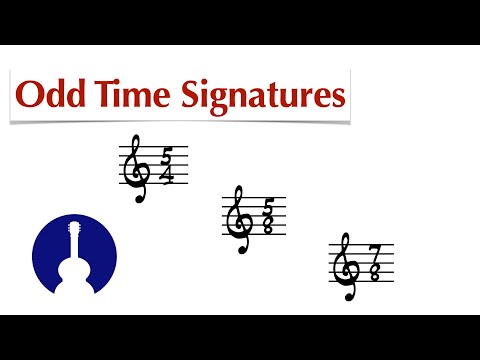
Video: "Odd Time Signatures • 5/4, 5/8, 7/8", Godfrey Guitar. Listen for how each bar is broken into groups of two and three, and count along with the examples.
Tip
Twos and threes, nothing else. Any asymmetric bar is just a chain of two-quaver and three-quaver beats. Find the threes, and the bar becomes easy to count.
Warning
Common mistake: counting seven-eight "1 2 3 4 5 6 7" evenly. It loses the shape of the music. Count the groups ("1 2 1 2 1 2 3") so the accents land where the composer wanted them.
Practice
Remember
Further reading
Sources and credits