Comparative Analysis of Prose
Senior 6 · Literature in English
Comparative Analysis of Prose
Lesson 4 of 5
20 min
Read this sentence aloud three times, putting the strongest stress on the word in capitals each time:
The words do not change, but the meaning does. When you read prose aloud in class, perform a scene, or give an oral presentation in the examination, stress and intonation carry half of the meaning. Writers know this: the punctuation, italics and rhythm of a good sentence tell a reader where the voice should rise and fall.
Definition
Stressed syllables are in capitals.
| Word | Stress | Related word | Stress |
|---|---|---|---|
| literature | LIT-er-a-ture | literary | LIT-er-a-ry |
| irony | I-ro-ny | ironic | i-RON-ic |
| poetry | PO-et-ry | poetic | po-ET-ic |
| narrative | NAR-ra-tive | narrator | na-RRA-tor |
| comparison | com-PAR-i-son | comparative | com-PAR-a-tive |
| character | CHAR-ac-ter | characterisation | char-ac-ter-i-SA-tion |
Noun or verb? In many two-syllable pairs, the noun is stressed on the first syllable and the verb on the second: a CON-trast / to con-TRAST; a RE-cord / to re-CORD; a PRE-sent / to pre-SENT; an OB-ject / to ob-JECT; a CON-duct / to con-DUCT.
English gives roughly equal time to each stressed syllable and squeezes the weak syllables between them. Read the opening of "The Gift of the Magi" with the stresses marked:
ONE DOL-lar and EIGHT-y-sev-en CENTS. That was ALL. And SIX-ty cents of it was in PEN-nies.
The short second sentence has only one stress, ALL, and it lands like a sigh. In the third, stress falls on SIXty and PENnies: the shame of small coins. Reading it this way brings out Della's careful counting.
| Pattern | Used for | Example |
|---|---|---|
| Fall ↘ | Statements; wh- questions; commands; question tags that expect agreement | Where did you buy it ↘? It's beautiful, isn't it ↘? |
| Rise ↗ | Yes or no questions; surprise; question tags that really ask; items in a list before the last | Have you heard that Netherfield Park is let at last ↗? You've read it, haven't you ↗? (I'm not sure.) |
| Fall-rise ↘↗ | Reservation, polite disagreement, something left unsaid | The ending is clever ↘↗ … (but I didn't like it). |
Lists: rise on each item and fall on the last: "Plot ↗, character ↗, setting ↗ and theme ↘."
Worked example: preparing a passage for reading aloud
Passage (adapted from the ending of "The Necklace"): Madame Forestier was deeply moved. She took her hands. "Oh, my poor Mathilde! Why, my necklace was paste!"
Tip
Punctuation is a score. A full stop asks for a fall and a pause; a question mark after a yes or no question asks for a rise; a dash asks for a sudden break; italics ask for contrastive stress. Read the punctuation, and the intonation follows.
Warning
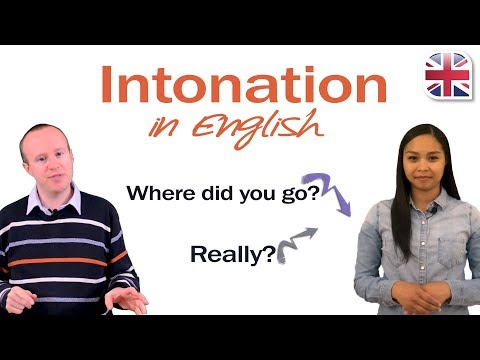
"Intonation in English", a pronunciation lesson from Oxford Online English. Practise each pattern with the speaker, then reread the examples in this lesson.
Practice
Sources and credits