Counting Techniques
Senior 6 · Basic Mathematics
Counting Techniques
Lesson 4 of 5
25 min
A youth cooperative of 10 members must elect a president, a secretary and a treasurer, three different posts held by three different people. The president can be any of 10, the secretary any of the remaining 9, the treasurer any of the remaining 8: possible results. This is an arrangement of 3 people chosen from 10.
Definition
The number of permutations of objects chosen from different objects () is
Example: . Note that .
Why the formula is right. Multiplying by completes the full product . So .
When some objects are identical, no longer applies directly. Split the count into cases by how many identical objects are used, count each case, and add (the cases are mutually exclusive).
Worked example
Worked example 1. How many 3-letter arrangements can be made from the letters of AKAGERA?
The letters are A (three times), K, G, E, R: five different letters, and only A is repeated.
| Case | Count |
|---|---|
| all three letters different (from A, K, G, E, R) | |
| two A's and one other letter (4 choices), arranged | |
| three A's | |
| Total |
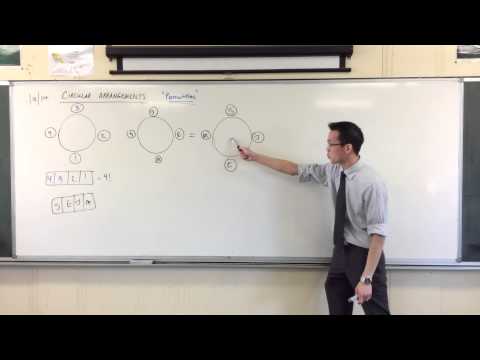
Four friends, A, B, C and D, sit at a round table. In a row there would be orders. Round a table, though, turning everyone one seat to the left changes nobody's neighbours. The four seatings below are the same circular arrangement:
Every circular arrangement of people appears times among the row orders (once for each rotation), so the number of circular arrangements is . Another way to see it: fix one person's seat, then arrange the other in a row.
Definition
Circular permutations. different objects can be arranged round a circle in ways, when only their order relative to each other matters.
If the circle can also be turned over, as with beads on a bracelet or keys on a ring, clockwise and anticlockwise orders are the same, and the number is (for ).
Example: 4 friends at a round table: ways.
Worked example
Worked example 2. Six delegates sit round a circular table. In how many ways can they sit (a) with no restriction; (b) if two delegates, Mutesi and Habimana, sit together; (c) if they do not sit together?
(a) .
(b) Treat Mutesi and Habimana as one block: 5 units round the table, ways; the pair can swap: . Total .
(c) .
Worked example
Worked example 3. Seven different beads are threaded on a bracelet. How many different bracelets are possible?
We divide by 2 because a bracelet can be turned over, so an arrangement and its mirror image are one bracelet.
Eddie Woo introduces circular arrangements: why rotating everyone gives the same seating, and why fixing one person's place leads to (n − 1)!.
Warning
Do not divide by 2 at a table. People at a round table are not like beads: turning the table over is not possible, and A having B on the right differs from A having B on the left. Use for tables and only for things that can be flipped, like necklaces.
Tip
Calculator: most models have an key. Type 10, then nPr, then 3 to get 720. Use it to check, but show the formula in your working.
Practice
Important
. Round a table: . On a necklace or ring: . With identical objects, count case by case.
Sources and credits
Text, diagram, worked examples and exercises: Written by Ganzaa.
Video: Introduction to Circular Arrangements, Eddie Woo, embedded from YouTube.